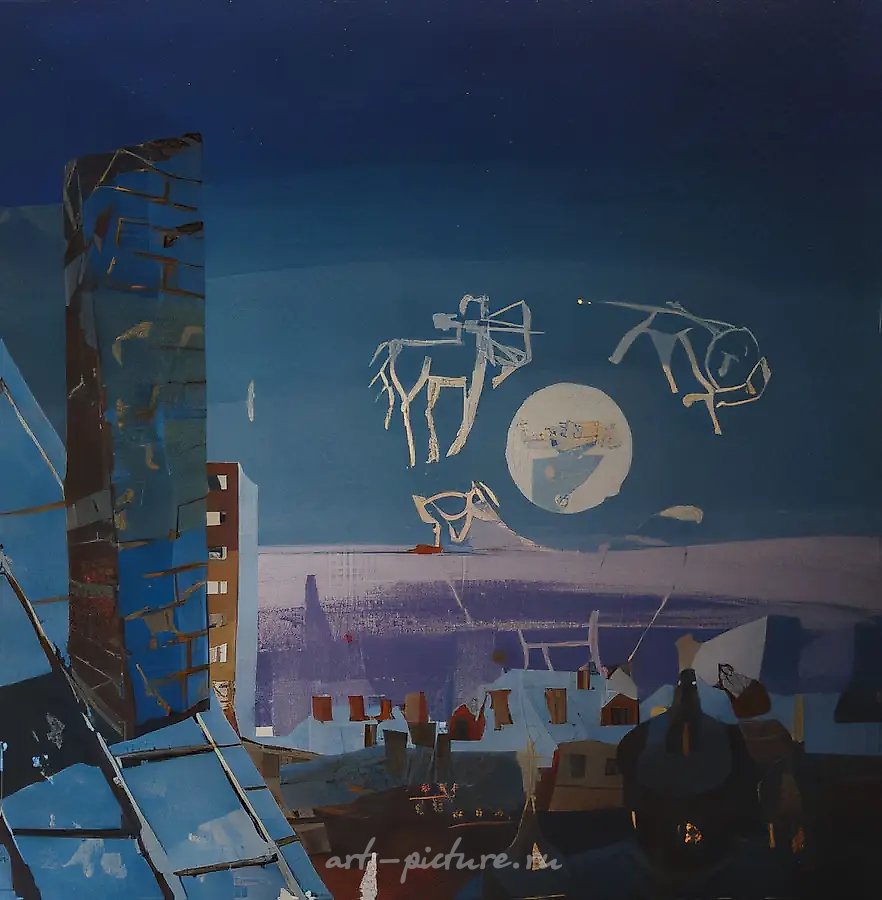
Dmitry Vitalyevich Didorenko
Dmitry Vitalyevich Didorenko (born December 17, 1967, Kharkov, Ukrainian SSR, USSR) is a Ukrainian blind artist (he lost his sight at the age of 23 due to an accident), and the creator of his own unique drawing technique.
Biography
He graduated from the Kharkov Art and Industrial Institute with a degree in industrial design. Dmitry began drawing from early childhood. Even during his student years, he would go out into the streets of Kharkov and Crimea to showcase his work. By 1991, he had established himself as a watercolorist of urban landscapes, selling and distributing about 700 watercolors.
In the summer of 1991, while participating in a search expedition, he was injured by a German WWII mine. He was seriously wounded, suffered a concussion, and completely lost his sight.
The artist needed four months for rehabilitation, and on October 31, 1991, he created his first artwork in complete blindness.
Faced with a hopeless situation, the master invented his own unique technology for creating easel graphics without sight—the "Impossible Technique." For years, he honed and complicated it. Now his paintings use up to three thousand color shades, and any compositional complexity becomes accessible.
=== The Impossible Technique ===
To achieve these results, the artist glues together disposable, complex systems of stencil templates from paper, fixes the construction on the edge of the board, and uses them, replacing one with another as necessary. Paint is applied with a foam sponge into open windows of the glued silhouettes. The color scheme is composed by the artist using about a thousand jars arranged in boxes. Precise dosing and sorting of paint into boxes are performed using a measuring spoon and brush. Each box contains 12 shades that the artist commits to memory.
Each artwork requires between 230 and 650 working hours.
For a quarter of a century, the artist has participated in more than 60 group and solo exhibitions. His paintings are in 19 countries around the world, as well as in the collections of the Kharkov and Donetsk Art Museums, other galleries, and private collections. The artist's archive contains about 700 publications in newspapers, magazines, almanacs, directories, catalogs, and postcard sets. There exists a vast amount of recordings, documentary films, video essays, and news materials for various TV channels and radio programs.
Works in collections
His works are held in the Art Museum (Donetsk), as well as in private collections.
Exhibitions and auctions
14 solo exhibitions in art museums in cities across Ukraine and in private galleries (Boston, New York, USA, Osaka, Japan). 24 group art fairs.
Author about himself
"Happy is he who can understand the causes of things and trample underfoot all fears and relentless fate."
Virgil
The author thanks for financial support: the MLM Business Association, President Dragan Fratric; AOO 'Ice-Phili,' General Director Anatoly Shamanov, and Vladimir Borodaenko for supporting the project.
Critic
Published in the special magazine for galleries and artists 'Our Isograph.'
Magical Realism or Another Reality?
In 1995, the Arkhyp Kuindzhi competition was held in Donetsk. The jury selected winners without knowing the authors of the works: only the artist's motto was on each piece. How surprised they were to discover that one of the laureates was a blind artist—Dmitry Didorenko.
Who is Dmitry Didorenko, an artist who possesses the gift of painting while blind?
In 1989, the future artist enrolled in the Kharkov Art and Industrial Institute, majoring in industrial design. He devoted much time to creativity—he was fascinated by urban landscapes in watercolor. Dmitry created over 700 works during this period, dedicated to Kharkov. He painted them easily and quickly; they had incredible lightness and airiness, filled with kindness and light. He found hidden, untouched places in his native city, using unusual perspectives, so much that even residents of Kharkov saw their city anew and fell in love with it again. "He has a very good command of color," his teacher observed. Many of his works from that time decorate not only collections in the former USSR, but also in foreign interiors.
Didorenko was also passionate about participating in expeditions searching for the remains of WWII soldiers, a pursuit that ultimately dramatically changed his creative fate. In the summer of 1991, Dmitry participated in another search expedition in battlefields 30 km from Kharkov. An old German mine exploded in his hands. Surgeons removed 78 fragments from Didorenko, 25 from his face. He survived clinical death, but damage to the eyes rendered him blind.
Losing sight is tragic for anyone, but for an artist, this tragedy is unparalleled.
But, as they say, everything is God's will, and Dmitry had the willpower to defy fate.
In early 1992, he created his first graphic work after losing his sight, made with pen and ink, titled "The longest path begins with the first step."
This path continues today. Since then, he has created 230 works, mainly with gouache, and had 15 solo and 25 joint exhibitions, participated in the Moscow International Art Salon 1999, received the Kuindzhi prize, exhibited at the World Festival of Arts in Osaka (Japan), and his graphic work 'Heights' is held by the Donetsk Art Museum. These works are not mere realities seen and transferred to canvas, as were most of his pre-injury watercolors; they are paintings that allow the viewer to experience and love the immense inner world of the artist.
Most of his paintings are not stand-alone but united by a common theme, idea, or feelings into graphic series. One such is the 'Desires' series, painted under the impression of sudden desires. The painting 'Hot' depicts a sweltering summer seashore with a watermelon floating in air, inviting the viewer to want to be there and taste it.
The 'Old Romance' series tells stories of Didorenko's ancestors, for example, 'Windmill from Great-Grandfather,' filled with love for the life’s work of Didorenko's ancestor.
The 'Inhabitant of Planet DI' series consists, in the artist's words, of images he pulled from dreams and transferred to canvas. They reflect the mysterious world of dreams as experienced and shared by the artist.
Another series, 'Russian Theme,' are paintings reflecting on Russian writers: 'Yesenin's' is dedicated to the poet; Yesenin is absent, but his spirit permeates the work. 'Sevastopol' is inspired by Tolstoy’s 'Sevastopol Stories,' showing soldiers resting after a battle, making one want to sit and listen to their stories. 'Chekhov's' is about the Crimean period of the writer's life.
Lastly, the 'Golden Moscow' series, with works like 'Open Opportunities,' is a hymn to night Moscow, its magic, beauty, and charm of roofs and domes.
"Dmitry Didorenko is not only an excellent colorist," said Valentina Myzgina, director of the Kharkov Art Museum, "but also an artist working in an extremely unusual, complex technique."
Unlike other artists, Didorenko has only sensations and his inner world, which intertwine to create the peculiar reality of his canvases.
Can his style be called surrealism, symbolism, or realism? Probably not. Having created his own artistic world, he is perhaps closest to magical realism.
A key feature—almost every work by Didorenko is accompanied by a literary annotation-reflection. The power of image and word create a resonance that sinks deep into the viewer’s consciousness, expanding the perception of his art. These chamber works are best viewed in an intimate setting, though not everyone has this opportunity.
But from August 10 to 29, 1999, Didorenko's first solo exhibition in Moscow will take place at the Central House of Artists. Come! A meeting with a person of strong spirit in our difficult times, and with his paintings, is worth it!
Lyudmila Melville, Candidate of Art History.
Also about him:
- "Arguments and Facts" newspaper, No. 22, June 1999 (p.16), article "Blind Sapper-Artist"
- "Tribune" newspaper, April 28, 1999, article "Blind Artist" (last page)
- "Art Council" magazine, May 1999, rubric "Mini-brochure Artist."