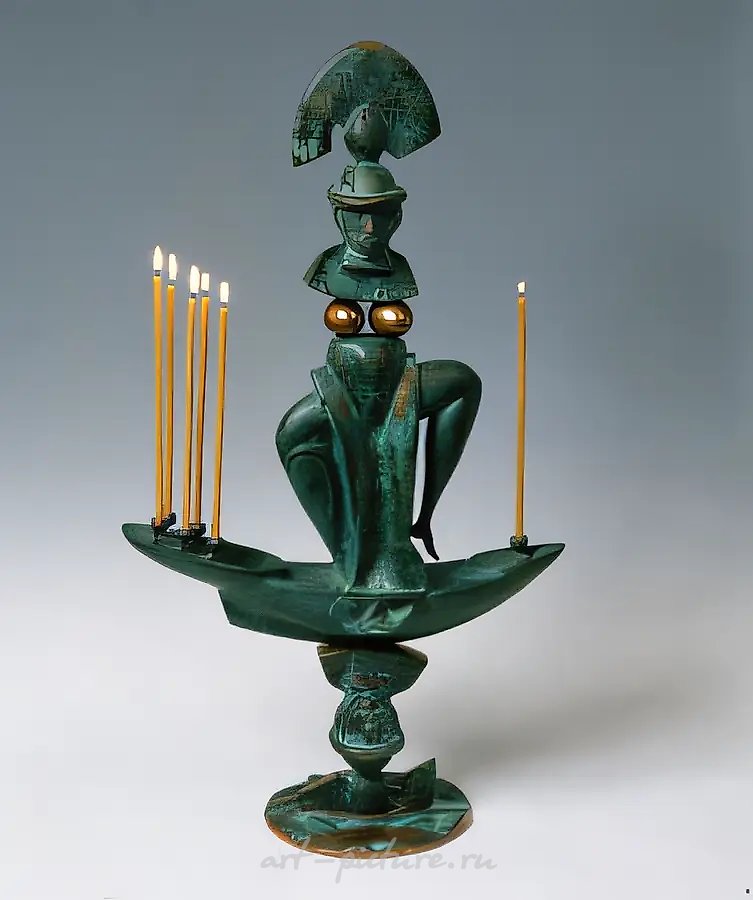

Alexander Iulianovich Rukavishnikov
Alexander Iulianovich Rukavishnikov (born October 2, 1950, Moscow, RSFSR, USSR) is a sculptor, People's Artist of the Russian Federation (1995), full member of the Russian Academy of Arts, and professor. Master of monumental and easel compositions, and sculptural portraits. Laureate of the State Prize of the Russian Federation (2021) and the Lenin Komsomol Prize (1976).
Biography
Alexander Iulianovich Rukavishnikov was born on October 2, 1950, in Moscow into a family of sculptors, becoming the third in a dynasty of hereditary sculptors after his father and grandfather, Mitrofan Sergeevich Rukavishnikov. He entered the Moscow State Art Institute named after V.I. Surikov (workshop of L.E. Kerbel), graduating with honors in 1974 by defending his diploma work "Northern Fisherman". In his student years, he was passionate about sports, practiced karate professionally, achieved a black belt, and later served as president of the Moscow Karate Federation from 1990. His interest in sports influenced his early works—while a student, he created compositions such as "Boxer" and "Wrestlers", which began a cycle of works dedicated to sports. In 1977, the sculpture "Karate Instructor V. Pak" was acquired by the State Tretyakov Gallery, and in 1983 the sculptural portrait "Tamara Bykova – former world champion in high jump" followed.
In 1984, Rukavishnikov was awarded the honorary title of Honored Artist of the RSFSR. From 1986 to 1991, he served as secretary of the Board of the Union of Artists of the USSR. Since 1993, he has chaired the department of sculpture at the Surikov Art Institute. In 1997, he was elected a full member of the Russian Academy of Arts. Rukavishnikov is a regular participant in all-Russian and international art exhibitions. His solo exhibitions have been held at the Central House of Artists, the halls of the Russian Academy of Arts in Moscow, the Nassau Museum of Modern Art (USA), the Dilemann Gallery (Belgium), and other venues.
His works are held in the collections of the Tretyakov Gallery, the Russian Museum, the Ludwig Museum, Siemens, Hermes, and John Wilson, as well as numerous private and corporate collections. In 2012, the Alexander Rukavishnikov Studio was opened on Zemlyanoy Val. In 2022, he was appointed chief artist of the Oleg Tabakov Moscow Theater.
Works in collections
A. Rukavishnikov is the author of monuments in Denmark (Copenhagen), USA (Lake Side), and South Korea (Seoul).
Exhibitions and auctions
1981 — Exhibition. Gallery of Contemporary Art. Aachen, Germany;
1981 — International Biennale on Figurative Sculpture, Austria;
1984 — Solo exhibition at "M'ARS" Gallery, Moscow;
1984 — Spring Salon, Paris;
1985 — Joint sculpture exhibition in USSR and FRG. Duisburg, Germany;
1987 — Solo exhibition, "M'ARS" Gallery, Moscow;
1991 — ART MIF 2. Moscow International Art Fair, Central Exhibition Hall "Manege", Moscow.
Critic
Alexander Rukavishnikov is a master who has happily combined talent with remarkable diligence. This explains the immediate success of his earliest works, created right after graduating from the Surikov Institute in 1974. Rukavishnikov participated in almost all major exhibitions of the 1970s. In less than 15 years, he created a significant number of monuments, small sculptures, and easel works. His early works fit into the traditions of Russian sculpture, as pioneered by A. Matveev and V. Mukhina. The development of his own distinct themes, plots, and plastic language emerged as a central task over time.
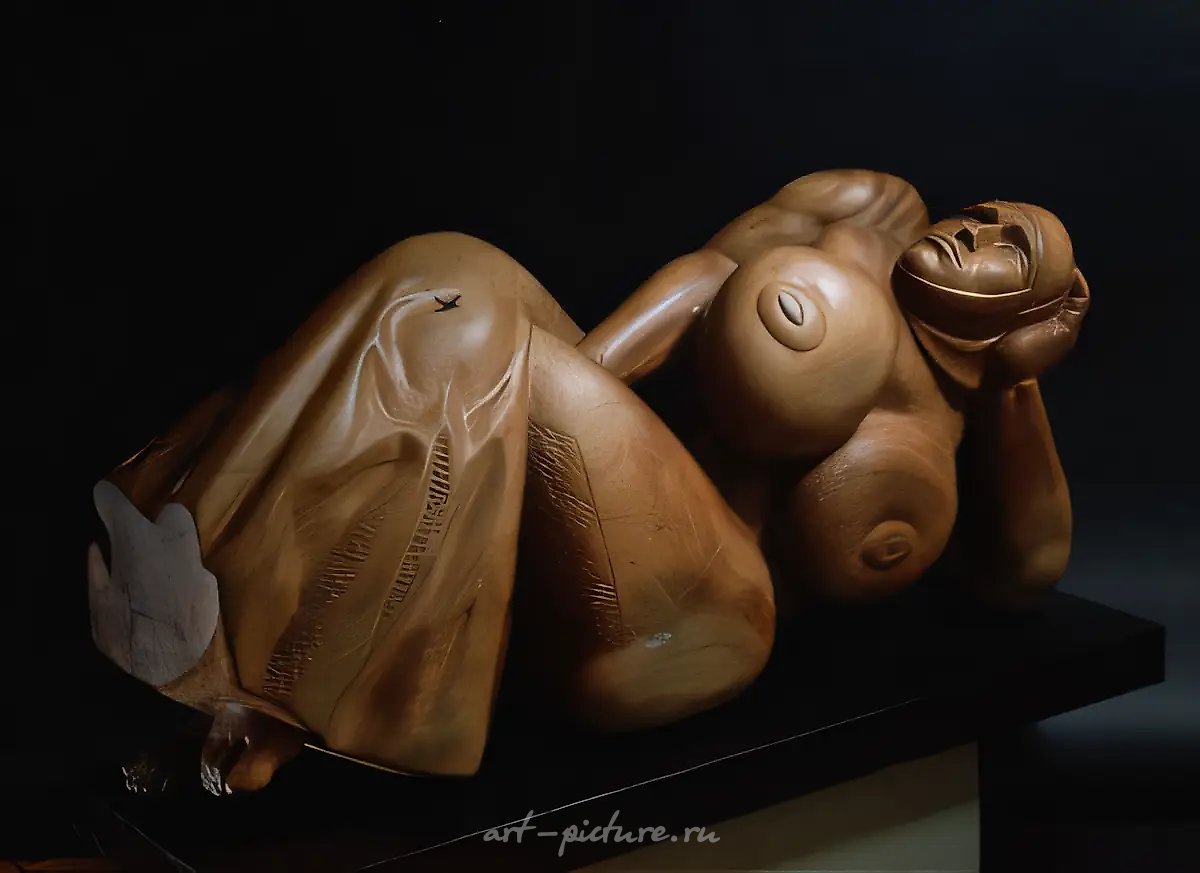
In the second half of the 1980s, Rukavishnikov demonstrates total freedom in using and combining different non-traditional materials. In the composition "Old Music," chamotte and fur become unexpectedly harmonious; in "Pagan Woman," bronze and fur coexist; "Finish" combines even more polar materials: bronze, wood (painted), and fur. This seemingly paradoxical combination of materials is understood by the artist as components of a unified image.
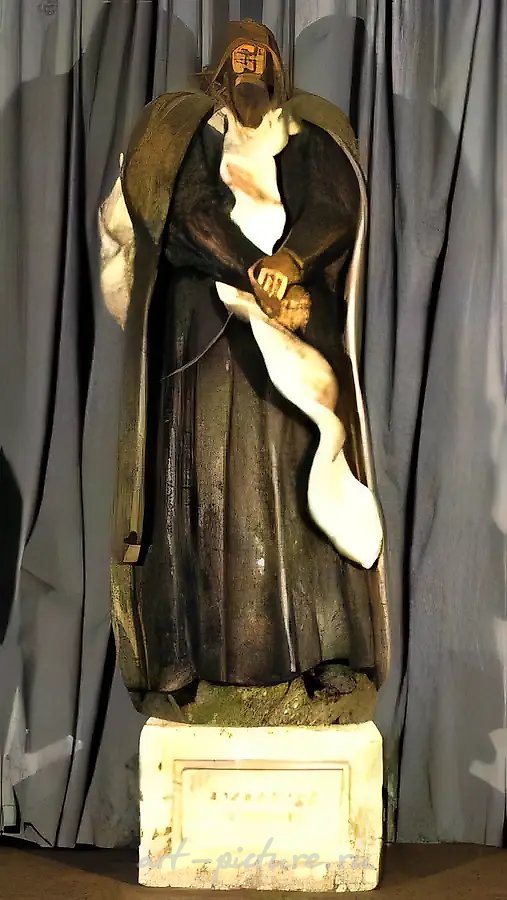
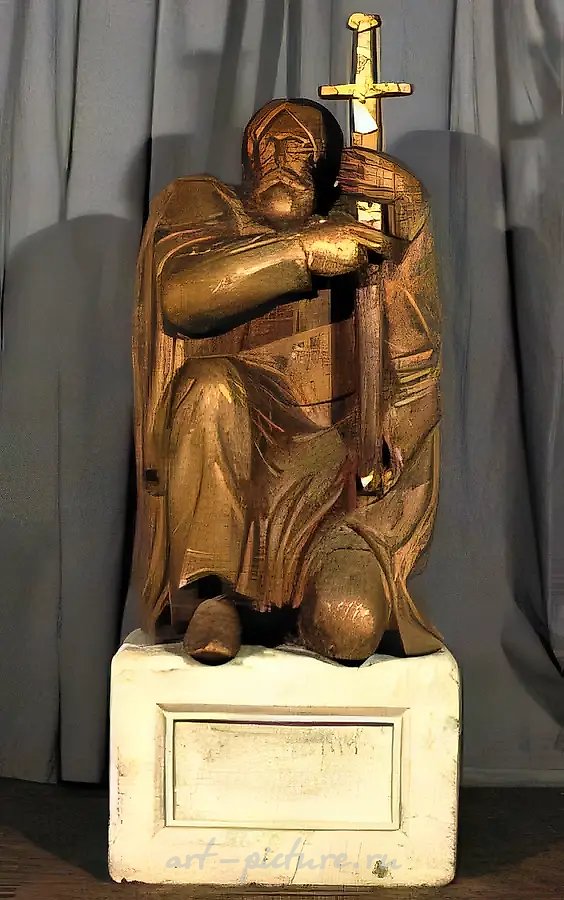
Rukavishnikov always works enthusiastically on subjects with civic and social pathos. Recall the tomb monument to Vladimir Vysotsky, or the "Roots of Russia" cycle, which refers to the past.
E. Yureneva
Bibliography
Catalog of the "M'ARS" Gallery
Works 9