Natalya Glebovna Savinova
Born on July 7, 1945, in Leningrad. Graduated from the Leningrad Higher Art and Industrial School named after V.I. Mukhina in 1969. Studied under Professors V.F. Markov and V.S. Vasilkovsky.
Works in collections
Her works are held in the State Russian Museum in St. Petersburg, the State Museum of Ceramics and the Kuskovo Estate of the 18th century, the All-Russian Museum of Decorative, Applied and Folk Art in Moscow, as well as in private collections in Russia, Italy, Germany, and Poland.
Exhibitions and auctions
1977-86 One Composition N1-10. LOSKH. Leningrad; 1982 Biennale of Contemporary Ceramics. Vallauris, France; 1984 Contemporary Soviet Ceramics. Höhr-Grenzhausen. Germany; 1990 Porcelain Otherwise. Wałbrzych. Poland; 1991 Leningrad Ceramics. Bologna. Lavena. Italy; 1991 Leningrad Ceramics. Bologna. Italy; 1992 1st Exhibition of the 'STANBET' Gallery. Exhibition and Auction Directorate Hall of the International Fund for Culture. Moscow; 1993 Solo Exhibition. 'Guild of Masters' Gallery. St. Petersburg.
Author about himself
I love my work. I strive to be sincere. I listen to myself and wait for the right note. I trust myself and my feelings.
Critic
My first feeling from Natalya Savinova’s works was a sense of warmth emanating from them. Even though twenty good years have passed and new tones and a higher degree of craftsmanship have appeared in her ceramics, for me this feeling remains the main defining quality of the artist’s creativity.
It seems that Savinova’s ceramics could not be any other way—they are, in essence, a cast of her relationship with the world around her, her plastic experience of it. Since kindness and intelligence originally underlie these relations, the spiritual space of her works primarily conveys these qualities.
Perhaps this is why Savinova is not interested in working with pure form, whose purpose is to create an image using non-narrative means. Neither are loud, grandiose themes characteristic of her. Her genre is chamber, lyrical. Her characters, especially in her early works, are most often people close to her—family, children, friends. The action may be confined to a home or garden. Yet it is precisely in these ‘domestic’ plots that the artist’s living, emotional experience and her ability to see the sublime in the mundane stand out with special clarity and force, creating an image starting from the concrete. And the quiet tone of her works, in my opinion, can say no less to a person than any loud reflections on abstract topics.
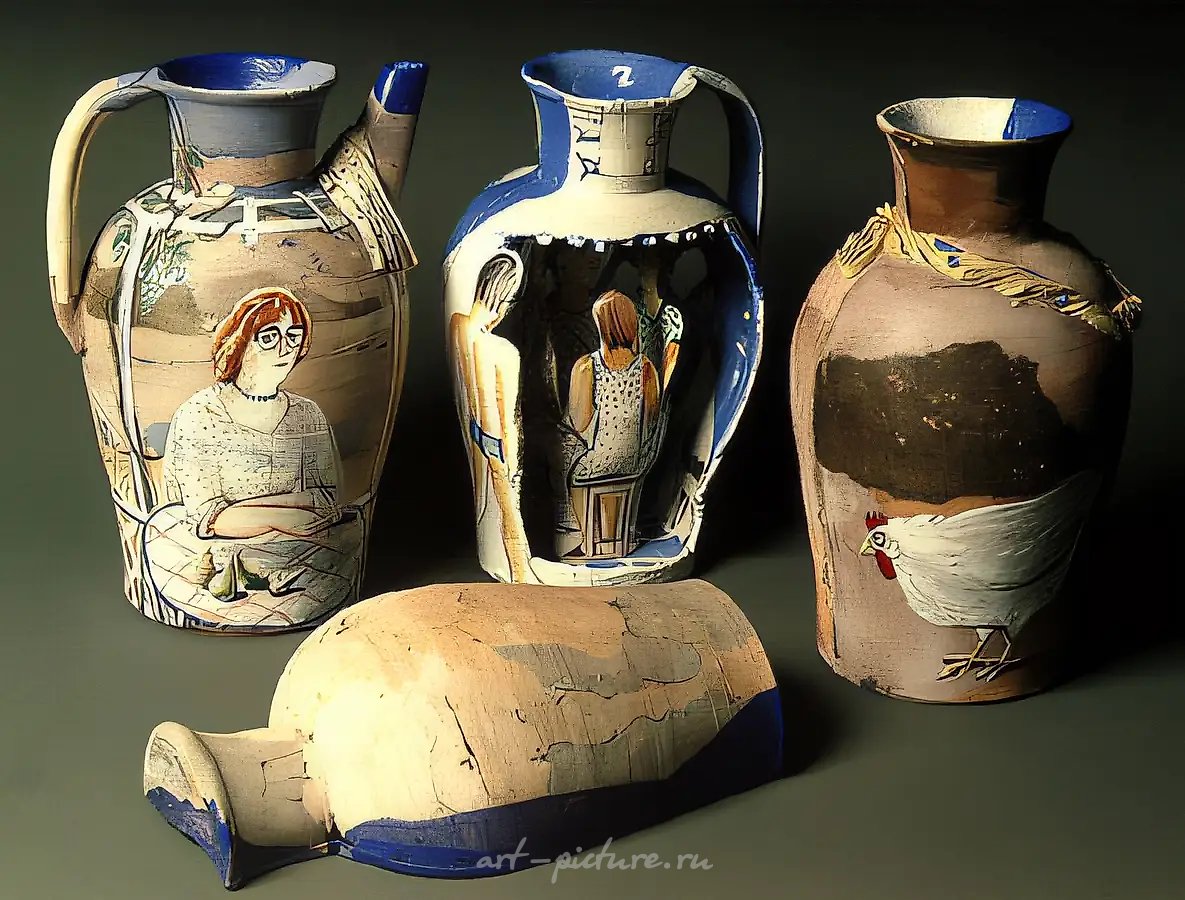
Savinova’s ceramics usually gravitate towards small plastic volumes. Her favorite form is a vessel, thrown on a potter’s wheel or molded by hand and retaining their warmth. It can be solid or open like a shell, revealing the action inside—most often, an ordinary, everyday scene, poetically rendered by the artist; it may be adorned with details—a figurine of a girl sitting on the teapot lid, a towel curled up on its handle. These details are always proportionate to the whole and to each other, united by internal ties. The vessel itself, populated by people, animals, birds—molded from clay that gives and takes life—is conceived by the artist as a symbol, a source of this life.
The plasticity of Savinova’s works is usually restrained but surprisingly expressive. Take her figures of angels, for example, sculpted succinctly, conventionally, but with what finest variety of characters and moods, conveyed by a modest yet precise gesture, a turn of the head. How touching are these incorporeal beings, fluttering around the studio, flying into ceramic windows, cozily settling on shelves. And how naturally the light, semi-transparent painting complements the form.
The artist’s works leave a sense of complete freedom in dealing with various ceramic materials and technologies. Creating a cycle of compositions inspired by travels in India, Ceylon, and Central Asia, she uses colored masses, chamotte; their rough, grainy texture seems the only possible choice, so precisely does it associate with sun-scorched earth and the dark faces of eastern women. And how artistically and effortlessly Savinova paints on unfamiliar porcelain, offered to artists at a symposium in Poland!
But behind the ease of handling material lies the most respectful attitude towards it, the artist’s high professional culture. This culture she absorbed from childhood, from her artist-parents, from the city with its richest artistic traditions where she was born and raised. The origins of her creativity are in Petersburg’s architecture, in the realistic painting of the early twentieth century, and in the graphics of the 'World of Art' association, but all these are organically fused into the single living, emotional stream of Natalya Savinova’s ceramics.
G. Gabriel
Bibliography
Aurora Magazine, N8, 1974, 4th cover page; Smena Magazine, N12, 1974, 4th cover page; Decorative Art Magazine, N8, 1974, p.20; Decorative Art Magazine, N10, 1977, pp. 8-9; Decorative Art Magazine, N12, 1977, p.14; Decorative Art Magazine, N2, 1978, p.26; Decorative Art Magazine, N10, 1978, p.12; Decorative Art Magazine, N12, 1978, p.8; Decorative Art Magazine, N12, 1982, p.14; Neva Magazine, N3, 1987, p.145; Rabotnitsa Magazine, N9, 1991, 4th cover page; Exhibition catalog of Soviet ceramics in Germany 1984, p.90; Catalog 'Keramika Leningrada il gardino dell atte', 1991, Bologna, Italy (in Italian); STANBET Gallery booklet, 1992, Moscow.
Works 6