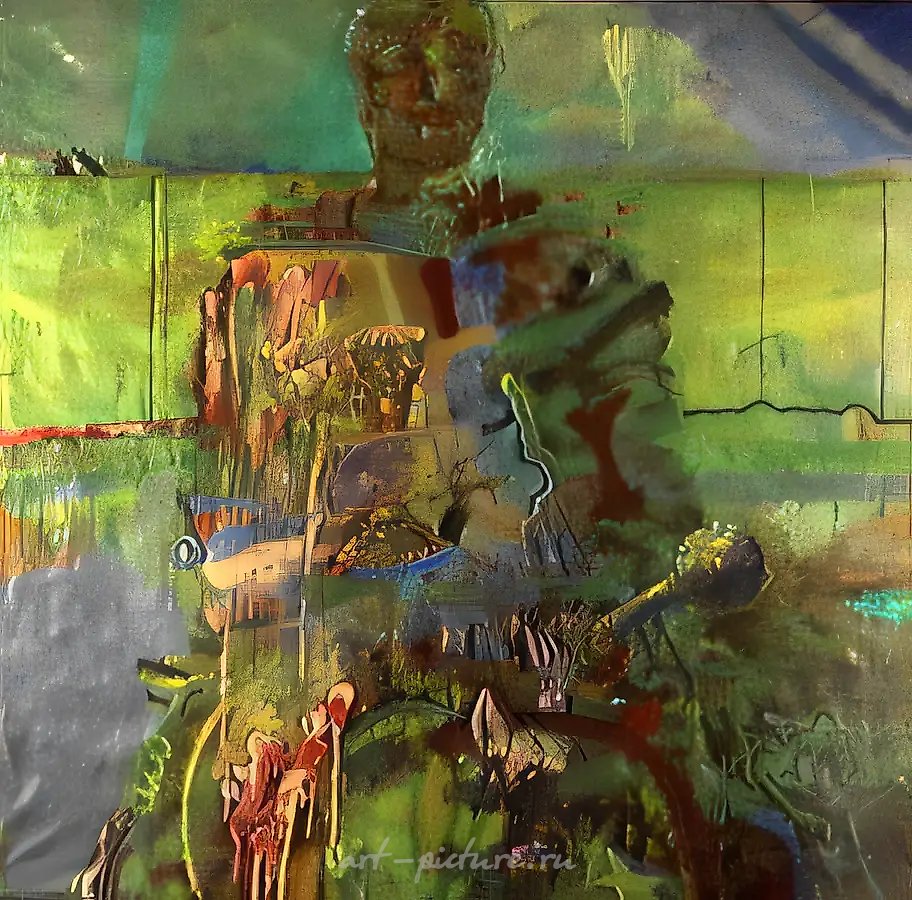
Oleh Mykhailovych Tistol
Oleh Mykhailovych Tistol (Ukrainian: Олег Михайлович Тістол; born August 25, 1960, Syrovo) is an artist, representative of Ukrainian Neo-Baroque, and one of the leaders of the New Ukrainian Wave.
Biography
Oleh Tistol was born in the village of Syrovo, Mykolaiv region, in the family of Mykhailo Fedorovych Tistol, an agronomist scientist. In 1970, his mother, Valentina Sergeevna Bolgarina (Tistol), became head of the regional department of culture and the family moved to Mykolaiv. He began his art education in 1972 at the children's art school opened in Mykolaiv at his mother's initiative. In 1974, he entered the Republican Secondary Art School named after T. G. Shevchenko, painting department, and moved to Kyiv. In 1978-1979, he worked as a designer-artist at the Mykolaiv Art Fund. From 1979 to 1984, he studied at the Lviv State Institute of Decorative and Applied Arts (now the Lviv National Academy of Arts). From 1984 to 1986, he served in the Soviet Army at military unit Makarov-1, unit 31600, where he met Konstantin (Vinny) Reunov. In 1988, he married the artist Marina Skugareva.
Participating in the first Soviet-American Sovyart exhibition, Tistol met the artist Dmytro Kantorov, who invited him to the Moscow squat Furmannyy Lane. At the end of 1988, Tistol and Reunov, in collaboration with curator Olga Sviblova, began exhibiting their works in Glasgow, Reykjavik, and Helsinki. From 2002 to 2009, he worked with curator Olga Lopukhova. (Joint project – “Khudfond” (2009)). Since 1993, he has lived and worked in Kyiv.
Artistic Practice
Tistol's works (paintings, large-scale installation projects, photography, sculpture, and art objects) have always been at the heart of the active creative scene, shown by his constant participation in international art events.
Formed at the border of the Soviet and post-Soviet eras, Tistol's art combines criticism of Soviet culture, a re-evaluation of its clichés, and a vital, joyful, playful atmosphere. By merging national and Soviet symbols, myths, and utopias in his works, Tistol discovered the phenomenon of the simulacrum—"a copy without an original", the paradoxical self-sufficiency of Soviet visual propaganda as a substitute for non-existent things, which unexpectedly links it to pop art. He was interested in its formal-aesthetic side: stencils, rasters, smoothly painted surfaces.
Tistol’s early works—paintings such as “Reunion” (1988), “Farewell of Slavianka” (1989), “Exercise with Clubs” (1989), “Zynoviy-Bohdan Khmelnytsky” (1988)—feature the main traits of the Ukrainian New Wave: bright expressiveness, emphasized "exaggeration", combined with post-avant-garde interpreations of historical plots, images, and national culture motives.
In 1987, Tistol and Reunov announced the program “The Willful Edge of National Post-Eclecticism,” whose main idea was to delineate national space for study, renew and rethink artistic language, art traditions, and the fundamentals of painting. The subject of Ukrainian artists' research was the national tradition, often identified with "Cossack Baroque." The ambiguity of stereotypes formed on this basis, domestic mythological worldview, and retrospective orientations were presented as the drama of culture, as its traditional features.
Since 1984, Tistol began work on the “Ukrainian Money” project. The project lasted until 2001 (in the early 1990s, Mykola Matsenko joined): from drawings and etchings, it turned into huge painted panels and installations. In this project, Tistol presents banknotes as a cultural-semantic category, not only capturing the history of national statehood (in 1918, the design of “Ukrainian karbovanets” was developed by renowned artists like G. Narbut, M. Boichuk, A. Bohomazov) but also reflecting main features of contemporary Ukraine. His project casts historic “Ukrainian brands”—the legendary Roksolana, hetmans, Cossack horsemen, heraldic figures, and pseudo-baroque patterns—through the Soviet aesthetic of stencils and clichés. The artist introduces the ghosts of the national myth into the definiteness of “marked spaces” of the modern market.
In parallel, since the mid-1990s, together with Mykola Matsenko, Tistol worked on the project “NatsProm” (National Industry)—a study of national stereotypes fixed in the material environment. In their joint works (“Ataturk Museum”, “Museum of Architecture”, “Museum of Ukraine”, “Mother of Cities”), combining painting, photography, and art objects, architecture is seen as decoration for life's spectacles. Familiar and mundane buildings, filtered by the authors’ vision, become mirages, ready to give way at any moment to new construction fantasies. Their works draw attention to a crucial theme for Ukraine—the manipulation of historical legacy, the popularity of “architectural reconstructions” filling historic city layouts with stylized replicas.
Tistol continues the theme of “stereotypes” in the “National Geography” painting cycle (1998–2004), where questions of authenticity and globalization are added. The source material for the paintings were old illustrated magazines with photos of the “peoples of the world.” National exoticism here is presented as a relevant strategy of “selling local brands on the global market.”
The events of the 2004 Orange Revolution, when the nation closely followed political events on television, inspired Tistol to create his version of a “postmedia painting”—the project “TV + Realism.” He was interested in the metamorphosis of the televised image, which turns human individuality into a flat media image. Transferring TV images to canvas, he treats them as ready-made objects, which acquire double illusion—when painting's illusoriness overlays that of the screen.
By translating the television image into a painting format using the principle of frequency breakdown, pixel nature of media images, he connects it to the tradition of plot painting, structuring the canvas space according to its classical rules.
Tistol’s cycle “Mountains” demonstrates his method of working with stereotypes. Started in 1987, the project includes series like “Landscape,” “Sinai,” “Caucasus,” “Kazbek,” and “Ararat.” All works are based on the same principle: over backgrounds of colored stripes, realistically painted mountain peaks are topped with stencil ornaments. The concise “Mountains” cycle is filled with play on meanings, symbols, and codes. The cycle has its own history: the image on the Kazbek cigarette pack quotes a famous work by artist E. Lansere. Tistol returns the “picture” from the extra-art, everyday sphere to the new painting space—not by simple repetition, but as a sign with artistic and non-artistic meanings.
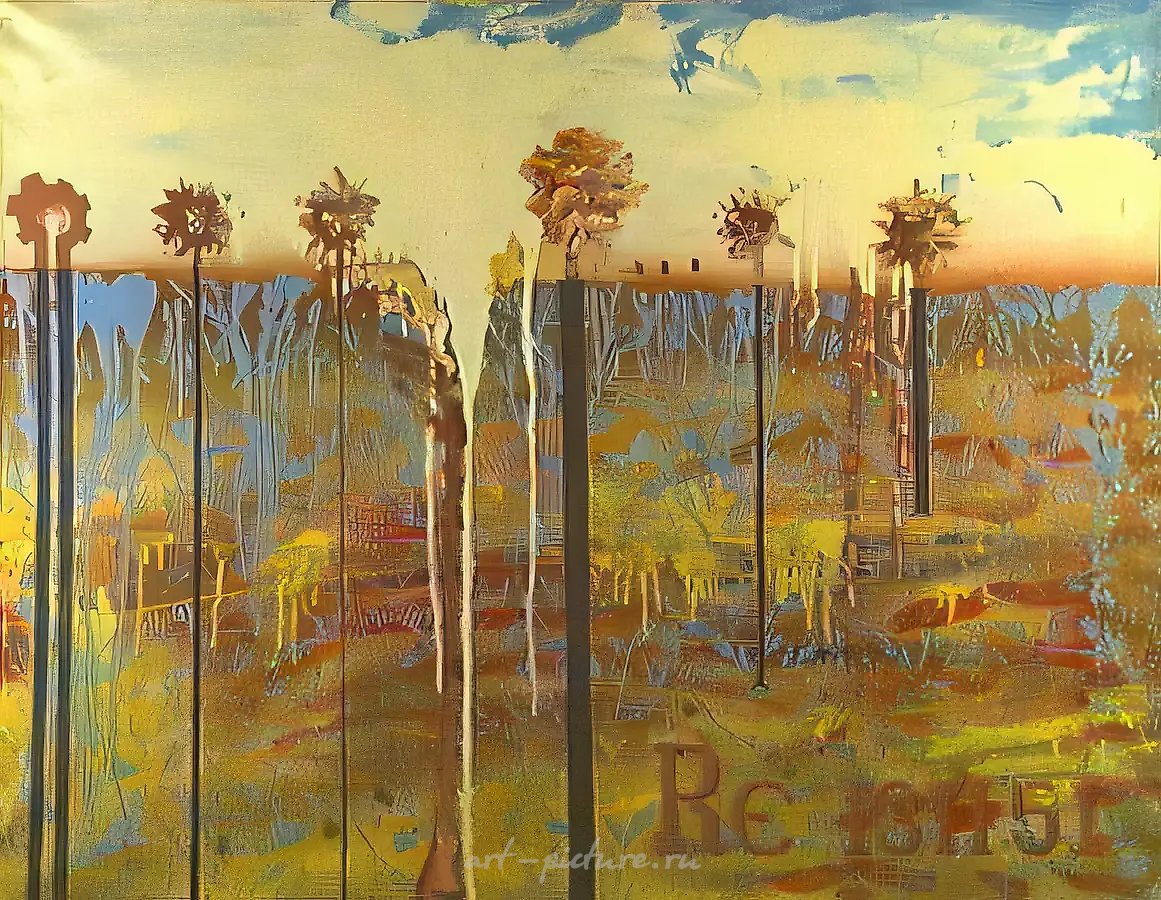
Since 2006, Tistol has worked on the “Yu. Be. Ka.” (“Southern Coast of Crimea”) project. Continuing his search for stereotypes, he finds them in ordinary surroundings. The central subject of the project is palm trees on the Yalta embankment. Thus continues the “national geography” theme, where Crimea is a symbol of vacation, perpetual holidays, paradise. Tistol is drawn to the man-made environment making the landscape part of culture; after all, palm trees are not indigenous to Crimea, they were planted in the 20th century, creating a “new stereotype.” “Yu. Be. Ka.” uses techniques of photography, painting, and drawing, easily transitioning from one to another. The project includes paintings and print cycles, using backgrounds like school notebook pages, quick notes, random sketches, supermarket receipts, hotel and laundry bills, letters, banners from past exhibitions, air tickets.
On April 11, 2013, at the "Under the Influence" auction at Phillips in London, Tistol's painting “Coloring” sold for £34,850 ($53,900).
Biennales Participation
2001 — “First Ukrainian Project,” 49th Venice Biennale.
1996 — “Interphoto,” Moscow Photobiennale.
1994 — “September 17,” 22nd Bienal de São Paulo.
Works in collections
Works are in the collection of Marat Guelman, Moscow.
PinchukArtCentre, Kyiv, Ukraine.
Stedelijk Museum, Amsterdam, Netherlands.
Museum of Moscow History, Russia.
Moscow Museum of Modern Art, Russia.
Ministry of Culture of Turkey, Ankara.
Christoph Merian Stiftung, Basel, Switzerland.
Norton Dodge Collection, USA.
Exhibitions and auctions
1987 Kyiv-Tallinn. Kyiv; 1987 Youth Exhibition. Kyiv; 1988 1st Soviet-American Exhibition. Kyiv; 1988 Kyiv-Kaunas. Kyiv; 1988 All-Union Youth Exhibition. Central Exhibition Hall "Manezh". Moscow; 1988 Eidos. Palace of Youth. Moscow; 1989 New Beginning. Festival of Soviet Art. Glasgow, UK; 1989 Ukrainian Avant-Garde. New York; 1989 The Willful Edge of National Post-Eclecticism. Exhibition Hall "Kashirka". Moscow; 1989 Furmannyy Lane. Warsaw; 1990 Festival of Soviet Culture. Warsaw, Krakow; 1990 Soviet-Icelandic Exhibition. Moscow; 1990 Young Artists from Kyiv. Helsinki; 1990 Horizontal Line. Belyaevo. Moscow; 1990 Artistic Confrontation. Central House of Artists. Moscow; 1990 ART MYTH 1. Fair. Central House of Artists. Moscow; 1990 End of the Century. Moscow, Reykjavik; 1991 End of the Century. Davos, Switzerland.
Bibliography
Catalogue of the 1st Soviet-American Exhibition, 1988, Moscow; Journal “Decorative Art”, N12, 1989, p.28; Journal “Art”, N4, 1989; Catalogue “Sovyart”, 1990, Moscow; Catalogue “Young Artists of Kyiv”, 1990, Kyiv; Journal “Decorative Art”, N2, 1990.