Georgy Vartanovich Frangulyan
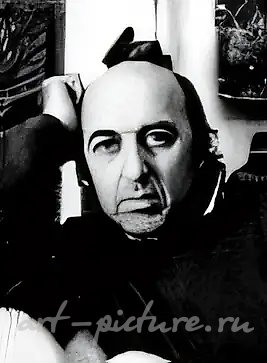
Georgy Vartanovich Frangulyan (Armenian: Գեորգի Վարդանի Ֆրանգուլյան; born May 29, 1945, Tbilisi) is a Soviet and Russian sculptor, Professor at the International Academy of Architecture. Academician of the Russian Academy of Arts (2009; corresponding member 2001). People's Artist of the Russian Federation (2011). Member of the Union of Artists of the USSR since 1973.
Biography
He was born on May 29, 1945, in the Sololaki district of Tbilisi. According to the sculptor, his birthplace significantly influenced his creative approach and attitude towards life:
"I was born and raised in Georgia, in Tbilisi, among the mountains. My sense of space was nurtured there. When you see clouds floating below you, eagles flying beneath you, and you follow their glide against the mountains, the movement of air currents and rising mist, then sensations are born that define your life."
He is of Armenian descent. Frangulyan's grandmother was a pianist, and everything related to art was welcomed in their home. The atmosphere of music and creativity created a special aura, shaping his attitude towards life and his future artistic method.
In 1956, the Frangulyan family moved to Moscow, where the future sculptor entered the famed Second School of Physics and Mathematics, known for providing a broad humanitarian education along with strong mathematics. Renowned educators such as Felix Raskolnikov and Israel Sivashinsky taught there. Literature teacher Raskolnikov, despite the risks, introduced students to banned authors, including one of Frangulyan's favorites, Isaac Babel. Years later, when working on a monument to Babel installed in Odessa in 2011, Frangulyan acknowledged how Babel's distinctive language shaped him:
"There is no empty space here, only an incredible density of images and unique Russian language... perhaps Isaac Babel is more of a sculptor in literature."
Shakespearean scholar and antiquity expert Vladimir Rogov also taught at the school. Rogov's initiative to stage Sophocles' tragedy "Philoctetes" played a decisive role in Frangulyan’s choice of profession. As a gift to the director, Frangulyan sculpted a statuette of Philoctetes that, once seen by the family friend and sculptor Mikhail Smirnov, received high praise, opening Frangulyan's door to the art world.
In 1964, he entered the sculpture department of the Stroganov Moscow State University of Arts and Industry. There, he was trained at the intersection of two schools: those of Georgy Motovilov and Alexander Matveyev. However, Frangulyan did not enter successfully on his first try, starting late and not being well prepared compared to specialized school graduates. He worked for an additional year learning drawing, which later played a significant role in his artistic formation. As he noted, every artist should be an excellent draftsman, as craft forms a personal style. Only by absorbing all stages of world art can one become part of it.
Still a student, Frangulyan became a regular participant in domestic and international art exhibitions. Throughout his creative journey, he participated in over 100 exhibitions.
In 1983, he created the first independent foundry for art casting in the USSR, at a time when there was a state monopoly on non-ferrous metals. Inspired after attending a casting symposium in Hungary in 1982, he built his own foundry at his studio, becoming the first in the USSR to make independent bronze sculptures.
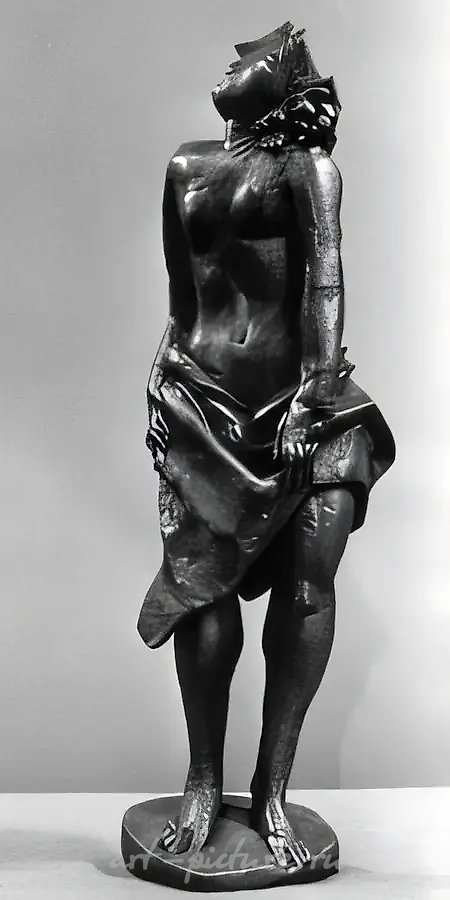
Frangulyan works in the genres of easel and monumental sculpture with various materials, including bronze, marble, wood, ceramics, wax, glass, mirrors, and even water. He gives special importance to graphic arts and has developed his own unique wax drawing technique, reminiscent of encaustic, combining graphite, ink, watercolor, and melted wax to create dynamic images on paper.
In the 1990s, he created a new genre he called 'sculptural design'—functional objects with an artistic image (the 'Clock' series, 1993).
Frangulyan is well-known for his monumental works in various cities in Russia, the former USSR, as well as in Hungary, Bulgaria, Italy, and Belgium.
Studio
Of special interest is his studio, located in an old log mansion near Arbat. Next door, Ilya Repin once worked, and Valentin Serov took drawing lessons. The studio complex also includes a foundry and a gallery showing sculpture and paintings. A unique space created by the artist, it conveys the atmosphere of a beautiful moment of life and creative triumph.
All Frangulyan's works are characterized by a blend of lyricism and sober calculation, intuition, and high professional culture. The artist's life's motto is: "You can destroy a temple, but every part of it will carry the spirit of creation." In 2021, Frangulyan opened his own non-profit gallery, exhibiting over 150 works spanning five decades. He holds free monthly tours for visitors.
Monumental Works
A detailed list is available in the source, including major monuments, memorial plaques, sculptures, and tombstones crafted across Russia and abroad between 1965 and 2024, commemorating figures from literature, politics, and art.
Easel Sculpture
A dominant theme is the nude figure, explored in single and paired compositions mainly in bronze, sometimes stone, wood, or ceramics.
Awards and Prizes
Frangulyan has received numerous awards, including membership honors, various medals, national orders, and prizes from Russia and Armenia. His works are in the State Tretyakov Gallery, Pushkin Museum of Fine Arts, State Russian Museum, museums in Sochi, Tomsk, Tbilisi, Tambov, Berdyansk, Kaliningrad, and private collections worldwide.
Major Exhibitions
List of solo and group exhibitions from 1967 (first exhibition in Moscow) through significant displays in Paris, Florence, Rome, Barcelona, Antwerp, Brussels, St. Petersburg, and Moscow.
Major Honors
Includes Grekov Silver Medal (1979), international prizes in Hungary, Poland, and Italy, honorary artist of Russia, and various state and international awards through 2025.
Works in collections
Works are in the State Tretyakov Gallery in Moscow, museums in Sochi, Tambov, Berdyansk, Kaliningrad, and in private collections in Italy, Germany, the United States, France, Sweden, Spain, Hungary, the Czech Republic, and Bulgaria.
Exhibitions and auctions
1982 — Exhibition of young artists, Paris; 1992 — The Third Dimension. Moscow Artists for Chernobyl. Florence, Italy; 1993 — Solo exhibition, Academy of Arts, Moscow.
Author about himself
I work in all genres of sculpture. Main materials: bronze, marble.
Bibliography
I. Svetlov, "The Antique Cycle of Georgy Frangulyan", Decorative Art Magazine, No.9, 1981; M. Agranovskaya, "Return to Bronze", Tvorchestvo Magazine, No.2, 1988.
Works 9