
AES Group
In 1987, Tatiana Arzamasova, Lev Evzovich, and Evgeny Svyatsky founded an art group, naming it after a combination of their initials—AES. Since 1995, the group has collaborated on several projects with photographer Vladimir Fridkes (AES+F).
Tatiana Arzamasova was born in Moscow in 1955. She graduated from the Moscow Architectural Institute in 1978 and was engaged in conceptual architecture. She is a recipient of the joint "Grand Prix" from the OISTT and the UNESCO "Theater of the Future" competition. She has participated in conceptual architectural exhibitions in London, Paris, and Venice.
Lev Evzovich was born in Moscow in 1958. He graduated from the Moscow Architectural Institute in 1982 and also pursued conceptual architecture. At the OISTT competition in Stockholm, he won in the "The Tour Theatre" category. He participated in conceptual architecture exhibitions in Milan, Frankfurt am Main, and Paris. He has worked as an artistic editor in animation (6 films), film director for animated films, and art director for the film "Sanset" (Mosfilm studio).
Evgeny Svyatsky was born in Moscow in 1957, and graduated from the Moscow Polygraphic Institute in 1980. He has worked with book and advertising design, poster, and graphic arts. He participated in international poster competitions, book illustration and design exhibitions, and exhibitions of graphic arts. He has worked as a creative director in several Moscow publishing houses ("Open World" and "Intersignal").
Group personal website: http://www.aes-group.org
Works in collections
Lewis & Lynn Pollock, Santa Fe, USA
Willa Merkel, Esslingen, Germany
Rainer & Theresia Haarman, Kiel, Germany
Alexander Novikov, Berlin, Germany
State Tretyakov Gallery, Moscow, Russia
Moscow House of Photography, Moscow, Russia
M&Y Gelman Contemporary Art Fund, Moscow, Russia
Russian Museum, Saint Petersburg, Russia
Exhibitions and auctions
AES Group solo exhibitions:
1989 “Apollo Inspiring an Epic Poet”. Dom 100 Gallery, Moscow
1989 “Apollo Inspiring an Epic Poet”. Howard Yesersky Gallery, Boston, USA
1989 Performance, Carpenter Center, Harvard University, Cambridge, USA
1990 “Moscow in Cambridge”. Emmanuel College, Cambridge, UK
1990 “Patetische Rhetoric”. Inter Art Gallery, Berlin, Germany
1991 East-West Gallery, London, UK
1991 “Das irdische Paradies”. IFA-Galerie, Friedrichstrasse, Berlin, Germany
1992 “Children’s Bible”. Kulturzentrum des Landes Schleswig-Holstein, Germany
1992 “AES - Drei Kunstler aus Moskau”. City Gallery of Esslingen, Esslingen, Germany
1993 “The Art of the Possible”. Marat Gelman Gallery, Moscow
1993 “Kain und Abel”. Caspar Bingemar Galerie, Hamburg, Germany
1994 “The Seam”. Marat Gelman Gallery, Moscow
1995 “19th Century Russian Landscape”. IAAB, Christoph Merian Foundation, Basel, Switzerland
1995 “Family Portrait in the Interior”. XL Gallery, Moscow
1995 “Spinal Trauma”. Kulturdorf, Tsarskoe Selo
1995 “Woe from Wit – 19th Century Russian Landscape” (Werkstatt Moskau II). Galerie im Marstall, Akademie der Künste am Hanseatenweg, Künstlerhof Buch, Berlin, Germany
1995 “Bodily Space”, National Centre for Contemporary Arts (NCCA), Central House of Artists, Moscow
“Prince and the Pauper”. Marat Gelman Gallery, Moscow
1996 “Moscow–Berlin, and Elsewhere...”. Marat Gelman Gallery, Pilot-Media, Goethe-Institut, Moscow
1997 “AES Travel Agency to the Future”. Neue Galerie Studio, Graz, Austria
1997 “AES Today”. Ujazdowski Castle Centre for Contemporary Art, Warsaw
1998 “Three Penny Show”, Rutgers University, USA
1998 “Yellow Cooks – White Eats”. Video installation, curator Nina Zaretskaya. TV Gallery, Moscow
GROUP EXHIBITIONS
1988 International exhibition as part of a theatre festival. Munich, Germany
1988 “Eidos”. Youth Palace, Moscow
1988 “Graphics by Moscow Artists: To the City and the World”. Central House of Artists, Moscow
1988 XVIII Youth Exhibition. Manege, Moscow
1989 XVII Exhibition of Moscow Book Artists. House of Artists on Kuznetsky Most, Moscow
1990 “Jalokivia Mudassa/Jewels in the Mud”. Tampere Art Museum, Tampere, Finland
1990 Book Graphics Exhibition, House of Artists on Kuznetsky Most, Moscow
1990 Imperial College. London, UK
1991 “Sex Ryska Konstnarer Kring Boken”. National Museum, Stockholm, Sweden
1991 “Aesthetic Experiments”. Kuskovo Museum, Moscow
1991 “Ars Baltica Prolog. Face to Face”. Kunsthalle, Kiel, Germany
1991 “Ars Baltica Prolog. Face to Face”. Exhibition Hall “Latvija”, Riga
1992 “Ars Baltica Prolog. Face to Face”. Kunstlerhaus Bethanien, Berlin, Germany
1992 “Stil”. UKV Gallery, Kiev
1992 “Diaspora”. Central House of Artists, Moscow
Aidan Gallery (within the Moscow Galleries Festival), Moscow
1993 “Art-Hamburg”. Marat Gelman Gallery, Hamburg, Germany
“Conversion”. Marat Gelman Gallery, Central House of Artists, Moscow
ART MYTH 3. Marat Gelman Gallery, Manege, Moscow
1993 “777 Distance Communication”. Aspex Gallery, Portsmouth, UK; Kunstnernes Hus, Aarhus, Denmark; Storm Gallery, Amsterdam, Netherlands; Galeria Nova, Bratislava, Slovakia; Reykjavik Art Museum, Reykjavik, Iceland; Marat Gelman Gallery, Moscow
1994 “Conversion”. Electronic Arts Festival. Marat Gelman Gallery, Helsinki, Finland
1995 “Bodily Space”. Central House of Artists, Moscow
1995 “Kiev Art Meeting”. XL Gallery, Ukrainian House Centre, Kiev, Ukraine
1995 “Contemporary Photographic Art from Russia”. Neue Galerie of Fine Arts, Berlin, Germany
1995 “Moscow meets Berlin”. Horn+Stammer. Dresdner Bank, Mercedes Benz, Aengevelt, Berlin, Germany
1995 “Animation” (from the collection of contemporary art of the Tsaritsyno Museum-Reserve). “Kashirka”, Moscow
1995 “Autumn Exhibition”, Marat Gelman Gallery, House of Artists on Kuznetsky Most, Moscow
1995 “Moskau meets Berlin”, Berlin firms present Moscow artists (Aengevelt Immobilienmakler, Dresdner Bank AG, Fritz Palm “Burototal” Buromaschinen-Bürobedarf GmbH, Mercedes-Benz AG), Horn+Stammer Art Management, Berlin.
1996 Photo Biennale-96. International Month of Photography in Moscow, Moscow House of Photography. House of Artists on Kuznetsky Most, Moscow
1996 “European Art Forum”, Marat Gelman Gallery, Berlin, Germany
1996 “Contemporary Russian Photography”, “La Base” Center of Contemporary Art, Paris, France
1997 Moscow Forum for Artistic Initiatives. Small Manege, Moscow (catalog)
1997 “The World of Sensual Things in Pictures – End of the 20th Century”, M`ARS Gallery. Pushkin State Museum of Fine Arts, Moscow (catalog)
Author about himself
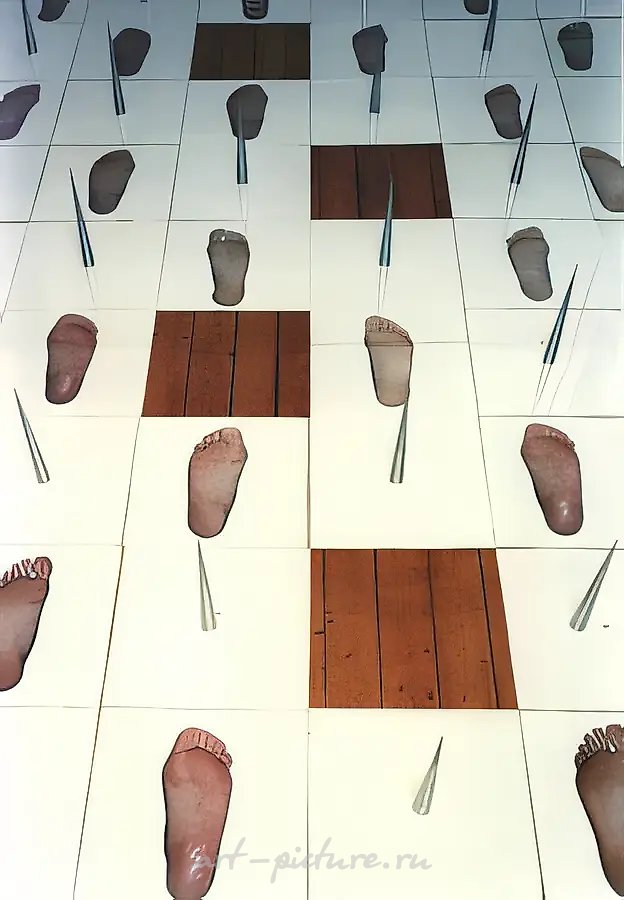
In general, corporeal exploration is a well-known novelty. There has clearly been a shift in discourse from the intellectual to the bodily. In Kabakov's work dedicated to Noma, there is a statement defining intellectual art: "the commentary on an object is more important than the object itself." In this sense, we are doing the exact opposite. The object is more important than any commentary; commentary may not exist at all. On one hand, there is a desire for "physics", i.e., sensuality, and on the other, a new metaphysics. We are interested in a direct, raw vision and sensation.
What is important to us is the frustration between the viewer’s sensuality and the moment of losing or finding meaning. There is also a provocation based on the laws of perception—when a person is given fragments, they piece them together into something whole. The thing is, we offer nothing but an invitation to feel. The project is assembled like a human body. It all begins with feet and ends with the head.
We wanted to avoid dividing art into feminist or homosexual, into “black” and “white” (as is the case in America), striving for a new post-political, meta-sexual understanding of the body. Temperature or pain sensations are felt equally by all genders, races, and parties.
We also wanted to move away from the strategy of creating an artist’s image. There are three of us, and we are, as it were, dissolved into the project, with mixed masculine and feminine aspects. The theme of one of our installations is defined as androgyny. We photographed a pregnant woman and her husband. The collaged models, on one hand, resemble medieval armor, and on the other, some androgynous ruin.
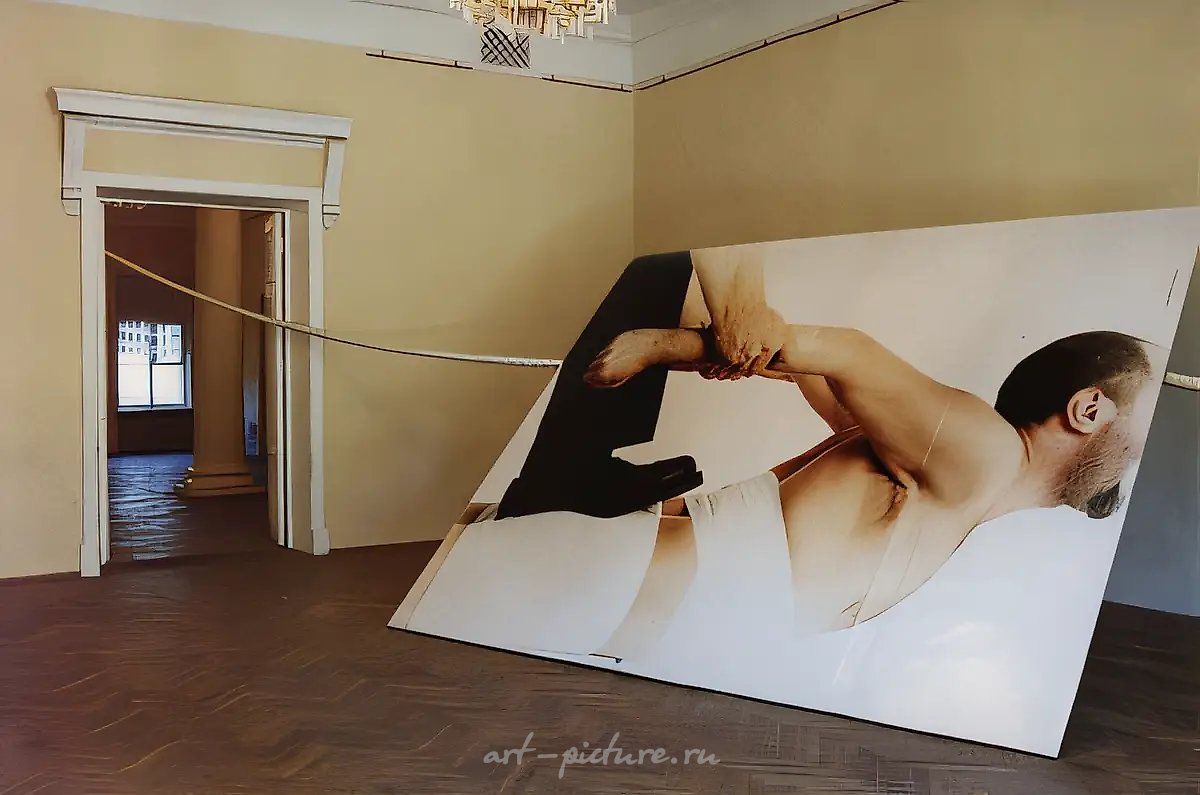
In “Bodily Space,” we focus on working with the everyday—we do not go beyond the skin. But when the bodily shell is fixed and presented in such an obvious way, the question arises––what is the inner?
Critic
The AES Group created their famous “Islamic Project” long before radical Islam loudly made itself known, changing the famous skyline of New York. After September 11th, when the phobias they mocked became reality, AES were labelled "prophets". The perception of the "Islamic Project" in the West changed significantly—no longer does it violate the norms of political correctness, which Evzovich called a form of censorship. The artists exist organically not within the Russian but the global art context and freely operate with the values of Western society. Their works are situated within the field of culture. Their themes include the confrontation of civilizations, phobias of mass culture, transgressions, war and death, childhood, cultural differences, and the future.
Alexander Evangel
The theme of violence, which so interests the AES group, is perhaps the main backbone of this world, besides the basic and therefore less adrenaline-inducing stimuli—diligently chewed up by Freudians and successfully processed by us all. Literature, cinema, video, music, electronic and computer entertainment, mass media as a source of news about the surrounding reality, and as a consequence (and/or cause)–reality itself–are all based on violence. Children's battles from archaic "Cossacks-robbers" have gradually transformed into bloody plots of game consoles and computer games, almost completely replacing the former. Just as it is natural to want to consume sound and image in the highest-quality forms of Dolby Stereo, CDs, and satellite communication, so too does the craving for maximum realism in electronic virtual violence seem natural—from stylized arcade "jumpers" and "shooters" to bone-crushing blockbusters like "Mortal Kombat" and on to the lawless realm of 3D virtual helmets-gloves-chairs, designed to perfectly provide DOOM fans with total reflexive annihilation
Violence, as a theme, idea, and condition, is already an almost ungrateful material for discussion, in terms of "talking about", which is better left to puritans and political correctness advocates. Doing violence is a worthy task, and creative personalities—above all, representatives of contemporary art as the avant-garde of the world community—primarily engage in this. From David Lynch and Steven Spielberg to Oliver Stone and Quentin Tarantino, from AC/DC and Sting to Red Hot Chili Peppers and Acid House, from Bruce Nauman and Cindy Sherman to Anatoly Osmolovsky and Oleg Kulik, and to AES—they all make their heroes, themselves, and us suffer, scream, bleed, kill and be killed. In this sense, the image of Frankenstein in AES’s production (incidentally, Lev Evzovich is very similar) involuntarily echoes the equally "terrifying" and inhuman Freddy Krueger (or his "younger brother"—Edward Scissorhands). Full-blooded and safe violence, separated by the frame of the screen, shot, and exhibition space, is certainly more interesting than AIDS-driven rubber-protected safe sex. Although the directors of “The Terminator” and “Die Hard” have yet to imagine the Pentagon’s means of organizing “Desert Storm,” CNN presents us this archetypal action movie ahead of real events at a breathtaking pace. The Gulf War "did not happen" exactly to the extent that Hannibal Lecter did not bite the noses off his victims. That is, the war happened. Good guys almost always beat bad guys; the point is, bad guys must be really bad, strong, and hurt the good guys, otherwise—it's not interesting to watch.
S. Khripun. “If you wanna blood, you got it.” Catalog for the exhibition “Family Portrait in the Interior”. XL Gallery, Moscow, 1995.
Bibliography
“AES. AES+F”. (Palace Editions, St. Petersburg, 2007)
Zeldovich, Alexander. Half-Dead, Half-Alive. (Nazraeli Press, Portland, 2007)
Koppenwaller, Anna-Maria. Modern Condition of Sculpture: Statues of Lost Childhood. (Agey Tomesh, Moscow, 2006)
INTERNATIONAL DESIGN MAGAZINE, May-June 1989, “Notes from the Underground” by Konstantin Boym, p. 34
PRINT MAGAZINE, XLV-II, March-April 1990, “Reviding in USSR” by Konstantin Boym, pp. 76-85
FLASH ART MAGAZINE, INTERNATIONAL EDITION, Vol. XXIV, N 158, May-June 1991, “Old Fashioned Passion” by Victor Miziano, pp. 110-113
ART NEWS MAGAZINE, January 1992, “After the Coup. Art for Art`s Sake” by Konstantin Akinsha, pp. 55-59
CATALOG of the exhibition in Tampere Art Museum, 1990, pp. 11-17, 22-23
CATALOG of exhibition in National Museum, Stockholm, 1991, Article by Jury Molok, pp. 3-10
AES. Catalog “Das irdische Paradies”, IFA-Galerie Friedrichstrasse, “Das irdische Paradies. Projektionen Postmoderner Malerei im Zeitalter der Deconstruction” by Barbara Straka
NEW RUSSIAN DESIGN, Rizzoli – New York, 1992, by Konstantin Boym, pp.152-157
CIRCA Art Magazine, Belfast, Ireland, N 63, Spring 1993, pp. 24-29
ART JOURNAL N 1, 1993, p. 42, Galina Kuryerova
ART JOURNAL N 6, 1995, pp. 26-27, Vitaly Patsyukov
BODILY SPACE, Catalog, Moscow
A NINETEENTH CENTURY RUSSIAN LANDSCAPE, Catalog, Basel, Switzerland
IZVESTIA, July 9, 1995, Dmitry Silin, p.41, Moscow
SEGODNYA, January 20, 1996, p.10, Sergey Epikhin, Andrey Kovalev
MEGAPOLIS-EXPRESS, Moscow N 20, May 29, 1996
ITOGI, June 4, 1996, p. 75, Nikita Alekseev
ITOGI, November 26, 1996, p. 70, Iosif Bakshtein
ART, 7/1996, p. 114, G. Inglerait
ART, 12/1996, p. 8, AES
MATADOR, 8/1996, p.6, p.32
ART JOURNAL N 12, 1996, pp.48-51, Alexander Balashov, p. 85, Oleg Kireev
EUROPEAN ART FORUM, Catalog, Berlin, 1996, Marat Gelman Gallery
DOMESTIC COMPUTER, N 5, 1996, pp.32-33, A. Petrochenkow
WOCHENPOST, N 45, October 31, 1996, p. 4
Books
“Double Rainbow” Molodaya Gvardiya, Moscow, 1989
“Woe from Wit”, A. Griboedov, 2 vols., Moscow, 1995
Works 12