Garif Sharipovich Basyrov
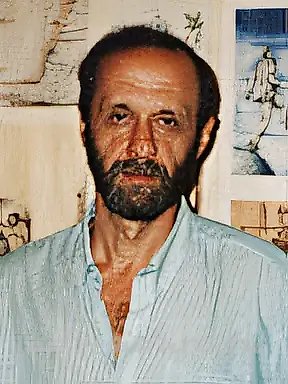
Garif Sharipovich Basyrov (February 24, 1944, Akmolinsk Camp for Wives of Traitors to the Motherland, Kazakh SSR – February 23, 2004, Moscow) was a Russian and Soviet artist, graphic artist, a member of the Union of Artists of the USSR since 1975, and one of the original masters of Russian easel graphics, magazine illustration, caricature, and small plastic art of the last third of the 20th century.
Biography
Basyrov was born on February 24, 1944, in Settlement No. 26 of "ALZHIR"—the 17th women's special camp division of Karlag, the largest Soviet women's camp. His mother was a 'cheseir' (family member of a traitor) and served time for her first husband, a Kharkov railroad official who died during the 1937 purges. With Basyrov's future father, a Tatar and also a prisoner, she began a relationship in the camp, but registered the newborn Garif as a Bashkir to avoid possible negative associations for her son with the Crimean Tatars, who were deported in May 1944. Garif spent his early years in a special barrack for prisoners' children, where mothers could stay with their children after work. Usually, children at three years old were sent to orphanages, but the Basyrovs were released from prison in 1947, so Garif remained with his family, and the three moved to Ukraine. The parents soon divorced and settled in Zaporizhia. Garif's mother died in 1968 before being rehabilitated, while his father was rehabilitated and reinstated in the Party in the late 1980s.
Basyrov took his first steps toward art in a school art club, demonstrating notable talent by age 14: in spring 1958 his Chapayev-themed drawings won first prize at the Ukrainian Pioneer Convention. That same year, he entered the Moscow Secondary Art School at the Surikov Institute, graduating in 1963. Afterwards, he enrolled at VGIK's Faculty of Arts and graduated in 1968, but decided to work in illustration and easel graphics rather than cinema.
Since 1969, Basyrov participated in Moscow, republican, and all-Union exhibitions; in 1975 he joined the Union of Artists of the USSR (graphics section). His first monographic exhibition was held in 1983 at the MOSKh exhibition hall on Vavilova St. His first solo show took place in 1989–1990 at the “Ost-West” gallery in Zurich. A major retrospective, with about 400 works, was held in the Central House of Artists in 1992 (catalog published in 1991).
In the 1990s, Basyrov’s exhibitions were held in the Tretyakov Gallery (1993; 100 works from the new series “The Insignificant”), the Museum of the Orient (1994), and in various Russian and international galleries.
He died suddenly on February 23, 2004, just before his 60th birthday. A posthumous exhibition was displayed by the Tretyakov Gallery from April to August 2004.
Wife: Inna Oskarovna Litvin (b. 1941), production designer, member of the Union of Artists of the USSR since 1976.
Works in collections
State Tretyakov Gallery, Moscow
State Pushkin Museum of Fine Arts, Moscow
State Museum of Oriental Art, Moscow
Ministry of Culture of the Russian Federation, Moscow
Russian Culture Foundation, Moscow
Moscow Union of Artists, Moscow
Gallery "M`ARS", Moscow
Gallery "Moscow Palette", Moscow
Gallery "Krymsky Val", Moscow
Gallery "A 3", Moscow
Gallery "Manezh", Moscow
Yaroslavl Art Museum, Yaroslavl
Far Eastern Art Museum, Khabarovsk
State Russian Museum, St. Petersburg
Yekaterinburg Museum of Fine Arts, Yekaterinburg
Kaliningrad Art Gallery, Kaliningrad
The European Illustration Collection Hull Gallery, Hull, Great Britain
Ost-West Gallery, Zurich, Switzerland
Galerie Enrico Navarra, Paris, France
Kunstraum, Stuttgart, Germany
KPMG, Stuttgart, Germany
Museums of humorous art: Basel, Switzerland; Tokyo, Japan; Istanbul, Turkey; Tolentino, Forte dei Marmi, Italy; Skopje, Macedonia; Gabrovo, Bulgaria; Warsaw, Poland; Seoul, South Korea; Knokke-Heist, Belgium, and others.
Private collections in the USA, Switzerland, France, Germany, Austria, UK, Italy, Israel, Denmark, Poland, Bulgaria.
Exhibitions and auctions
SOLO EXHIBITIONS
1982 One-day exhibition. Artists' House on Kuznetsky Most, Moscow
1989-90 Ost-West Gallery, Zurich, Switzerland
1990 Galerie der Bayerischen Landesbank, Munich, Germany
1991 SAK House, Svendborg, Denmark
1992 Retrospective. Central House of Artists, Moscow
1993 "One Hundred Works from the New Insignificant Series." Tretyakov Gallery, Moscow
1994 "Apocrypha." Krymsky Val Gallery. State Museum of Oriental Art, Moscow
1995 "Seven Versions and Walls of Opposition." Gallery "A 3", Moscow
1995 "Incubi." Gallery "Manezh", Moscow
1996 "WagonArt." Gallery "A-3", Moscow
1996 "The Insignificant, 1991-95." Central House of Artists, Moscow
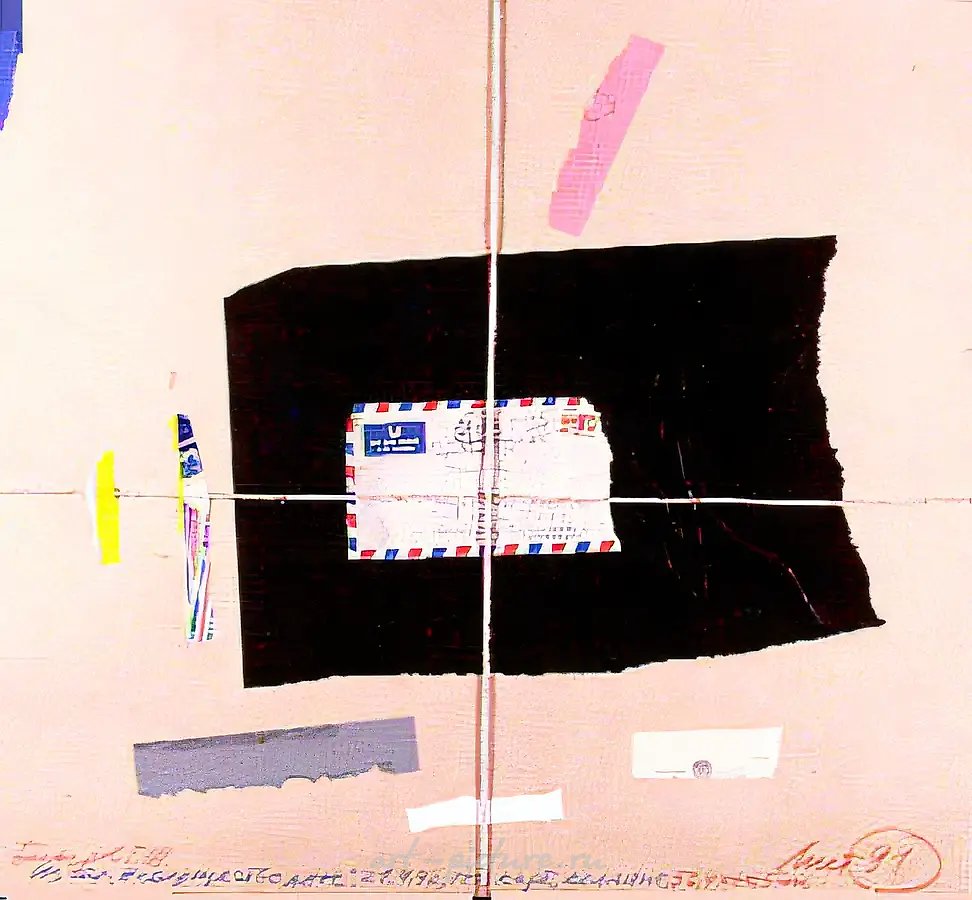
1996 "Mail Art." Gallery "Kino", Moscow
1996 "Works 1976–91." Kunsthalle, Osnabruck, Germany
1997 "Incubi–2", gallery "Obscuri Viri", ROSIZO, Moscow
1998 "Illustrations and Drawings. 1970–80s. Russian Cultural Center. Vienna
1999 Works from the 1980s. Central House of Artists, Moscow
1999 Miniatures. Gallery "Moscow Collection", Moscow
2000 Mail & Art. Gallery "Manezh", Moscow.
GROUP EXHIBITIONS: For detailed list see source.
Author about himself
...In my previous works (such as the series "Inhabited Landscapes," "Cosmos," "People with Burdens," "Narcissus," "Wind," "Sleepers," etc.), critics found a wealth of meanings: 'a philosophical outlook,' 'social issues,' 'human loneliness,' 'irony and grotesque,' 'the atmosphere of Soviet life,' 'fantastic realism,' and even the presence of some 'Mystery.'
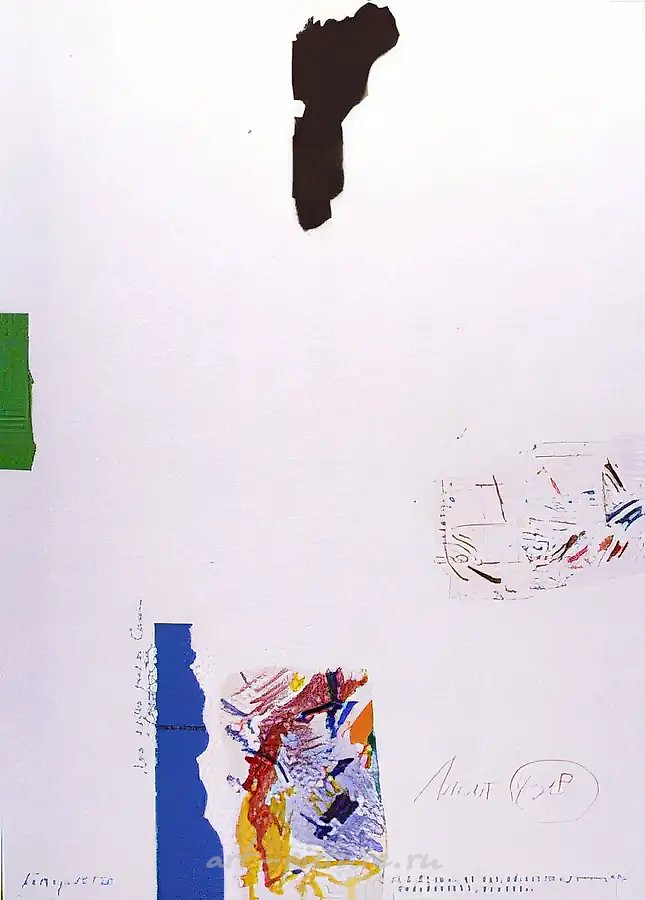
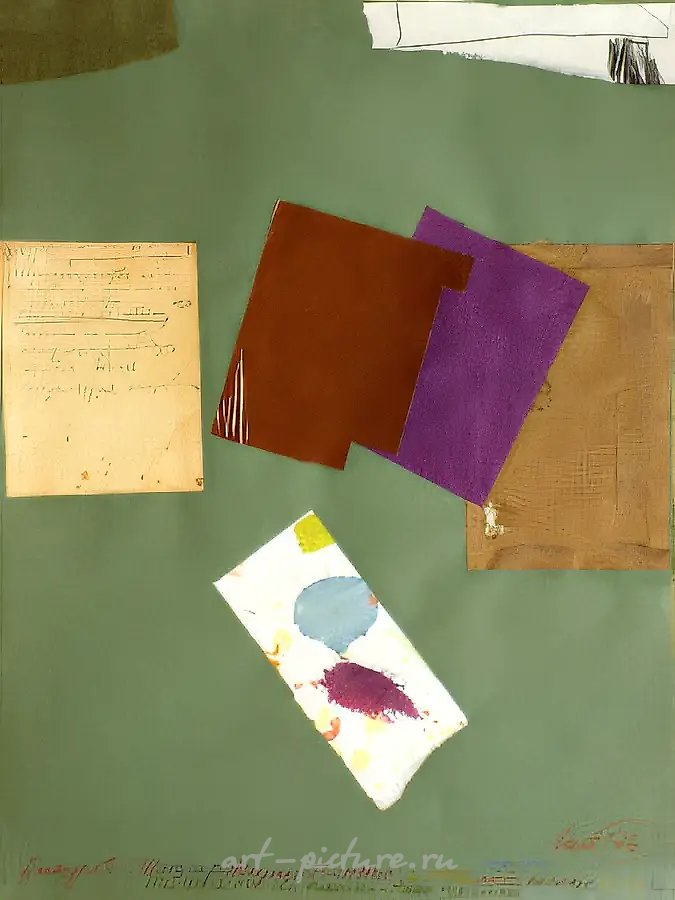
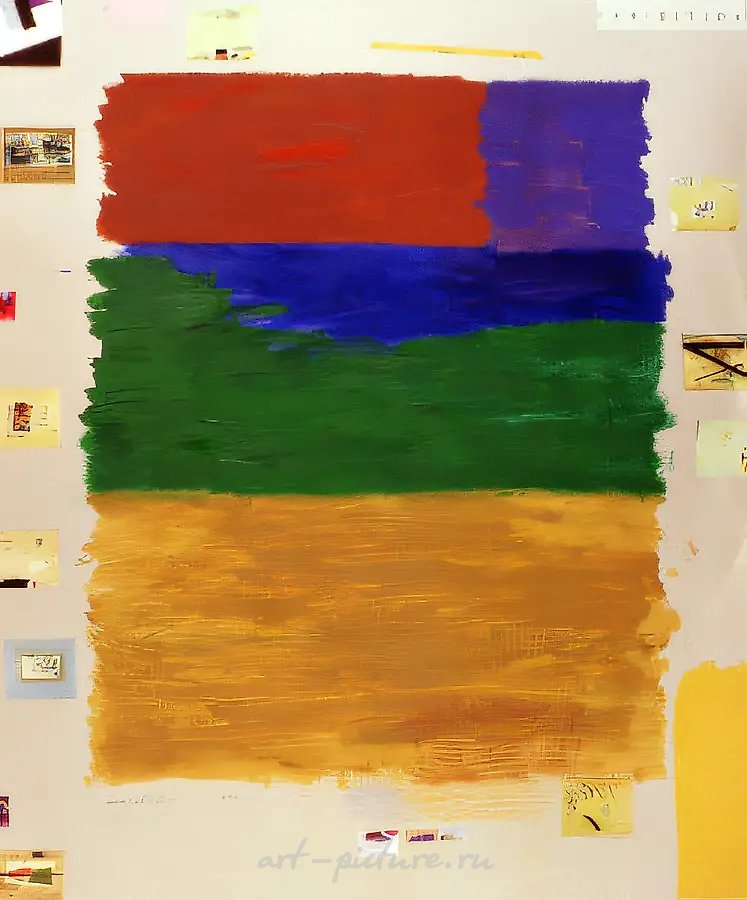
I hope that in the new series "The Insignificant," they won't find anything like that. After all, what can be found in these scraps of paper, children's scrawls, and old receipts? There is certainly no nostalgia or aesthetic admiration for the fleeting traces of someone's past life.
Perhaps there is an attempt to, through the materials at hand, move away from this previously mentioned multiplicity of meanings, and focus on what should really interest the artist: the plane of the sheet, composition, rhythm, color, the relationships of various structures and spots; their contrast and harmony.
That, perhaps, is the genuine, eternal theme of art. And the 'Mystery' as well. The important thing is not to do this with prejudice, but to follow one's intuition rather than someone else's templates.
By the way, about templates: it is said that ancient poets and Zen Buddhist artists, having reached the heights of their careers, changed their name after forty and started anew…
...About six months ago I noticed that from my, shall we say, non-figurative experiments (the "The Insignificant" series) emerged something akin to an unknown alphabet from an unknown language, resembling, perhaps, Far Eastern characters. Being absolutely sure that such a script doesn't exist, I named this spontaneous series "Apocrypha," that is, something non-canonical and even 'sacred.'
While preparing my last booklet and trying to improve its quality, I visited a printing house where I discovered a large amount of rejects, tests, and all kinds of waste in which my poor works were dissected and varied with astounding nonchalance and boldness. These 'variations' or 'versions' seemed to me so striking and original that I decided to present seven originals and seven printing 'versions' of each in one exposition. The posters show the 'development' of one work's theme by the printing process.
In another section of the exhibition, 'Walls of Opposition,' new works are displayed, themed around various slogans and inscriptions on the walls of houses, garages, fences, and the battle against them—whitewashing, covering up, erasing—which together create unique abstract compositions.
"INCUBI–2"
Many people know, but not many have witnessed how the tectonic force or time itself engulfs continents, civilizations, cities, and smaller objects—say, the witnesses themselves.
Sometimes after days or millennia, what has disappeared reemerges from mysterious depths and is seen again by new witnesses—us.
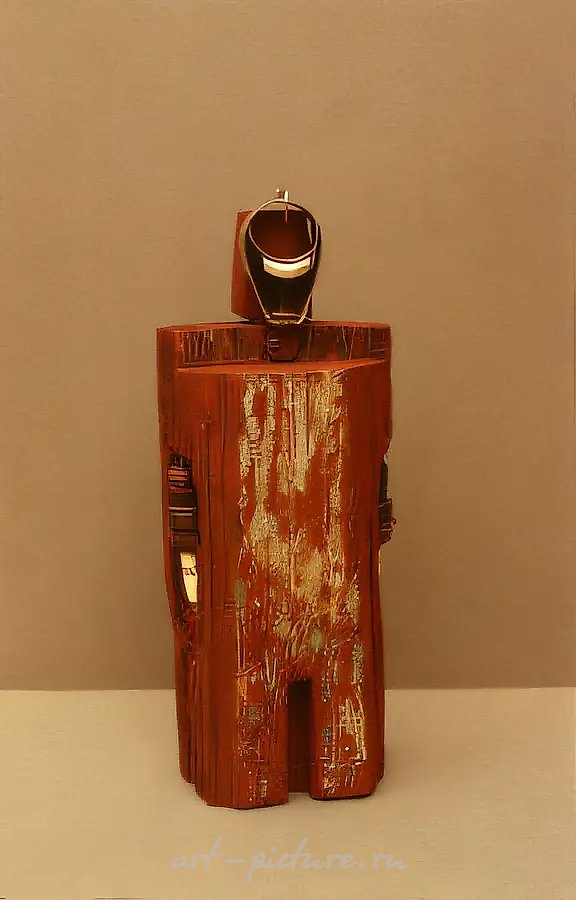
So what do we see in this case? Unknown contraptions, evoking in memory half-familiar words: ziggurat-orthostat-cenotaph-apadana-mastaba-naos-necropolis…
It's impossible to say anything clearer about these newfound objects. It seems all of them were discovered by some unknown archaeological expedition; the place and time of the excavation could not be established, nor could the finds themselves be attributed.
Only one thing is certain: all the objects share a certain unfriendly closure, an elusive similarity, and an irritating vagueness of their purpose and origin.
It is only reasonable to hope that the already known 'Incubi' will help shed light on the mystery of these unclear ancient (or post?) forms.
Critic
The graphic and pictorial characters of G. Basyrov are highly recognizable and could easily have become the artist’s 'trademark.' During perestroika, these faceless, massive figures floating in the air or, conversely, buried in trash, were reproduced in magazines, newspapers, and on posters as 'victims and products of totalitarianism,' or as the artist put it, 'objects.' (Basyrov’s very birthplace—the GULAG, labor camp No. 26 in the Akmolinsk region of Kazakhstan—said much.) But artists are called the pulse of the times for a reason, for feeling its subtle changes. In the early nineties Basyrov sharply changed his style, moving away from figurative painting to abstract works. Sometimes it resulted in 'The Insignificant' series exhibited at the Tretyakov Gallery. In the Museum of Oriental Art, Basyrov presented 'hieroglyphs'—signs of his own, Basyrov's writing...
The current exhibition continues to present 'the unexpected Basyrov.' Shocked visitors at the vernissage did not see familiar paintings or even 'something' hanging on the walls. The exposition consists of five large open boxes displaying wooden, metal, and other strange figurines seemingly made from anything at hand. But upon closer inspection, one can easily and enthusiastically recognize something long-familiar, ancient, and archetypal—from Sumer, Ancient Egypt, archaic antiquity, Africa, ancient American cultures, and even what the artist calls 'archaeological traces of future civilizations.' These are eternal symbols of ourselves, discovered or excavated from within by Basyrov.
Incubi, from Latin, are guardians of treasures (literally, 'lying on hoards'), and at the same time, night nightmares—the famous incubi who visit sinners and seduce them. These figurines—somewhere between dolls and household gods—represent that collective unconscious that lies at the foundation of human psyche and culture. In daylight, such things are unseen by our conscious mind. The Incubi want to communicate something with their silence. Indeed, the world has changed if, suddenly, they become visible to the attentive artist. All that’s left for us is to look at what the artist does and, through this, to learn about ourselves...
I. Gerbov, "The Unexpected Basyrov",—Obshchaya Gazeta, October 26 – November 1, 1995
Bibliography
G. Anisimov, "By the Call of the Soul," Yunost magazine, N11, 1970; G. Anisimov, "The Mystery that Inspires the World," Moskovsky Khudozhnik newspaper, January 7, 1983, Moscow; I. Shavarkova, "Inhabitants of Inhabited Landscapes," Moskovsky Khudozhnik newspaper, July 25, 1985, Moscow; I. Klutschewskaja, "Garif Scharipowitsch Bassyrow," Bildende Kunst magazine, N2, 1986, Berlin (in German); V. Meiland, "Garif Basyrov," Illustrations collection, 1988, Moscow; G. Elshvetskaya, "Who Looks at the Sky," Tvorchestvo magazine, N1, 1988; M. Sokolov, "Inhabited Landscapes," Ogonyok magazine, N20, 1989; N. Filippovsky, "Emblems of Perestroika," Apollo magazine, N1, 1990, UK (in English); N. Nazarevskaya, "Earthling by Profession," Literary Review magazine, N10, 1990; The book "New Album of Graphics," Sovetsky Khudozhnik, 1991, Moscow; Catalog of the solo exhibition at Central House of Artists, February–March 1992, Moscow; N. Orlova, "Artist Basyrov Sells Graphics in Stacks," Kommersant newspaper, N6 (106), February 3–10, 1992, Moscow; Stolitsa magazine, N11 (69), 1992, "Diary I" column; V. Meiland, "Air of Time," Nashe Nasledie magazine, N2, 1993, Moscow, pp. 116–121 (in English). As well as numerous exhibition catalogs, booklets, radio and television interviews in Russia, USA, UK, Italy, Denmark.
Works 19