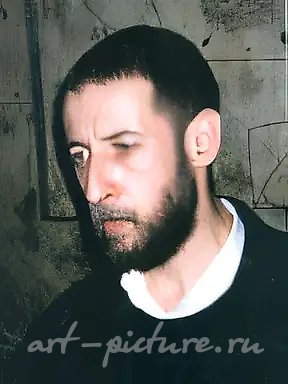
Alexander Savvich Brodsky
Born in 1955 in Moscow.
1968-69 studied at Moscow Secondary Art School.
1978 graduated from Moscow Architectural Institute (Faculty of Residential and Public Buildings).
Member of the Union of Artists.
Member of the Union of Architects.
1973-93 worked jointly with Ilya Utkin.
Since 1995, professor at the International Academy of Architecture.
Works in collections
Museum of Modern Art, New York, USA
Deutsches Architekturmuseum, Frankfurt am Main, Germany
Pushkin State Museum of Fine Arts, Moscow
Duke University Museum of Art, Durham, USA
Nancy and Norton Dodge collection, Zimmerli Art Museum, Rutgers University, New Brunswick, New Jersey, USA
Exhibitions and auctions
SOLO EXHIBITIONS
1995 "Utopian Sewerage." Regina Gallery, Moscow
1996 "Canal Street Subway Project." New York, USA
1996 "Visible Parts." Ronald Feldman Gallery, New York, USA
1997 "Futurofobia." M. Gelman Gallery, Moscow
1997 "Starting Points." Shchusev Architecture Museum, Moscow
1999 "Gray Matter," Ronald Feldman Fine Arts, New York, USA
2000 "Coma," Marat Gelman Gallery, Moscow
2002 "Installation," Aedes Gallery, Berlin, Germany
2006 "Inhabited Area," Venice Biennale, Russian Pavilion, Venice, Italy
2007 "Alexander Brodsky," Ronald Feldman Fine Arts, New York, USA
2009 "Windows and Factories," M&Y Gelman Gallery, Moscow
2009 Third Moscow Biennale of Contemporary Art, Garage Center for Contemporary Culture, Moscow
SOLO EXHIBITIONS (with I. Utkin)
1989 "Alexander Brodsky and Ilya Utkin." University Art Gallery, San Diego State University, San Diego, USA
1990 "Alexander Brodsky and Ilya Utkin." Linda Farris Gallery, Seattle, Washington, USA
1990 "Brodsky & Utkin." Ronald Feldman Fine Arts, New York, USA
1991 "Brodsky and Utkin: Etchings." The Lab, San Francisco, USA
1991 "Tacoma Walkway Etchings and Drawings." Tacoma Art Museum, Tacoma, USA
1991 "Brodsky and Utkin: Paper Architects." Pittsburgh Center for the Arts, Pittsburgh, USA
1992 "Palazzo Nero." Wellington City Art Gallery, Wellington, New Zealand
1993 "Brodsky and Utkin." Bayly Art Museum, University of Virginia, Charlottesville, USA
1993 "Brodsky and Utkin." Portland Art Museum, Portland, USA
GROUP EXHIBITIONS (with I. Utkin)
1986 XVII Youth Exhibition. Artists' House on Kuznetsky Most, Moscow
1986 "Paper Architecture." SKUC Gallery, Ljubljana, Yugoslavia
1987 XVIII Youth Exhibition. Manezh, Moscow
1988 "Architecture de Papier d’URSS." La Grande Halle de La Villette, Paris, France
1988 "Soviet Architecture: 1917-1988." Museum of Finnish Architecture, Helsinki, Finland
1988 "The City of the World and the Future of the Metropolis." 17th Triennale. Milan, Italy
1988 "Inventor ’89." Paris, France
1988 "Present Tensions: 25 Years of Irreverence in Architecture." The Clocktower, New York, USA
1988 "Nostalgia of Culture." Architectural Association, London, UK
1989 "Exhibition Diomede." The Clocktower, New York, USA
1989 "Festival of Soviet Arts." La Jolla Museum of Contemporary Art, La Jolla, California, USA
1989 "Architecture and Imagination." De Tien van Fort Asperen, Leerdam, Netherlands
1989 "Concepts in Soviet Architecture: 1917-1988." Berlin, Germany
1989 "Paper Architecture." Antwerp, Belgium
1989 "East Meets West in Design." Jacob K. Javits Convention Center, New York, USA
1989 "Paper Architecture: New Projects from the Soviet Union." Deutsches Architekturmuseum, Frankfurt am Main, Germany
1990 "Paper Architecture: New Projects from the Soviet Union." MIT, List Visual Arts Center, Cambridge, USA
1990 "Intaglio Printing in the 1980s." Jane Voorhees Zimmerli Art Museum, Rutgers University, New Brunswick, USA
1990 "Paper Architecture." Fondation pour l’Architecture, Brussels, Belgium
1990-91 "Between Spring and Summer: Soviet Conceptual Art in the Era of Late Communism." Tacoma Art Museum, Tacoma; ICA, Boston; Des Moines Art Center, Des Moines, USA
1991 "Dead Heroes, Disfigured Love." Lorence Monk Gallery, New York, USA
1991 "After Perestroika." Irving Galleries, Sydney, Australia
1991 "Conceptual Soviet Architecture" (Avvakumov, Brodsky, Utkin). Spectrum Gallery, San Francisco, USA
1992 "Current/Currents." Ewing Gallery, University of Tennessee, Knoxville, USA
1992 "Teamwork." Lintas Corporation, New York, USA
1993 "From Chaos to Creation: Russian Art from 1972-1992." The Rye Arts Center, New York, USA
1994 "Ideal Landscapes: Artists from the Former Soviet Union." de Saisset Museum, Santa Clara University, USA
1994 "Universalism and Particularism: The Russian World in Transition." Lehman College Art Gallery, Bronx, USA
1995 "Romantic Visions." Wessel & Lieberman Books. Seattle, USA
1995 "A Place for Trestles." Seafirst Gallery, Seattle, USA
1996 "Elswhere." John Hansard Gallery, University of Southampton, UK
1996 "Archaeology of the Future." Museum of Contemporary Art, Tokyo; Hiroshima Museum of Art, Hiroshima, Japan
1996 "Blast Art Benefit." The X-Art Foundation, New York, USA
1996 "Withdrawing." Ronald Feldman Gallery. New York, USA
1996 "Russian Conceptual Art of the 1980s: The Collection of the Duke University Museum of Art." Duke University Museum of Art, USA
1997 "Reviving Bridges." State Tretyakov Gallery, Moscow
2000 "Working Here: Art at 111," Community Gallery, Jersey City, USA.
2001 "Fine secolo. I semi del futuro.", PAC and Milan Triennale, Milan, Italy, Milano Europa 2000.
2006 "Depository of Dreams", White Space Gallery, London, England.
2006 "Russia!", Fundacion del Museo Guggenheim, Bilbao, Spain.
2008 "Russian Dreams...", Bass Museum of Art, Miami, USA.
2008 "Drawing Review: 37 Years of Works on Paper", Ronald Feldman Fine Arts, New York, USA.
AWARDS
1978 Second Prize (with G. Solopov), OISTT Competition: "Theatre for Future Generations", Paris, France
1982 First Prize, Central Glass Company Competition "Crystal Palace", Tokyo, Japan
1983 Encouragement Prize, "Sculpture Museum" competition, Tokyo, Japan
1983 Third Prize, Shinkenchiku Competition: "A Dwelling with Historism and Localism", Tokyo, Japan
1984 Second Prize, Central Glass Company Competition: "Crystal Palace", Tokyo, Japan
1985 Second Prize, Shinkenchiku Competition: "Bulwark of Resistance", Tokyo, Japan
1986 Second Prize, Central Glass Company Competition: "A Glass Monument to the 2001", Tokyo, Japan
1987 Encouragement Prize, Central Glass Company Competition: "The Intelligent Market", Tokyo, Japan
1988 First Prize (architecture), "East Meets West in Design." Jacob K. Javits Convention Center, New York, USA
Critic
Alexander Brodsky is one of the main advocates and leaders of the "paper architecture" movement, which enjoyed its prime in the 1980s. Until 1993, all projects were developed jointly with Ilya Utkin, whose solo exhibition was held by Regina Gallery in the spring of 1995.
"Paper architecture," as its name suggests, was a branch of conceptual-architectural practice, and its results can also be considered a kind of easel graphics (Brodsky is also highly regarded as a virtuoso of etching), or as illustrated literature. One way or another, the work of the Brodsky-Utkin duo was highly valued by the international architectural community, as evidenced by numerous awards in professional competitions. However, the implementation rate of their projects was negligible, and all realizations referred either to architectural design (for example, the interior of the Atrium restaurant in Moscow) or to small architectural forms (the pedestrian bridge in Tacoma, USA, which, according to the exhibition press release, was in the process of being built).
Because Brodsky's work always laid on figurative imagery, his creative phenomenon has also always been adjacent to the practice of contemporary art. This exhibition presents him as an artist whose main professional occupation remains architecture. "Canalis utopicus" is Brodsky's first exhibition of this kind in Moscow. In it, he follows his favorite motifs and techniques—taking a lowly subject, mythologizing and mystifying it to the extreme, transforming it into a subject of "grand style," bringing it closer to the utopias of the great Piranesi. His architectural background is evident in the skillful arrangement of the installation within the space and maintaining the proportions between the expressive sweep of the object and the size of the exhibition hall.
"Utopian Sewerage" is essentially Alexander Brodsky's first monographic exhibition in Moscow. For over a decade, consistent with the "paper architecture" movement he adhered to, Brodsky figured on the Moscow scene as an indisputable yet elusive maestro, captivating the world art community with his graphic fantasies. Despite their otherworldliness, the Brodsky-Utkin tandem (all projects until 1993 were developed together) held a solid leading position in Moscow's artistic chaos, bearing (perhaps without realizing it) the burden of virtuosic masters of architectural utopias and living classics. It's known how each subsequent step becomes more complicated in the aura of one's own authority—with every gesture weighed against one's "past" glory. But Brodsky is protected from comparative trauma. Public applause or ridicule and a race with artist colleagues are not his destiny.
He continues on his chosen path organically and confidently, and "Utopian Sewerage" is easily read as an architectural fantasy, or rather—a utopia, materialized in a brutally tangible form.
Sewerage—a lowly and unseemly matter, becomes in Brodsky's work a vessel for another world—an invisible and alluring existence, bound by a giant pipe, flattened, hidden inside, and teeming with an unknown, hypnotic life. Gurgles and burbles, the sound of water erupting from the mysterious body, merely fuel curiosity but do not let us inside, stopping us at the fragile border between the incredible and the obvious.
"There are cities from which there is no return... One cannot enter them for any gold..."—these lines (from another Brodsky) seem to be about "Canalis Utopicus": the endless movement of someone's unnamed life, dark as Charon's abode, unfathomable as the waters of Lethe, and tempting as a ghostly Venice. Only its reflections surface—in the artist's graphics, which accumulate the romantic fantasies of all times. Of course, it's more pleasant to envision the other world as a city of the sun or at least a paradise garden. But Brodsky offers other kinds of romanticism—moist, dusky, vaguely aching and tingling the skin—more tactile than visual, like your subconscious foreboding at every familiar descent into the sucking tunnel of the subway.
From the exhibition catalogue "Canalis utopicus." Regina Gallery, Moscow, 1995.
Bibliography
Kishkovsky, Sophia. “For Richer and for Povera.” ARTnews 108, no. 5 (May 2009): 58, 60
Turner, Elisa. “Russian Dreams….” Art News 108 num. 4 (April, 2009) p. 118-19
Cote, David. “Beckett Shorts.” Time Out New York, January 3-9, 2008, p. 135.
“Aleksandr Brodsky: Pavilion in the Park in Moscow.” Lotus international 130 (2007): 51-54
Ashman, Angela. “Voice Choices” Village Voice, December 5 -11, 2007, p. 38.
Bennett, Kim. “Brodsky & Utkin: Etchings from the Projects Portfolio (1981-1990).” Article 3 (Fall 2007).
Architects in the World. Tokyo, Japan: Toto, 1995.
Boym, Constantin. New Russian Design. New York, NY: Rizzoli International Publications, 1992.
Fuchigami, Masayuki. Contemporary Architects – Ideas and Works. Tokyo, Japan, 1996.