
Andrey Borisovich Grositsky
Andrey Borisovich Grositsky (November 23, 1934, Moscow – September 25, 2017, Moscow) was a contemporary Russian artist.
Biography
Born on November 23, 1934 in Moscow.
In 1959, he graduated from the V.I. Surikov Moscow State Institute of Art (D.K. Mochalsky’s studio).
In 1968, he joined the Moscow Union of Artists.
The artist lived and worked in Moscow.
His style and artistic position were shaped in the 1960s in the circle of 'Other Art', the Moscow underground, alongside artists such as Ilya Kabakov, Erik Bulatov, Ivan Chuikov, Boris Turetsky, and Yuri Zlotnikov.
His works are held in a number of public collections, including the State Tretyakov Gallery, the State Russian Museum, the Moscow Museum of Modern Art, and several regional museums in Russia.
He passed away on September 25, 2017, in Moscow, and is buried at Vagankovo Cemetery.
Works in collections
State Tretyakov Gallery, Moscow
Modern Art Collection of the State Tsaritsyno Museum-Reserve, Moscow
New Jerusalem Historical, Architectural and Art Museum, Istra
Serpukhov Historical and Art Museum, Serpukhov
K.A. Savitsky Penza Picture Gallery, Penza
Museum of Modern Art, Vladivostok
Bank collections: Industry-Service, Incombank, Moskovia, Stolichny, Moscow
Miraf Firm, Omsk
Nancy and Norton Dodge Collection, Zimmerli Art Museum, Rutgers University, New Brunswick, NJ, USA
Gregori Gallery, Washington, USA
Trossingen-Volksbank, Klagenfurt, Austria
E. Nutovich, L. Melikhov, V. Patsyukov, I. Beletskaya, G. Osetskaya, A. Glezer, A. Zaripov, Moscow
N. Blagodotov, Saint Petersburg
E. Degov, Suren Melikyan, Paris, France
F. Schmorl, Berlin, Germany
Y. Bar-Gera, Cologne, Germany
A. Eremin, Mainz, Germany
M. Forman, New York, USA
P. Novitsky, Warsaw, Poland
D. Sperling, London, UK
Exhibitions and auctions
SOLO EXHIBITIONS
1988 Troitsk, Moscow region
1991 "Andrey Grositsky." Central House of Artists, Moscow
1993 New Jerusalem Historical, Architectural and Art Museum, Istra, Moscow region
1994 "Andrey Grositsky." Gregori Gallery, Washington, USA
"New Dimensions of Reality" (with Herard van de Uthelaar). Municipal Gallery "A-3", Moscow
1995 "The Wall of Alienation." Seven Nails Gallery. Russian-American Press Center, Moscow
1997 "The Life of Things." A-3 Gallery, Moscow
GROUP EXHIBITIONS
1975 "Exhibition of Moscow Artists’ Works." VDNKh, "House of Culture" pavilion, Moscow
1976 Group exhibition of Moscow artists (experimental). Begovaya st. 7-9, Moscow
1987 "Artist and Modernity." First Creative Association of Moscow Artists. "Kashirka," Moscow
"Retrospective of Moscow Artists’ Art. 1957–1987." Hermitage Society, Profsoyuznaya st., 100, Moscow
"Object-1." M. Gruzinskaya, 28, Moscow
1988 "Labyrinth." Youth Palace, Moscow
1990 with N. Kasatkin, D. A. Prigov, I. Shelkovsky. "Kashirka," Moscow
"Towards the Object." "Kashirka," Moscow
"Washington – Moscow." State Tretyakov Gallery, Moscow
1990-91 "Other Art. Moscow 1956–1976." Moscow Collection Gallery. State Tretyakov Gallery, Moscow; State Russian Museum, Leningrad
1991 "Washington-Moscow." Carnegie Library, Washington, USA
"In de USSR en Erbuiten." Stedelijk Museum, Amsterdam, Netherlands
Exhibition from the New Jerusalem Historical, Architectural and Art Museum collection. Istra, Moscow region
"Iron Way." Exhibition Hall of the Railway District, Moscow
"Cultural Exchange. Washington-Moscow." Central House of Artists, Moscow
1992 Group Exhibition. Volksbank, Trossingen, Germany
Group Exhibition. RIA Novosti, Moscow
Exhibition from the New Jerusalem Museum collection. Kino Center, Moscow
1993 Group Exhibition. Klagenfurt, Austria
"ART MYTH 3." Gregori Gallery. Manezh, Moscow
1994 "Claustrophobia of Color." Kino Center, Moscow
Moscow Fine Art Gallery, Moscow
"Socium Gallery" Exhibition. Kuznetsky Most, 11, Moscow
1995 "Autonomous Art." "Le Chat" Gallery. Central House of Artists, Moscow
"Between Corporeality and the Sign." Tverskaya-Yamskaya, 20, Moscow
Alexander Glezer Collection. Museum of Private Collections. Pushkin State Museum of Fine Arts, Moscow
"Art Without Barriers." Exhibition hall, 1st Tverskaya-Yamskaya, 20, Moscow
"A 1, A 2, A 3." A-3 Gallery, Moscow
1996 "Dialogue of Generations." A-3 Gallery, Moscow
Journal "Socium" Gallery. Moscow
"Avantgarde from Russia. 1960-1980." Gregori Gallery, New York, USA
"Nonconformists – The Second Russian Avant-garde." Bar-Gera Collection. Russian Museum, St. Petersburg; Frankfurt-am-Main, Germany
"Art in the Interior." Small Manezh, newspaper "Russian Collection", Moscow
1997 "Credo." Russian Culture Fund, Moscow
"Dialogue of Generations." Art Museum, Yaroslavl
"Harmony of Contrasts. Russian Art of the Second Half of the 20th Century" (auction exhibition), Magnum-Ars Association. Russian Academy of Arts, State Tretyakov Gallery. Russian Academy of Arts, Moscow
"The World of the Collector. A Contemporary's View" (from E. Nutovich collection). Museum of Private Collections, Moscow
"Nonconformist Art from the Soviet Union" (Nancy and Norton Dodge Collection, USA). Mucharnok, Budapest, Hungary
International Art Fair "Art-Manezh" (E. Nutovich and A. Eremin collections (Mainz, Germany). Manezh, Moscow
Author about himself
In the early stages of my creative path (the first half of the 1960s), I was strongly influenced by Cézanne and the artists of the 'Jack of Diamonds'. They gave me a lot, helping me to grasp the autonomous, self-sufficient nature of the painted surface, which was so important after academic training at the Art Institute.
Then came the discovery of ancient Russian art, especially icon painting with its penetrating spirituality. In addition, acquaintance with the works of great masters of the past and our time was of huge importance.
A dramatic turning point in my work occurred in 1968, when I seemed to veer off a well-trodden path into the thicket and began to make my own narrow, but personal, trail. Only the interest in the object remained, but it became and continues to become more deep and stable with the years; the object for me has become the sole means to express a philosophical understanding of all the complexity and contradictions of the modern world, the place of man within it, and everything that exists.
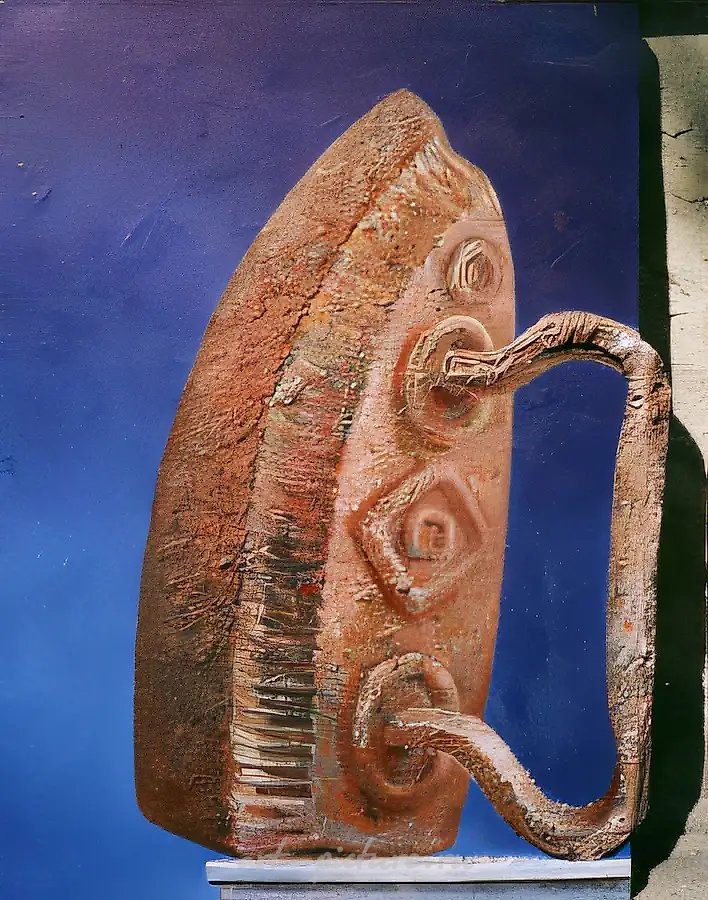
In the creative process, it is important for me that "my" object appears, the image of which vaguely arises in my subconscious before I actually meet the specific item. Then there is a leap forward, and the work proceeds intensely. I see deep meaning and mystery in the most ordinary, banal things.
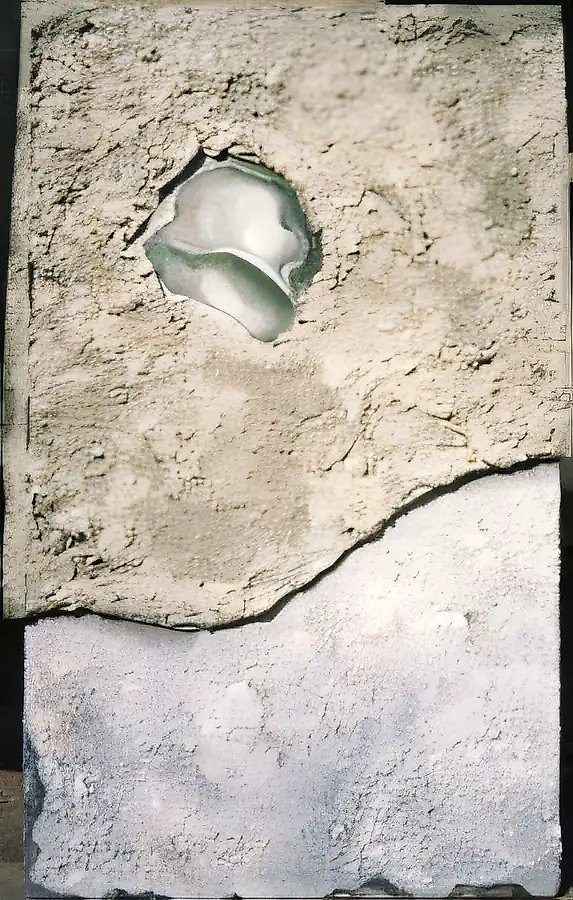
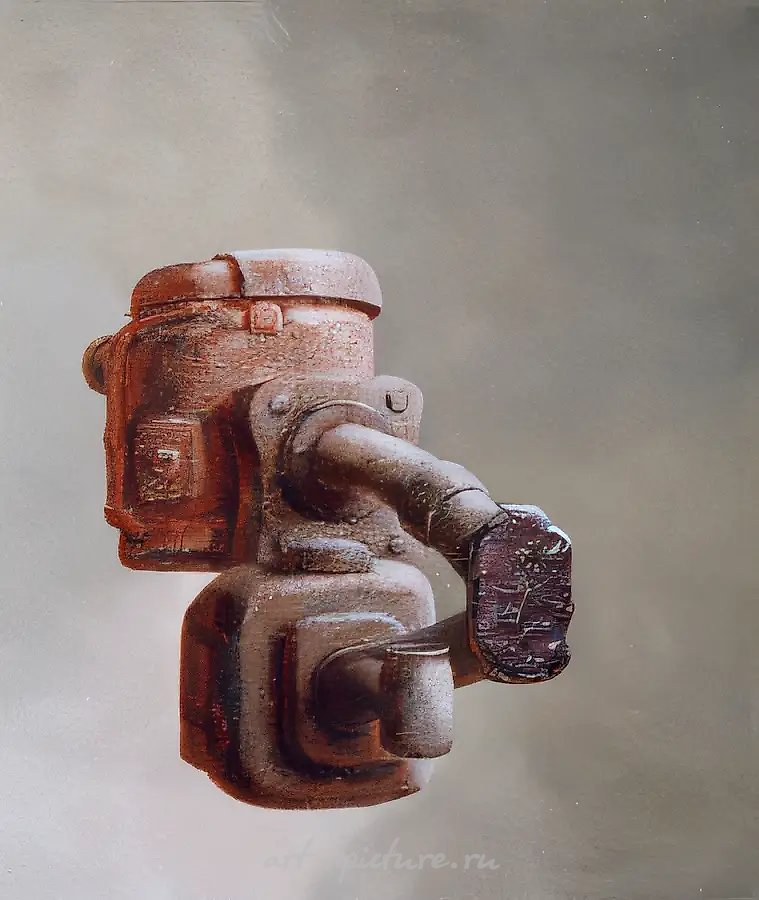
In recent years, I have developed a deep interest in old walls, peeling plaster, as well as worn-out, now useless details—old, rusty pipes, valves, and so on. At the same time, a peculiar aestheticization of these ugly (to average perception) objects appears in my works.
Illusion often arises in the depiction of objects in my works, further enhanced by the use of relief, which helps the painted volume emerge from the pictorial plane. As a result, a painting-object is born.
It's hard to predict how development will proceed, but for me now a work is simultaneously a sign, a symbol, and an object.
Critic
The art of Andrey Grositsky is a unique memorial to things, where the artist narrates experiences and cherished, dear objects, so that their transience is not forgotten. He combines the personal significance of an object and its existential presence, revealing their limited role in human fate and art. The soul's life of his lyrical 'I' is not separated from tangible things among which it passed, around which it was centered, through which it materialized.
The artist’s plasticity forms the life's value of a thing, the meaning it acquires for people during its service to them.
Andrey Grositsky’s art has become a meaningful, "eidetic" mirror, reflecting the existence of things, their enduring essence.
It seems that the objects themselves, through the artist's images, recognize their prototype shaken by time and discover their own immortality in it.
*
The work of A. Grositsky affirms the existence of the world, its unity and integrity in the most seemingly modest and, at first glance, banal manifestations. Grositsky’s objects are always autonomous and full of energy. Thus, they are transformed into living actors in the artist’s theater. Self-sufficient, they are held together by internal energy.
*
Andrey Grositsky’s objects are carnival-like, capable of masquerading, but they also assert the immutable. They are dual, sometimes unreal, but always directed toward people. It is the object, so often neglected by man, that is oddly able to ask: "Who are we, where did we come from, and where are we going?"
V. Patsyukov. "G. Bruskin, A. Grositsky, N. Kasatkin, B. Orlov, D.A. Prigov" exhibition catalogue, "Kashirka," Moscow, 1990; Exhibition booklet "New Dimensions of Reality." Gallery "A-3," Moscow, 1994.
Works 10