

Konstantinova (Alekseeva) Maria Mikhailovna
Born in 1953 in Moscow. In 1980 she graduated from the Surikov Moscow State Art Institute (faculty of painting, department of theater). Since 1983 a member of the City Committee of Graphic Artists. Since 1993 a member of the Moscow Union of Artists.
Exhibitions and auctions
SOLO EXHIBITIONS
1992 One-day exhibition at Kuznetsky Most, Moscow
GROUP EXHIBITIONS
1977-87 Exhibitions of the Association of Young Artists at the halls of the Union of Artists of the USSR, Moscow
1986 XVII Youth Exhibition, House of Artists at Kuznetsky Most, Moscow
1987 First exhibition of the Club of Avant-Gardists (KLAVA), Peresvetov Lane, Moscow
1988 Second exhibition of the Club of Avant-Gardists, Peresvetov Lane, Moscow
1989 "Expensive Art", Youth Palace, Moscow
"Inexpensive Art", First Gallery, Moscow
New Jerusalem (exhibition-action), Club of Avant-Gardists, New Jerusalem, Moscow region
"Perspectives of Conceptualism", Peresvetov Lane, Moscow
1990 "Woman as Object and Subject of Art", "Kashirka", Moscow
"ART MYTH 1", Central House of Artists, Moscow
"The Work of Art in the Age of Perestroika", Phyllis Kind Gallery, New York, USA
"Schizo-China", Club of Avant-Gardists, Exhibition Pavilion, Frunzenskaya Embankment, Moscow
"Inspiration. Young Art in Europe", Hanover, Germany
"Rabotsnitsa" (Woman Worker), Exhibition Hall, Oktyabrskaya St. 26, Moscow
1991 "Harmful Souvenirs" (jointly with N.Kozlov), First Gallery, Moscow
"ART MYTH 2", Manezh, Moscow
"Visitation", Peresvetov Lane, Moscow
"Mamka-kosmos", Gallery "Propeller", Profsoyuznaya 100, Moscow
"Novecento", L Gallery, Central House of Artists, Moscow
"MANI Museum - 40 Moscow Artists in Frankfurt Karmelitenkloster", MANI. Frankfurt am Main, Germany
"Perspectives of Conceptualism", University of Hawaii Art Gallery, Honolulu; Clocktower Gallery, Public School 1, New York, USA
"Art Messe", Frankfurt am Main, Germany
1992 "Hearts of Four", Officers' House, Moscow
1992-93 "Perspectives of Conceptualism", North Carolina Museum of Art, Raleigh, USA
"Humanitarian Aid, Packages for Germany. 27 Moscow artists", Central House of Artists, Moscow; "Humanitare Hilfe, Packchen fur Deutschland", Tranenpalast, Berlin, Germany
1993 "White Night", Yakut Gallery, Moscow
1994 "Drawings", Aidan Gallery, Moscow
"Outsider Art Fair", New York, USA
1995 "Winter Garden", Phoenix Cultural Center, Moscow
"Esotericum", XL Gallery, Moscow
"Dry Water", Bakhchisarai Palace Museum, Bakhchisarai, Crimea
"Walks Beyond the Horizon", Profsoyuznaya 100, Moscow
"Rabotsnitsa-2", L Gallery, Moscow
"About the House", Profsoyuznaya 100, Moscow
1996 "Velvet, Wood, Paper", Gallery "Obscuri Viri", Moscow
GROUP EXHIBITIONS
1995 "Winter Garden", Phoenix Cultural Center, Moscow
"Esotericum", XL Gallery, Moscow
"Dry Water", Bakhchisarai Palace Museum, Bakhchisarai, Crimea
"Walks Beyond the Horizon", Profsoyuznaya 100, Moscow
"Rabotsnitsa-2", L Gallery, Moscow
"About the House", Profsoyuznaya 100, Moscow
1996 International Art Fair ART-MOSCOW, Central House of Artists, Moscow
"10 Years of Club of Avant-Gardists", Peresvetov Lane, Moscow (catalog)
"Moscow Studio", Hemistyle Gallery, Washington, USA (catalog)
1997 "Second Point", Phoenix Cultural Center, Moscow
"Ecology of Emptiness", ISI, Moscow
International Art Fair ART-MOSCOW, Central House of Artists, Moscow
"History in Faces" (from the collection of contemporary art of Tsaritsyno museum-reserve), Samara, Perm, Novosibirsk, Yekaterinburg (catalog)
"Contemporary Russian Art", Budapest, Hungary
"Depository 1", Manezh, Moscow
1998 International Art Fair ART-MOSCOW, "Obscuri Viri" Gallery, Maly Manezh, Moscow
Critic
The door opened, I walked through a long corridor and found myself... inside a painting. "For me, the room is also a painting, a work of art," says its hostess Maria Konstantinova. "Sometimes I rearrange the furniture, change things around, but it's still static, where the frozen world supports my own stability."
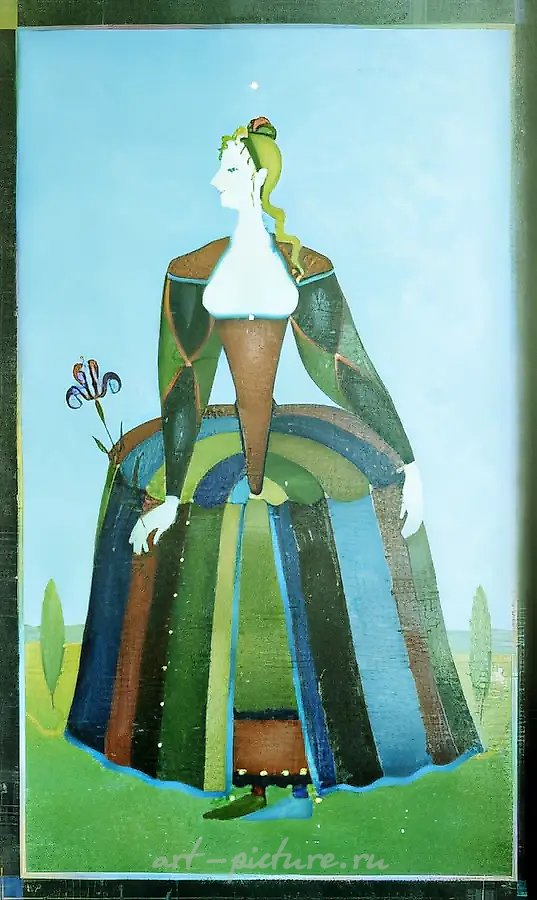
Maria Konstantinova was born into a family of architects, studied at the Moscow Secondary Art School, then entered the Theater faculty of the Surikov Art Institute. Theatre, theatre... Alas, the theater did not captivate Maria. "I am by nature an individualist, and the theatrical act is a collective, chaotic process. I don't want a director telling me what and how to draw, or actors being fussy: 'I won't wear this costume.' She did not stage a single play; her only concession to Melpomene was her diploma work—costume designs for Shakespeare's 'Twentieth Night.' Maria wanted to create authentic, epoch-appropriate images, balancing imagination with the history of costume and art.
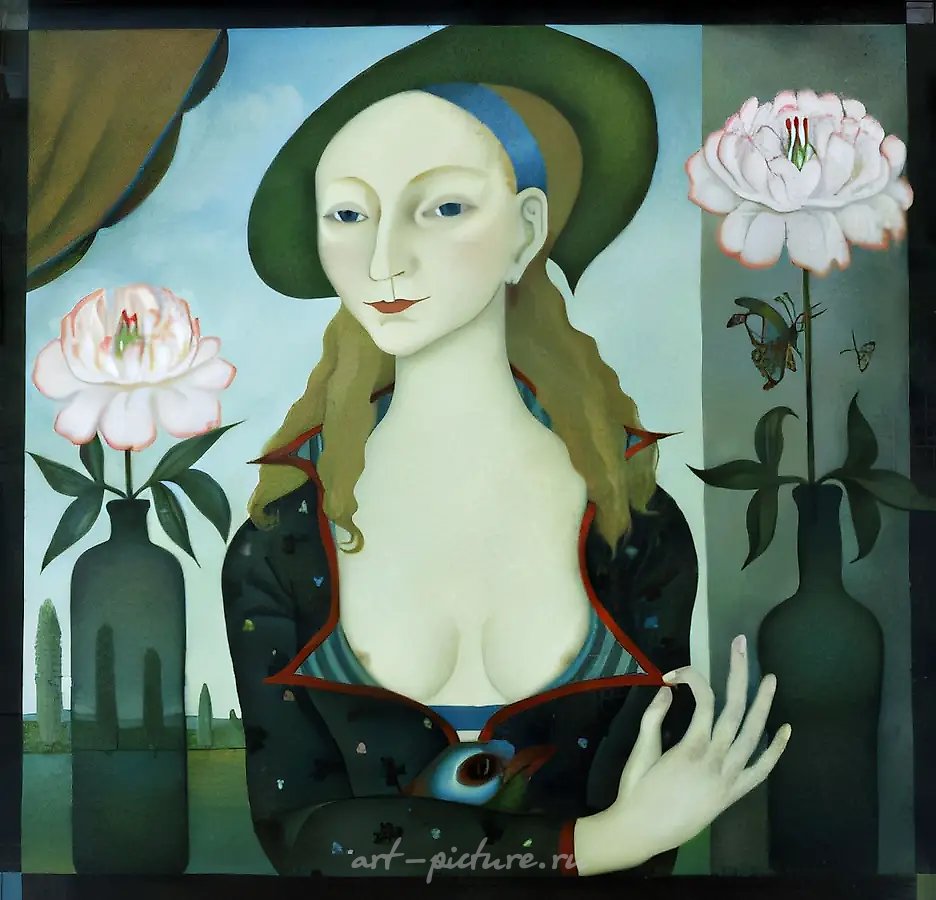
Absolute love for this history became the main theme of her creative reflections. Early works, which we can conditionally call her "soft" phase as opposed to her later, more aggressive one, bear the imprint of "historically artificial" prototypes. But these are not works "after" the old masters; they are works "with" the old masters, whom Maria has brought into a certain kaleidoscope: a Cranach-like girl crowned with Chinese symbols—peony, butterfly, and bird; a Cretan-Mycenaean girl. All her characters, as you might notice, are feminine, their lines inherently gentle and flexible. "Even if I draw a man, he still turns out somewhat feminine," laughs Maria. There's no subtext here—it's all about the captivating grace of the lines. The artist, who loves Beardsley, is interested in the figures formed outside the pictorial character, accidental outlines, "holes."
And what about the characters? He (or she?) was not born immediately. Serendipity led Maria to an image in a psychology professor's book—a photograph of the famous conjoined twins, Masha and Dasha Krivoshlyapov. Many may remember those amazing girls—two figures sharing one pair of legs. This striking phenomenon led to the invention of a surprising character—a female form with a mirrored axis appearing in unexpected places. The visual kaleidoscope aligned with the historical one (such twists being characteristic of Buddhist tradition and tantric dance).
Thus, the image was found, and object symbols of ancient cultures transformed into familiar ones. The magical kaleidoscope scattered colorful esoteric graphemes and hieroglyphs over the delicate body of the character, over the holes and colored backgrounds. Interestingly, in antiquity, symbols bore sacred meanings. "Writing" was not always universal or semantic in nature; often the text encoded in signs was understandable only to the author who knew its code. Perhaps distant descendants will someday try to decipher Maria Konstantinova's script, but for her contemporaries, I’ll reveal a secret: for Maria, a sign is rather a line, a form, and not a meaning.
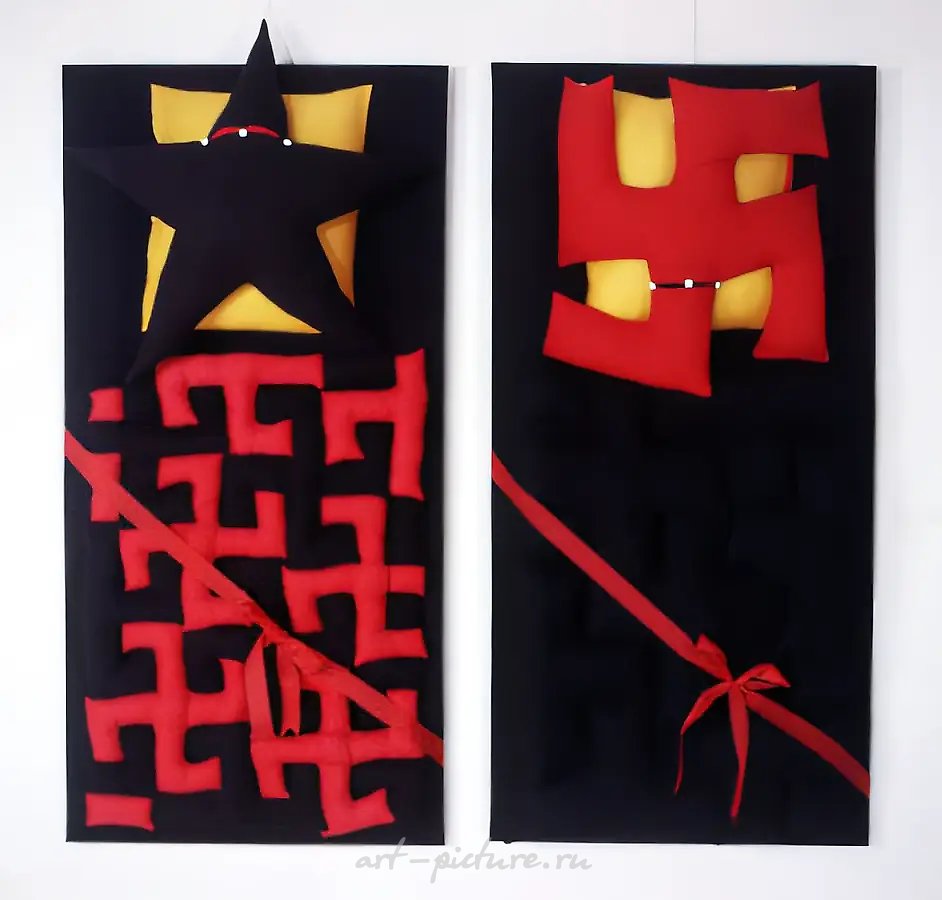
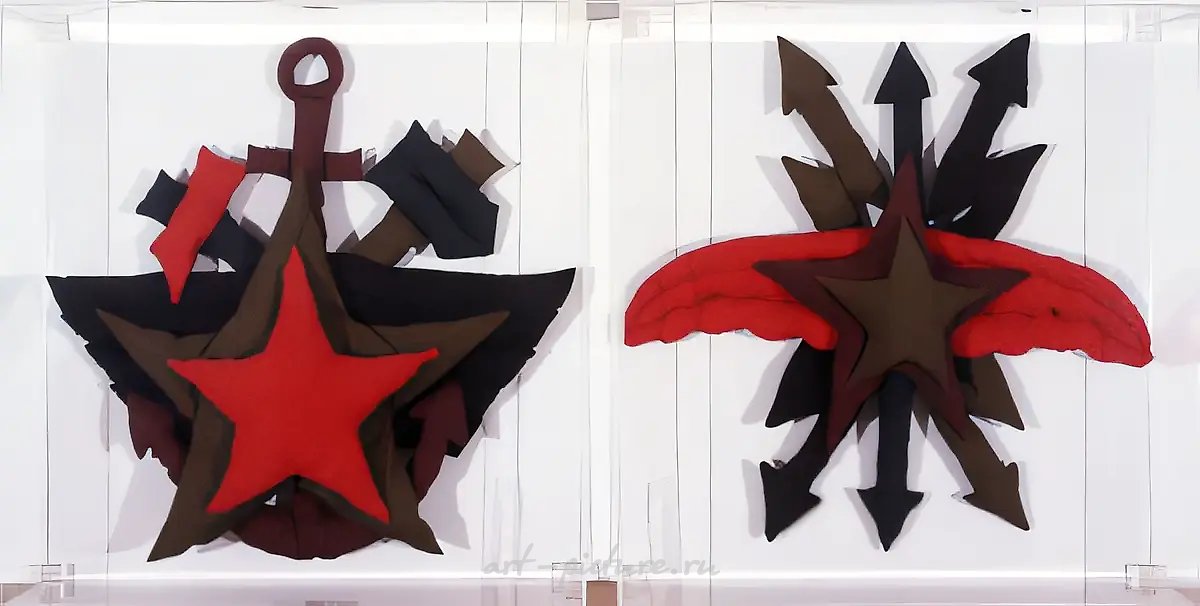
A material approach to the form of the sign led to the use of special materials—intertwining stars and swastikas made of satin, esoteric symbols reclining on order cushions. When the Soviet regime began to falter, it became possible to openly joke about the most powerful symbols—the star and the swastika; their screaming aggressiveness melted away, becoming suddenly soft and gentle. And these signs (incidentally, also having their mirror points) began to intertwine and merge.
Konstantinova’s series of soft objects was a resounding success, to which the artist was completely indifferent. "I have no ambition at all, I can't actively strive for something or, as is fashionable to say now, 'change my vector.' I prefer the anonymity of the ancients, who elevated the created object above the creator’s personality. Please don’t think this is arrogance, but I would gladly do an anonymous exhibition."
The list of Russian and international exhibitions in which Maria Konstantinova has participated is impressive. Her paintings and objects are found in German and American collections, and top Moscow galleries are happy to work with her; among her favorites are the Aidan Gallery, and Elena Selina’s XL Gallery, where this year she held the "Tarot Cards" exhibition. Maria created several fantastic works for it.
In the 1980s, it was difficult to make a living through painting. Book commissions helped; at 'Kniga' publishers, a wonderful book by A.Pogorelsky 'The Double, or My Evenings in Little Russia,' illustrated by Maria, was published in a very small print run. "By pure chance, I became a master of children’s popular science literature. Many of my friends participated in the work on 'Pochemuchka.' The book was reprinted dozens of times. Sadly, the epic 'Kalidasa,' which Maria also illustrated, never saw the light of day.
She recalls always drawing 'for herself.' She still does, and this current series could be called aggressive—though aggressive only in color. Outdated academic canons, especially the theory of "dirty color," prompted Maria to use pure colors, typical of folk prints or Tibetan thangkas. Maria paints her friends in pure color. Their marvelous faces, merged with ironic esotericism, invite thoughts about a new iconography at the turn of the 21st century. But we do not speculate; we just look into the kaleidoscope, admiring the intricate pattern composed of art history, mirroring, and anonymity. For Maria, "friends" weave a reality more appealing than the one bustling beyond her apartment-painting. In this reality—an enchanting combination of color, plasticity, lines, forms, subtle historical intricacies, and a vague irony in the shimmer of ancient cultures.
A. Berkut, "The New Iconography of Maria Konstantinova", Harper's Bazaar, 1996, March-April
Works 9




s monument in Yerevan (sculptor Tomsky), 1992, textile, 60x60x15, 60x60x15 authors property