Lebedev Rostislav Evgenievich
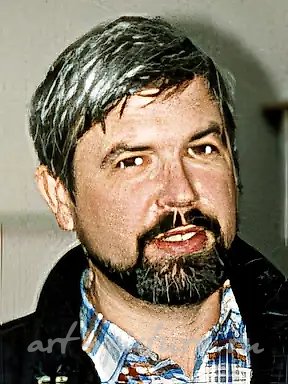
Rostislav Evgenievich Lebedev (born April 8, 1946, Moscow) is a Soviet and Russian artist.
Biography
Born in 1946 in Moscow. In 1969, he graduated from the art and graphic faculty of the Moscow State Pedagogical Institute. Since 1994, he has been a member of the Moscow Union of Artists.
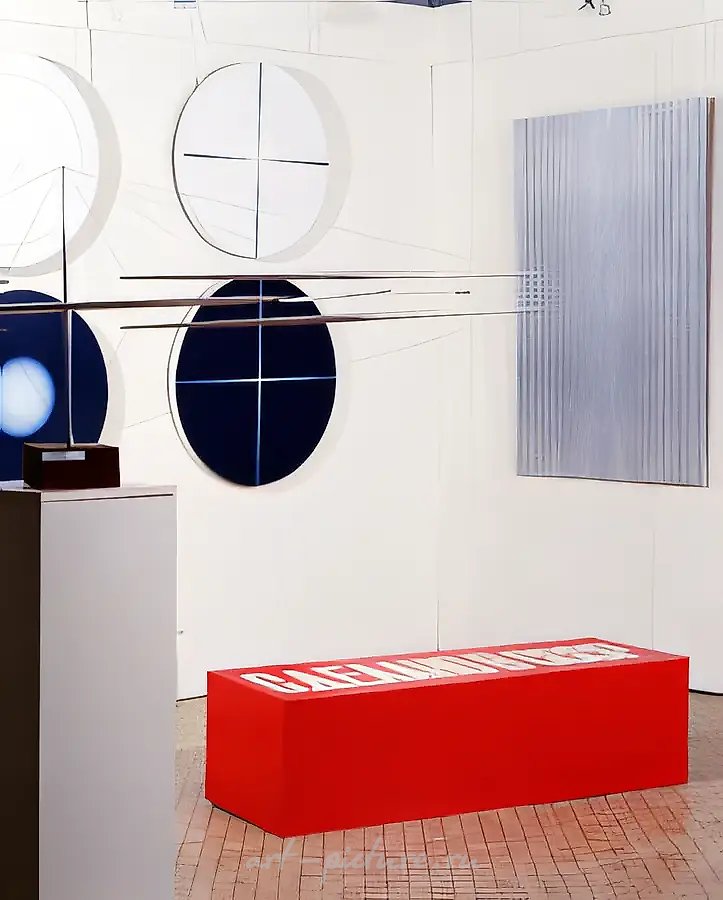
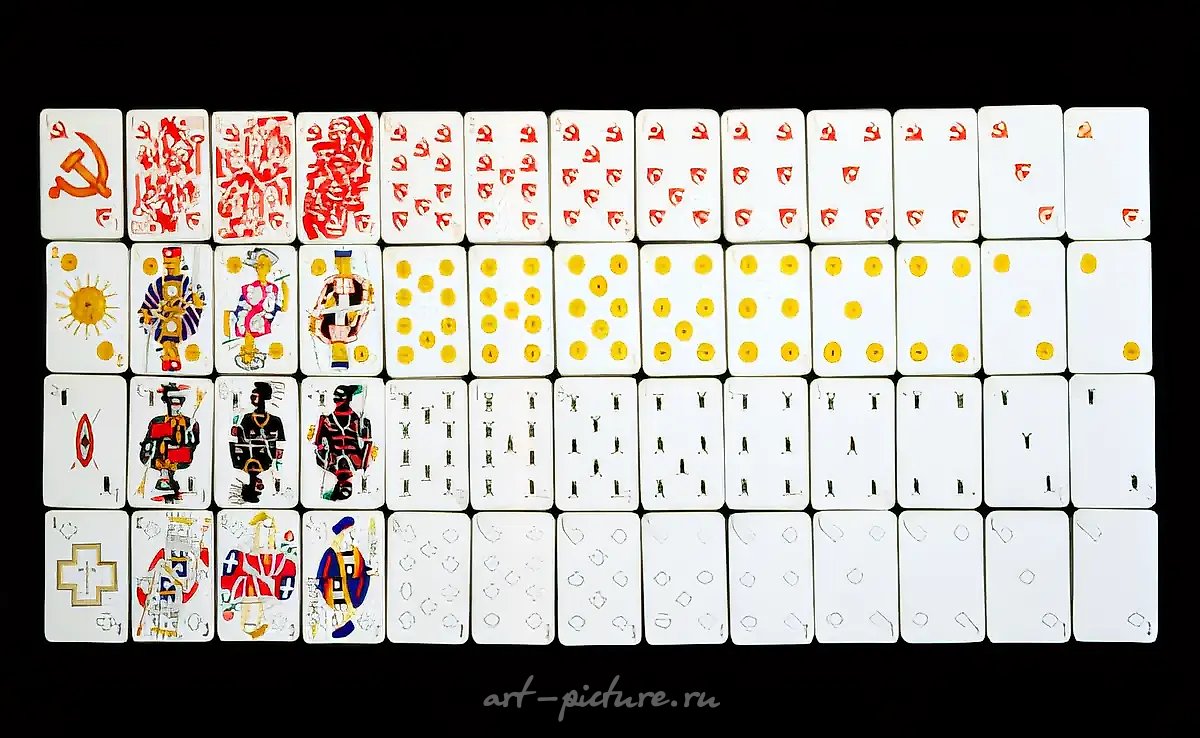
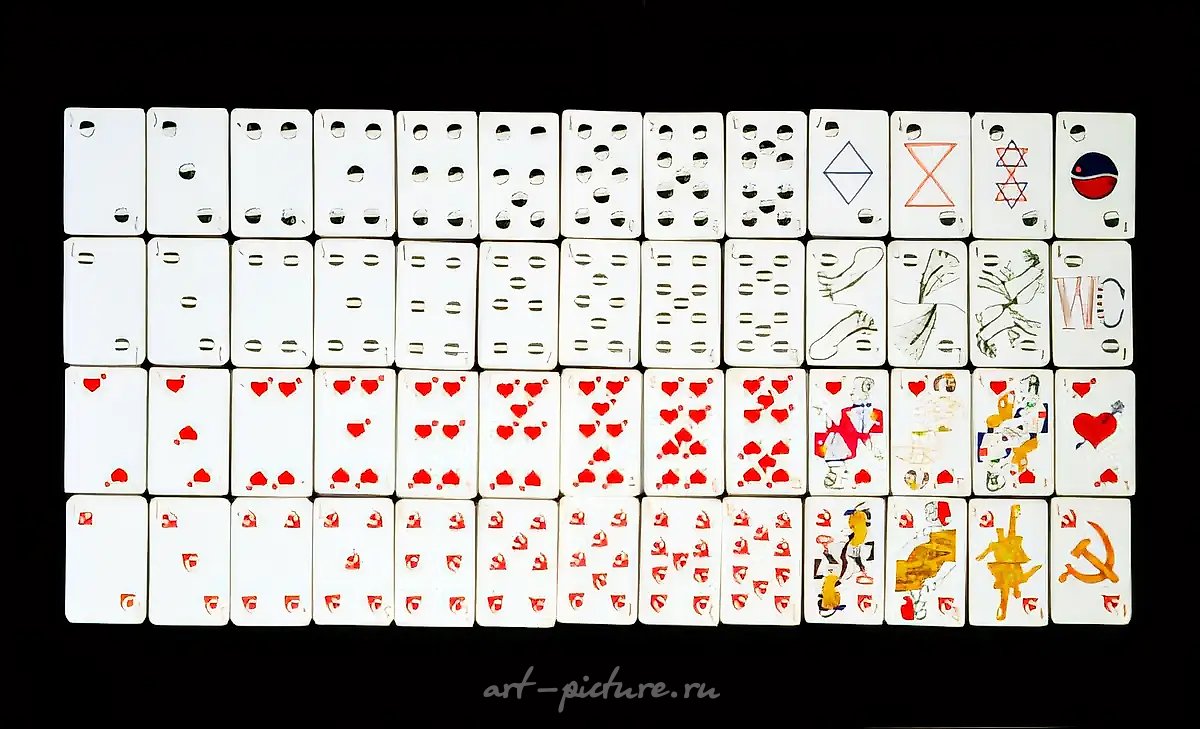
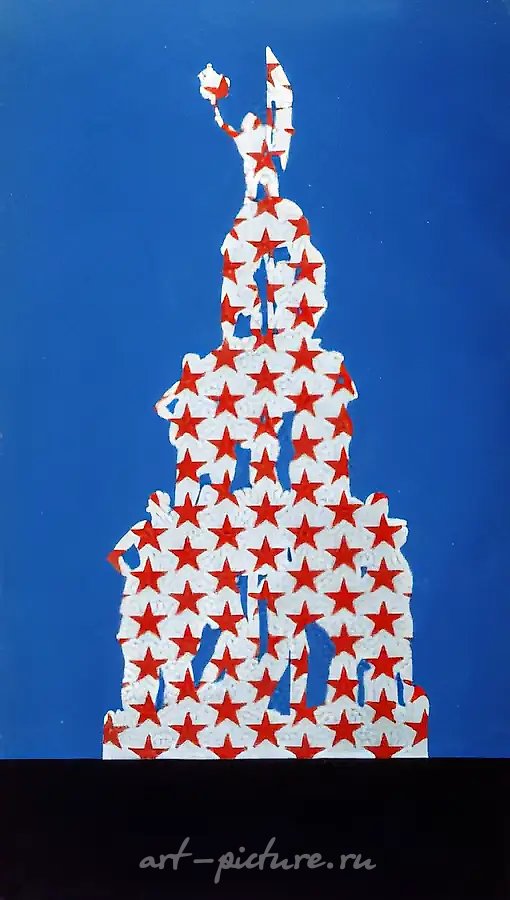
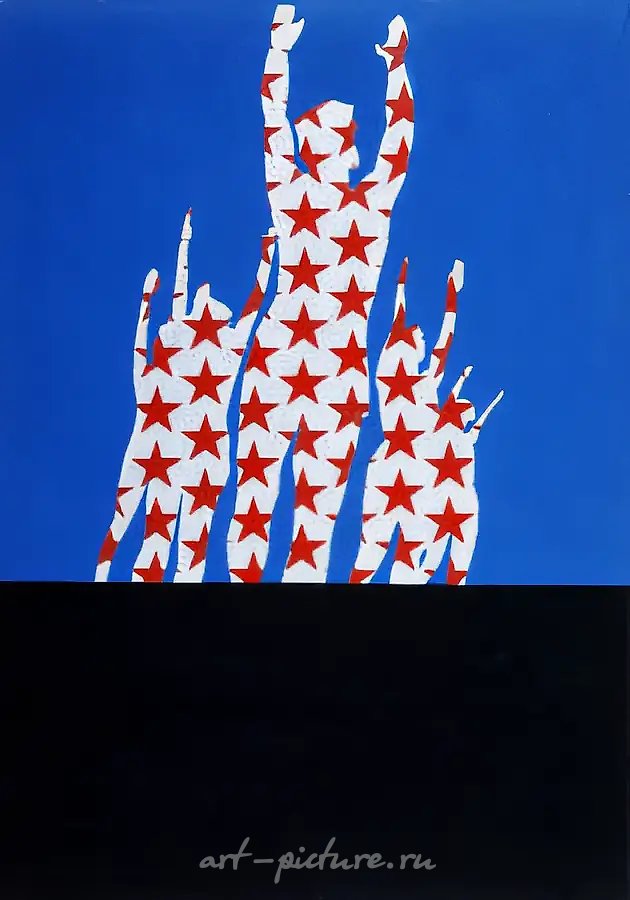
Rostislav Lebedev is a classic of contemporary art, known as one of the leaders of Sots Art. He is the author of epoch-making works such as 'Made in the USSR', 'Tarot Cards'.
Works in collections
State Tretyakov Gallery, Moscow
State Russian Museum, St. Petersburg
State Pushkin Museum of Fine Arts, Moscow
Cremona Foundation, Minnesota, USA
Rutgers University, New Jersey, USA
Staatliches Lindenau Museum, Altenburg, Germany
Sakharov Museum and Public Center, Moscow
Anton Kozlov Collection, Moscow
Private collections in the USA, Switzerland, Germany, Denmark, Italy, France, England, Sweden, Australia, Russia
Exhibitions and auctions
SOLO EXHIBITIONS
1990 Eduard Nakhamkin Fine Arts, New York, USA
GROUP EXHIBITIONS
1968-83 Annual group exhibitions of young Moscow artists. Artist's House on Kuznetsky Most, Moscow
1975 'Preliminary apartment previews for the All-Union Exhibition'. Moscow
'Exhibition of works by Moscow artists'. VDNKh, 'House of Culture' pavilion, Moscow
1976 'Spring apartment exhibitions' (preliminary expositions for the forthcoming exhibition at Begovaya Street), Moscow
'Exposition at Musee en Exil' (A. Glezer collection). Montgeron, France
1975-83 One-day creative evening exhibitions. Artist's House on Kuznetsky Most, Moscow
1981 'Nouvelles Tendances de l’art Russe non-officiel. 1970-1980'. Le Centre Culturel de la Villedieu, Elancourt, France
1987 'Artist and Modernity'. First creative association of Moscow artists. 'Kashirka', Moscow
'Creative Retrospective of Moscow artists. 1957-1987'. 'Hermitage' society, Profsoyuznaya St., 100, Moscow
1988 'Geometry in Art'. 'Kashirka', Moscow
'Labyrinth'. Youth Palace, Moscow
'Ich lebe - ich sehe'. Kunstmuseum, Bern, Switzerland
2nd exhibition of the First Creative Association of Moscow Artists. Artist's House on Kuznetsky Most, Moscow
1989 'Expensive Art'. Youth Palace, Moscow
Showroom Gallery, London, UK
'New Soviet Art'. Cologne, FRG
'Dialogue'. 'Avant-Garde' Russe et Art Contemporain Sovietique'. Centre Boris Vian, Ville des Ulis, Paris, France
1989-90 'Transformation'. The Legacy of Authority'. Camden Arts Centre, London; Colchester, UK
1990 'Towards the Object'. 'Kashirka', Moscow
'Russian Painting Traditions'. Museum of History and Reconstruction of Moscow, Moscow
Chicago International Art Fair. Chicago, USA
1991 'Back to Square One'. E.N. Berman Gallery, New York, USA
3rd International Master Print Fair. Sydney, Australia
'In de USSR en Erbuiten'. Stedelijk Museum, Amsterdam, Netherlands
'Contemporary Soviet Art: From the Thaw to Perestroika'. Collection of contemporary art of the Tsaritsyno Museum-Reserve. Setagaya Art Museum, Tokyo, Japan
'After Perestroika'. Irving Galleries, Sydney, Australia
'Contemporary Artists – To Malevich'. Tretyakov Gallery, Moscow
1992 'Sots-Art' (Contemporary Art Collection of the Tsaritsyno Museum-Reserve). Lenin Museum, Moscow
'Gorby in Images'. Traveling exhibition to US universities
1993 'Philosophy of the Name'. CSI, Moscow
1994 'May Exhibition'. 'Moscow Gallery'. Kuznetsky Most, 20, Moscow
'Artist instead of the Work'. Central House of Artists, Moscow
'Adresse provisoire pour l’art contemporain russe'. Musee de la Poste, Paris, France
Cetinjski Bienale II. Cetinje, Montenegro
1995 'Kunst im verborgenen. Nonconformists Russia 1957-1995'. Contemporary Art Collection of the Tsaritsyno Museum-Reserve. Wilhelm-Hack Museum, Ludwigshafen am Rhein; Documenta-Halle, Kassel; Staatliches Lindenau Museum, Altenburg, Germany
1997 'Russian Art in 15 Biographies' (from the contemporary art collection of the Tsaritsyno Museum-Reserve). Mucarnok, Budapest, Hungary
Third Biennale of Contemporary Art. Cetinje, Montenegro
Author about himself
In my work, I love diversity: painting, installations, objects, collages.
A new genre and a new material give a new sense of space, which is the main theme of my works. I do not do painting, I do not do Sots art, I do not do collages – I create space. It does not matter what it is filled with – what matters is its presence. It is formed from everything that is visible, from the energy that makes everything visible come alive, fill, and create a certain universe where there is hell and heaven, sky and earth, and between them a person with his drama.
Maybe this is what Jung called 'mystical participation'?
I am only a conductor of this energy, its transformer. Perhaps this is the 'meaning that is above me.'
The work proceeds as if in two planes: ideological, so to speak, and professional. The main thing here is for these two planes to intersect at the right point. But sometimes one overlaps the other and blocks it.
It is not about a speculative concept, with which it is so fashionable to start one's path in art. This concept (not at all speculative for me) comes after many years of intense, banal labor and often does not resemble what you started with at all. But for me, it is not even about that, but about the fact that I am interested in everything that happens around me, and I try to figure it out. That is when my own vision appears.
You could say that creativity is a form of my existence. There is a gradual search for this form, a search for its place in life.
It is interesting to connect or clash opposite, seemingly incompatible things, and see what happens. And what happens is something different, not like what came before, a space that has not existed before.
More often, I am attracted to the idea of a 'layer cake', as I call it. This is when different layers exist in one work: metaphysical, social, aesthetic, even ethical, sexual, formal, etc.
I do not like to talk about art, especially my own. For me, there was never a question 'to be or not to be.' This is my fate, I cannot do anything about it.
There are certain vibrations: external, internal, cosmic, they can be called different things. The point is to find them, so that they resonate in unison, and someone else, besides you, also sees it.
Critic
The creative principles of R. Lebedev are based on the ideas of the cycles of nature, its constant renewal — where nature is understood as the unity of the natural world and the world of artificial environment. Cosmos and chaos, nature and technology, society and spirit are perceived not as oppositions, but as something indivisible and inseparable, since the microcosm and macrocosm are mutually dependent and, as John Cage said, 'the music of the spheres can be heard even in the sizzle of frying eggs.'
Entering into a dialogue with the viewer, R. Lebedev opens up his works, offering his creative capacity as an inexhaustible source of possibilities.
Lebedev's art hints at the truth that a person is not only homo sapiens (the rational), and not only homo faber (the maker), but also homo ludens — the playing person, and in this lies not weakness, but the strength of his spirit, the guarantee of his freedom. The new reality in Lebedev's work is immanent to our social reality and arises naturally for the artist — as a reward for openness and spontaneity of the creative act. One always plays with something that, through the game, receives a new, changed meaning. Objects (as they are called), and the 'person who plays' by the power of his imagination and artistic will, transforms them or gives them new significance. But for this, one must have such things that would contain the impulse of play. And Lebedev invented or, rather, discovered such things in this capacity. He 'materialized' consciousness, 'solidified' clichéd ideology, 'measured' and 'connected' the coordinates of physical and social space. Lebedev discovered a new dimension of plasticity; he understood that the ability to be a sign in things serving and created by man is more stable than much else in our lives.
It turns out that, in appropriate situations and combinations, the 'object' sign-symbols of Soviet reality play quite powerfully — at the level of ritual-ceremonial pathos of a new festive 'culture.'
The first step into the element of play for Lebedev was collages and assemblages. Perhaps continuing his childhood games, he used toys in them, which created an amazing tension in the picture, breaking the frame and ingeniously enriching the space. The drawn and inscribed were assembled with fragments of real objects, entering into a kind of competition for material persuasiveness, forming an unexpected unity. In Lebedev's compositions of the mid-70s, there were often echoes of Russian Cubo-Futurism — signs, posters, new objectness — all this made one's head spin and was perceived as a kaleidoscope, where objects broke away from habitual places and lost their usual appearance. Here, the urban theme itself provoked the fragmentation of perception. But by the late 70s, Lebedev's desire to 'animate' things was becoming more complex. There was a shift in the very view of things: the artist's manner was maturing into a viewpoint. With things interacts not just the painter affirming his individual vision, but a person affirming the reality of the Soviet way of life. He inhabits the very object, and the object begins to live in a new reality, a new context. 'I love to juxtapose different things,' he says, 'natural and abstract, material with weightless. It's very interesting — a tree and the cube of a house, sky and car, slogan and person.'
These seemingly random shifts and juxtapositions led him to a true plastic discovery: the invention of a single conceptual module, bringing together public life and everyday life into Lebedev's card games.
(V. Patsyukov. 'Rostislav Lebedev' (abridged). - A-Ya, 1982, No. 4)
Works 10