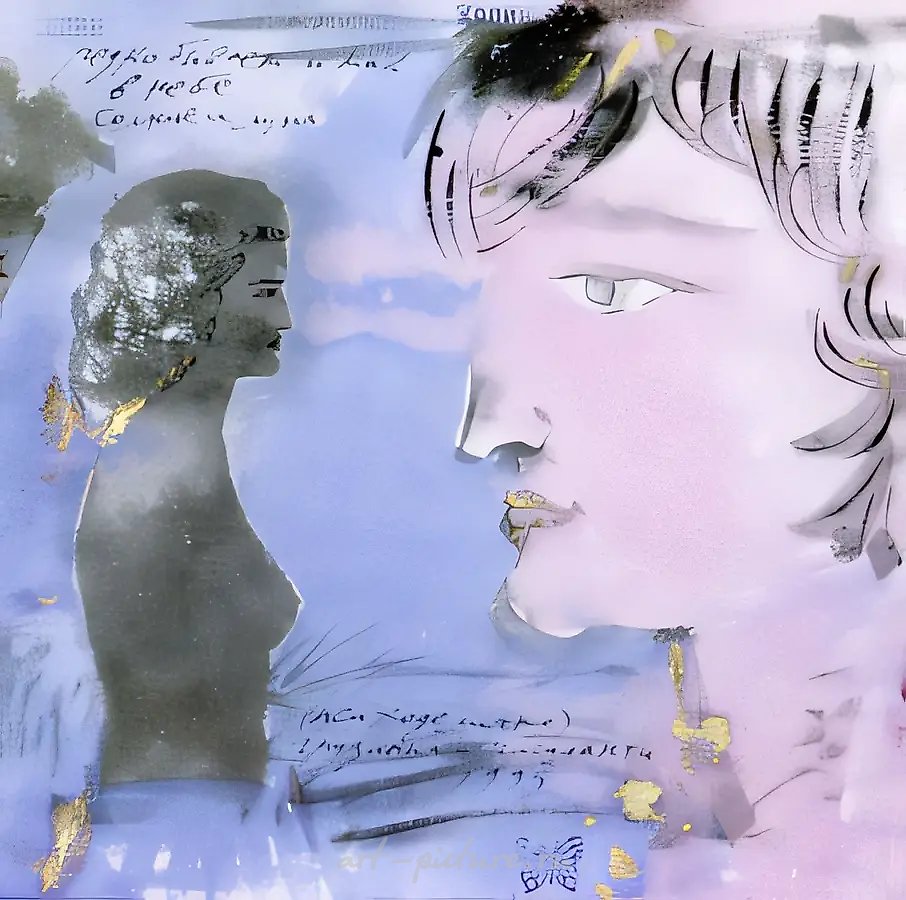

Mareev (Lim) Alexander Vladimirovich
1969 Born in Moscow
1989 Graduated from the Moscow Art School in Memory of 1905 (faculty of easel painting)
Participated in actions and exhibitions of the association "Good Friends", the inspection "Medical Hermeneutics", the "Cloud Commission"
Works in collections
Galerie Carenina, Vienna, Austria
P.Sprovieri, Rome, Italy
Exhibitions and auctions
SOLO EXHIBITIONS
1991 "Watercolors of Sasha Mareev". L Gallery, Moscow
1992 "Two Weeks of the Artist S. Mareev's (A.V. Lim) Life" - Gallery "Studio 20". Gallery "Studio 20", Moscow
GROUP EXHIBITIONS
1990 XIX Youth Exhibition. House of Artists on Kuznetsky Most. Moscow
"For Cultural Leisure". Kashirka, Moscow
"The First Day of Spring". Artists' Studios, Lavrushinsky Lane, Moscow
"Form and Content". Trekhprudny Lane, Moscow
Group exhibition. Gallery "Red Art", Moscow
"Before and After". Palace of Youth, Moscow
"Graphics and Painting". ART Modern, Moscow
1991 "Ahasuerus". Palace of Youth, Moscow
"Saturday Evening". Lenin Museum, Lviv
"Novecento". L Gallery. Central House of Artists, Moscow
"Sea of Vodka". Trekhprudny Lane, Moscow
1991-92 "Happy New Year, comrades!" Exhibition hall of the Culture Foundation, Moscow
1992 Painting and graphics. 28 Malaya Gruzinskaya, Moscow
"Sorting things out with weapons". Trekhprudny Lane, Moscow
"Still leven". Velta Gallery, Moscow
"About the Transparent". Regina Gallery, Zimenki village, Moscow Region
"a Mosca... a Mosca...". Villa Campoleto, Ercolano; Galleria Comunale d`Arte Moderna, Bologna, Italy
"Art firsthand, or Apology for Shyness". Regina Gallery, Moscow
1993 "Art as Power, Power as Art". Central House of Artists, Moscow
"Monuments: Transformation for the Future". ISI, Central House of Artists, Moscow; ICA, New York, USA
La Biennale di Venezia. Venice, Italy
1994 "Border Zones of Art". Contemporary Art Festival. Art Museum, Sochi
"Tyrannei des schonen" (with P. Noever). MAK (Austrian Museum of Applied Arts), Vienna, Austria
"Drawings". Aidan Gallery, Moscow
1995 "The Art of Dying". Yakut Gallery. Manege, Moscow
"Kunst im Verborgenen. Nonkonformists Russia 1957-1995". Collection of Contemporary Art, Tsaritsyno Museum-Reserve. Wilhelm-Hack Museum, Ludwigshafen am Rhein; Documenta-Halle, Kassel; State Lindenau Museum, Altenburg, Germany
"in Moskau... in Moskau...". Badischer Kunstverein, Karlsruhe, Germany
"Einblicke" (Workshop Moscow II). Galerie im Marstall, Akademie der Künste am Hanseatenweg, Künstlerhof Buch, Berlin, Germany
1997 International Art Fair ART-MOSCOW, XL Gallery. Central House of Artists, Moscow (catalog)
ACTIONS AND PERFORMANCES
1989 "... between two bridges, rug and slippers..." (with O. Filianova). Osipenko St., Moscow
1990 "First Day of Spring" (with A.-M. Fansoni). Artists' Studios, Lavrushinsky Lane, Moscow
"Flowers for Veronika - VIII" (with K. Reunov and A. Shmandurova). Gallery in Trekhprudny Lane, Moscow
1991 "S+O=L" (with A. Smirnsky and K. Susheva). Gallery in Trekhprudny Lane, Moscow
1992 "Without Words and Without Title" (with N. Vlahova). Gallery "Studio 20". Moscow
1993 "Laziness-Yin" (with A. Melamid). Marat Gelman Gallery. Moscow
1994 "Fist in the Snake" (part of the Sochi Contemporary Art Festival, with a group of artists). Passenger trains "Moscow-Sochi", "Sochi-Moscow".
"Ant above the bridge and dragonfly under the bush". Botanical Garden, Moscow
1995 "..., ..., Motherland and Noma" (within the exhibition "The Art of Dying"). Manege, Moscow
"Winter" (with A. Alekseev). House of Artists on Kuznetsky Most, Moscow
"Elite Exhibition of the Highest Extra-Class, Only for Three". On the territory of the Pushkin State Museum of Fine Arts, Moscow
Author about himself
No information available
Critic
Among the most substantive and at the same time irresponsible reflections on the modern concept of the history of culture, there are variants of the answer to the question: does visual art have any roots in the physical natural world—unhistorical, undescribed, untold, not yet named by Adam? Or is the whole history of artistic creativity a consecutive embodiment of phantoms of human speech, more powerful than all the physical forces of nature, and with even greater perseverance placing cosmos in the cosmos, and earth on the earth? Like all questions posed by oppositional thinking, this sounds silly, but precisely for this reason the answers to it become even more significant and interesting.
If, after all, we allow that works of visual art have a precise address in one of the streams of language, if we are able to see and hear the meaningful and intonational correspondence of the artist's actions to those or other well-formed literary systems, then the works of Sasha Mareev, after a series of deceptive coincidences and identifications, turn to the viewer with a strange and ambiguous exposure to the zone bordering the space of languages from which the most intimate and mysterious system among the registered organizations in Russian literature of the second half of the 20th century is assembled.
In the context of conceptual art, which remained in 1990 the main referential model of artistic practices, Sasha Mareev's works looked strange. This strangeness, defined by the "strange-alien" form, manifested in the unaccepted openness of the graphic sheet or series. It was not so much about plastic openness as about the absence of obligation of the image to the attached descriptions. Unbound by references to commentary or explanatory text, Mareev's works appeared as disorganized and superficial quotation of brilliant, but barely recalled, anonymous fragments.
In Mareev's execution, quoting—much talked about but little understood in the art world then—differed in that through frequent, too frequent, and often inappropriate reproduction, "quotes" lost many attributes of citations, including quotation marks. Thus, they lost their primary generic feature. Thus, Mareev's works declared their alibi, and fragments of history moved to a state of indifference to their historical status.
Quotation is an edition. And an edition is the loss of uniqueness, or more precisely—an escape from conception to invention, the absolute triumph of writing over speech, disregard for historical integrity and coherence, and ultimately, the impossibility of choosing an interlocutor.
In the previous fragment, the main thing for the reader becomes the consistent emergence of three definitions of Mareev's work: strange, superficial, and inappropriate, as well as their persistent association with the noun "history."
In "strangeness," we hear detachment, based on indifference to any attempts at recording a single (unique) "history," to the very intention to appropriate and carry out some universal and all-encompassing "historical process."
At the same time, artistic practice is registered only as the constant entry into "different histories," too private, or recall the widespread in the early 90s word "private," to be present in History. These are not events, but stories about what may be represented as an event or "at the site of the event," stories that have actually replaced in language involvement in history or the grand strategy of contemporary culture. Narrated stories, cases of so-called lying, folding into graphomaniac verses, have replaced critical judgments and expert evaluations of the artist's work.
Thus, a significant characteristic of Mareev's works is defined—inappropriateness, that is, absence in the actual, real process of recording the history of art.
And this is already a case of the so-called Mozartism—an indifferent attitude to the intention to describe the place of contemporary art and one's participation in designating this place. Instead, it became possible to slide along the surface of contrived destinies, stories, and lives.
A. Balashov
Works 6