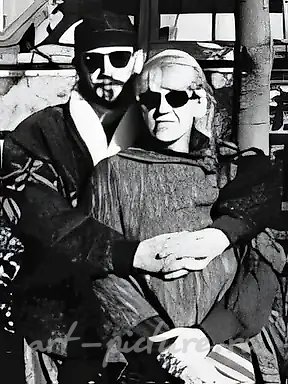
Martynchik Svetlana and Stepin Igor
Martynchik Svetlana
1965 born in Odessa
1982-85 studied at Odessa State University (Faculty of Philology)
Stepin Igor
1967 born in Odessa
Since 1986 work together
Since 1993 live and work in Moscow
Works in collections
State Russian Museum, St. Petersburg
Neue Pinakothek, Karl Ernst Osthause Museum der Stadt Hagen, Hagen, Germany
Private collections in USA and Europe
Exhibitions and auctions
SOLO EXHIBITIONS
1992 "People of Ho". M. Gelman Gallery, Moscow
1993 "Black Square". M. Gelman Gallery, Moscow
"Childhood, Adolescence, Youth". Gallery at Trekhprudny Pereulok, Moscow
"Chronicles of Abbae". M. Gelman Gallery, Moscow
1994 "Aiyishana". Gallery "Dar", Moscow
"You Must Remember It". Ronald Feldman Fine Arts, New York, USA
"Chronicles of Abbae". IBM, Moscow
"Chronicles of Abbae". State Russian Museum, St. Petersburg
1995 "Chronicles of Mahum". M. Gelman Gallery, Moscow
"People of Shapituk". Neue Pinakothek, Munich, Germany
"Flora and Fauna of the Madaik Continent". Galerie Wittenbrink, Munich, Germany
"Madaik, the Sixth Continent". Karl Ernst Osthause Museum der Stadt Hagen, Hagen, Germany
1996 "Madaik, the Sixth Continent". Municipal Gallery at Fischmarkt, Erfurt; Kunstverein, Braunschweig; Albrecht Dürer Kunstverein, Nuremberg, Germany
"Stramoslyaba". M. Gelman Gallery, Moscow
GROUP EXHIBITIONS
1990 "New Figurations". Literary Museum, Odessa
1993 "Dedicated to the VII Congress of People's Deputies". M. Gelman Gallery, Central House of Artists, Moscow
"Monuments: Transformation for the Future". ICI, Central House of Artists, Moscow; ICA, New York, USA
"Conversion". M. Gelman Gallery, Central House of Artists, Moscow
"Art Hamburg". Ronald Feldman Fine Arts. Hamburg, Germany
1994 "EUROPA - 94". Munich, Germany
1995 "5 Years of Marat Gelman Gallery". House of Artists at Kuznetsky Most, Moscow
1996 "Vis-a-vis". Museum of Contemporary Art of the City of Hagen (Karl Ernst Osthause Museum der Stadt Hagen)
"5 Years of Marat Gelman Gallery". Exhibition Hall at Kuznetsky Most, Moscow
"Drawings on White". Ronald Feldman Gallery, New York, USA
Liz Janstrup Collection. State Tretyakov Gallery, Moscow
1997 "Verbal Series in Contemporary Art of Moscow". Russian Cultural Center, Budapest
International Art Fair ART-MOSCOW, Ronald Feldman Gallery. Central House of Artists, Moscow
SOLO CATALOGS
"People of Ho" – M. Gelman Gallery
Ronald Feldman Fine Arts
Publishing House "Popugai", Moscow
"Chronicles of Abbae" – M. Gelman Gallery
State Russian Museum, publishing house "Ima-Press", Moscow, 1994
"Madaik", Karl Ernst Osthause Museum der Stadt Hagen, Verlag fur Moderne Kunst Nurenberg, 1995
"Stramoslyaba". M. Gelman Gallery, 1996
Author about himself
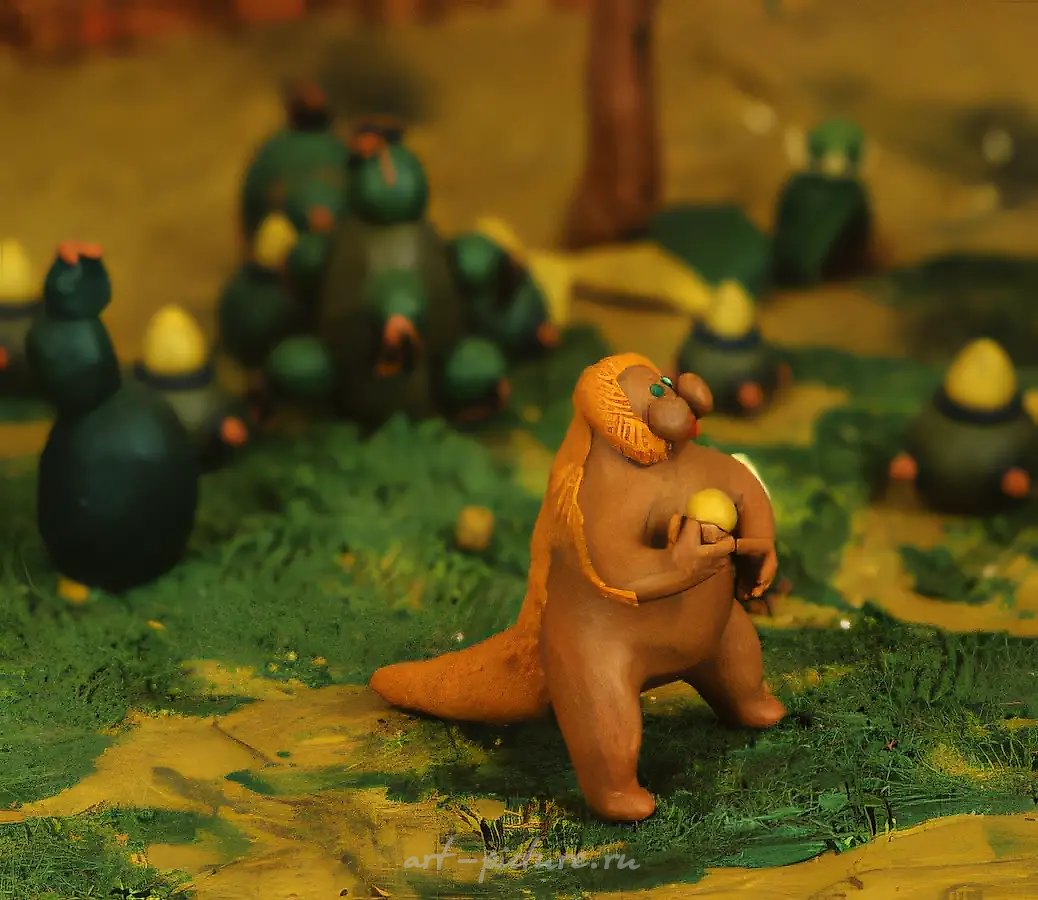
In our case, the word came first. For technical reasons, our visuals always lag behind the verbal: by a day, a month, or years. Therefore, we are simply illustrators. We are illustrators of our own myths. But the one who creates the myth lives in the myth themselves. In a sense, we do not exist. For this reason, it is very important for us to carefully gather and document evidence of our own existence. The unsophisticated charm of plasticine landscapes is a trick by which we try to make you pay attention to this evidence, to read our endless "dossiers" about our creations and about ourselves. The abundance of texts, heaped by us onto the intangible flesh of myth, led all researchers to seek the roots of our work in literature. This is close, but not quite right. Our affinity with literary traditions is obvious. But the nature of our activity is not identical to that of writers. Rather, it is closer to the activity of the characters they create. This is natural: inhabitants of one myth cannot fail to resemble inhabitants of other myths. We are close not to Borges, but to his heroes: generations of scholars who created the Encyclopedia of Tlön are, in a sense, our "colleagues." Not Tolkien, but his invented Frodo, cast out of life into myth, resembles us. We are not the ones who write. Like our plasticine characters, we are but shadows envisioned by the writer. We preferred the stepwise development of an unfinished system to the laconic completeness of an artistic gesture. It seems to us this is a fundamentally new method in the field of visual art. In most other fields of human activity, this method has been used since the creation of the world itself, which, by the way, took place (and continues to take place) in a similar way.
Critic
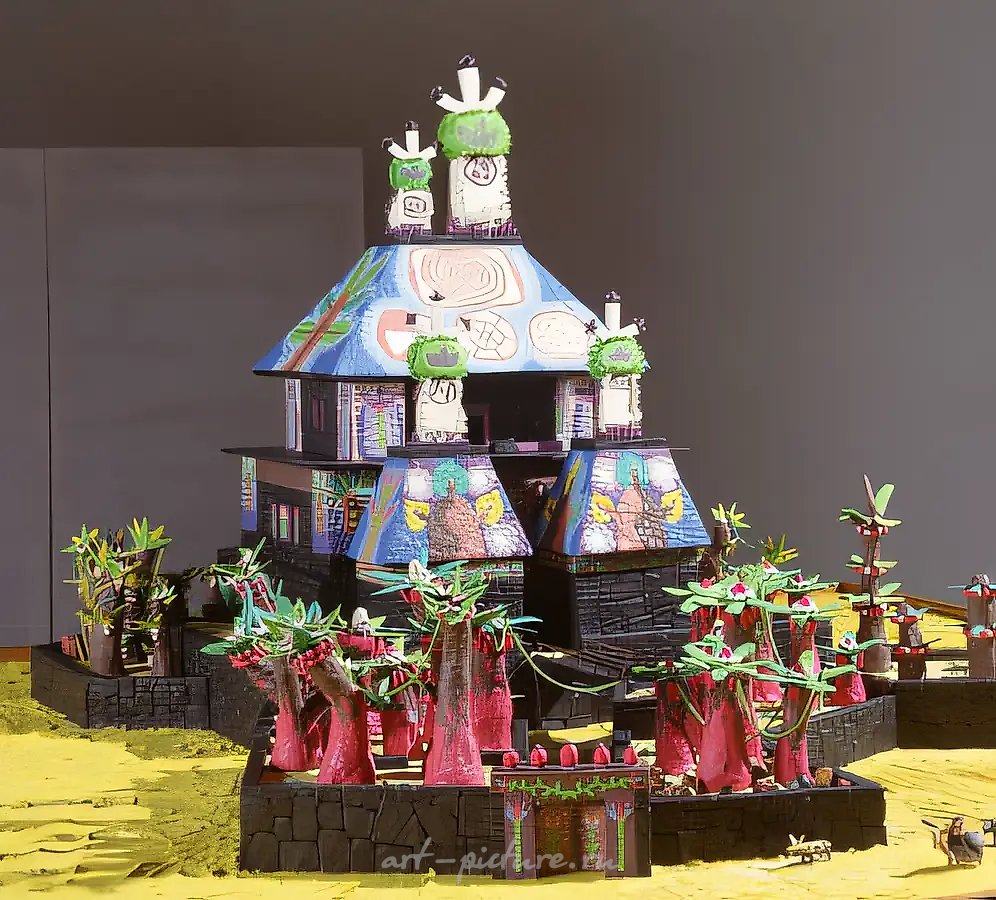
In Moscow, the names Martynchik and Stepin are first of all associated with the Marat Gelman Gallery, where, over the past three years, step by step, exhibition by exhibition, the artists have tried to give us some idea of their long-term project, requiring total dedication from both authors (which is customary) and spectators (to which we are unaccustomed). The charming plasticine figures and their equally charming plasticine environment themselves, in the artists' opinion, have no value. But they do not exist by themselves—they are part of an artificially created, meticulously and thoroughly thought-out system. "Everything is very simple," the artists say, "first we created the world, and now we have to illustrate it. When a writer wants illustrations for his novel, he usually looks for an artist. But we, as demiurges, have to do everything ourselves. That's the only difference. But today, we are simply illustrators." Whether they are joking or serious is impossible to say.
The Gelman Gallery first presented the plasticine people to the public in September 1992 at an exhibition during the Moscow galleries festival, which became the undisputed discovery of the season. This was the People of Ho, whose charm did not leave indifferent even those Muscovites, seemingly jaded by contemporary art. The pages of the magazines "Stolitsa", "Sputnik", "Ogonyok" were covered with images of the city of Matiapatuki—a small (three by four meters), but attractive capital of the state of Ho. The reviews in the press were extremely enthusiastic, but all the authors, probably focusing on the spectacular material, seemed to have agreed "not to dig deeper," as if such "excavations" might damage the fragile plasticine constructions. Calling the created world a "dream," a "land of childhood," or simply "Shvambrania," the first researchers gave them an honorary but not obliging place in the history of contemporary Russian art—somewhere between the crafts of Arizona Indians and Konstantin Zvezdochetov's "Land of Perdo." It was easy and pleasant to love them as such—such "Martynchiks" could decorate the artistic environment like fresh flowers decorate an interior, without actually changing anything fundamentally.
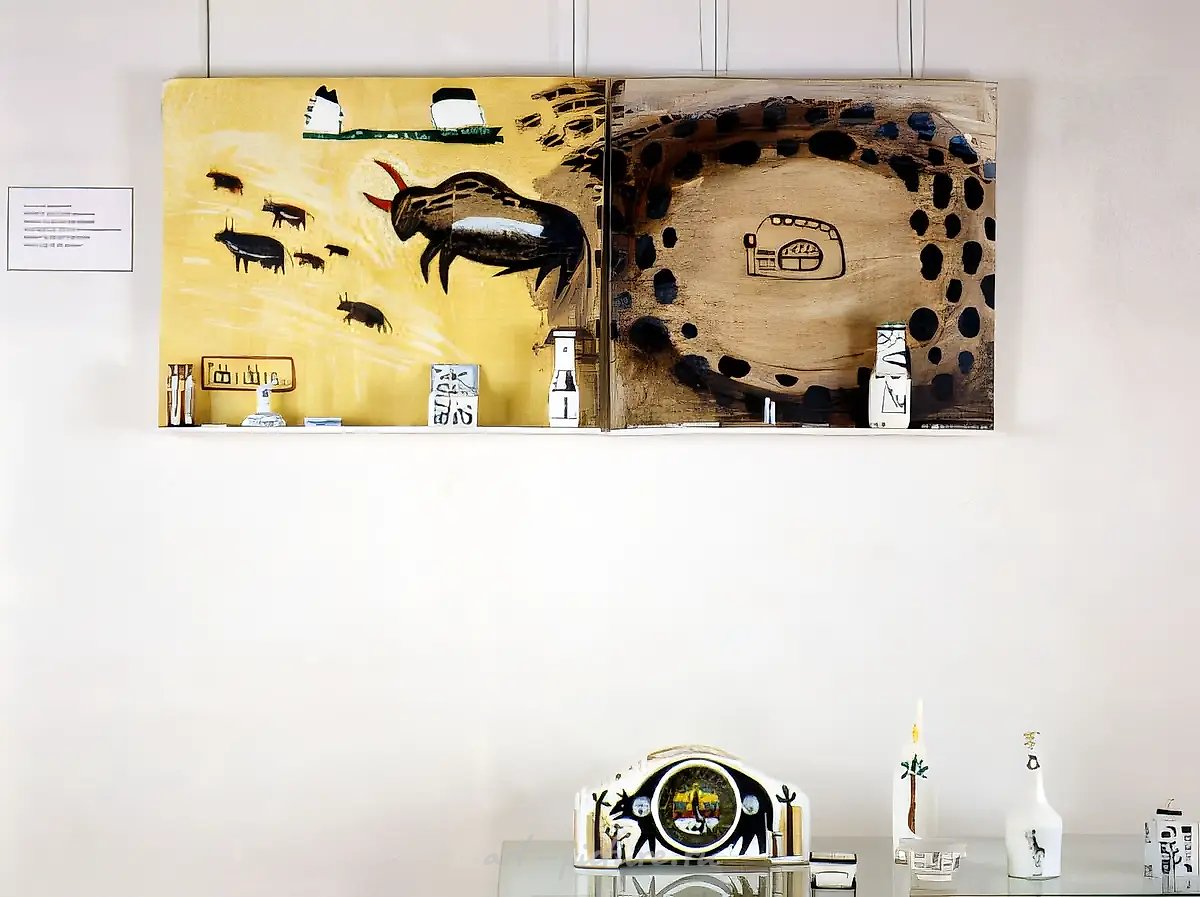
The artists themselves tend to consider theoretical inquiries less spectacular but the most important part of their activity. Just look at the catalogs of their exhibitions: there are few illustrations, so usual and appropriate in an art catalog; instead, most of the content is text. The first among them, "People of Ho," published in Russian and English together with Ronald Feldman Gallery in New York, may be called a short encyclopedia of the People of Ho: there are chronologies and genealogical tables of ruling dynasties, excerpts from myths and chronicles, data about flora, fauna, measurements, chronology, and the Ho calendar. "Nowhere before did we encounter such close, meticulous attention to every smallest detail of our work as in New York," recall the artists, "there, for the first time, we received serious feedback on the entire complex of our work on 'creating' a hypothetical world as a whole system, with its internal logic. We were glad for this exam, for we were not only ready for it, but had been waiting for something like that. Something similar happened in Germany. We did not have to explain that there is a system—not just 'houses and people.' It was understood from the start. That is why we were invited there as authors of a 'new utopia,' with full freedom of material. On the other hand, the world we created is not a utopia, for a utopia is always 'better' and always 'for people.' But the world we created is not 'better' or 'worse' and not exactly 'for people.' At best, for 'other people.' But discussions on this with German journalists seemed much more productive to us than attempts to explain to their Moscow colleagues that the people of Ho are not Indians, and, for instance, the Ippé-Gelippé civilization is not our attempt to invent something new after the public got tired of the people of Ho, but simply another of more than two hundred nations of the world of Homana, created long ago and patiently waiting for their time to be shown to an audience, which happens very slowly and gradually due to certain technological aspects: everything must be handmade and out of plasticine... And Germans are pedants. Almost the same pedants as ourselves. Therefore, for us, this is an extraordinarily grateful audience."
Much has been written about the rich literary roots of Martynchik and Stepin's work, and indeed, their work has some, though rather remote, relation to science fiction literature. Remote, above all, because artists must not only describe their hypothetical world, but also create with their own hands all elements of this world, from the soil to the flower on the tallest tree.
Another equally obvious difference is that texts accompanying the artists' works are only tangentially related to fiction. Reading them is complex and, possibly, dull—unless you are a lover of this kind of literature. The long list of 36 months from the "People of Ho" catalog or the obsessive chant accompanying the story of the creation of the world's first writing does not at all resemble Tolkien's hobbits' adventures, to whom the artists are often compared. If literary analogies are to be recalled, Borges may be closer—but not his stories, rather the books at their center. The first volume of the "Encyclopedia of Tlön" is closest. "We are glad that we manage, at least occasionally, to bring about boredom," say the authors. There is a stereotype: "boring means serious." And what could be more serious than the creation of a world? We are ready to proclaim the seriousness of our intentions within any sign system we can use." Whether they are joking or sincere remains an enigma.
S. Bulygina, G. Korneev
Works 11