Ovchinnikova Maria (Dyuzenko Elena Nikolaevna)
1959 Born in Moscow
1980 Graduated from the Moscow Art School in Memory of 1905
1988 Graduated from the Moscow Polygraphic Institute
Works in collections
Rheinbank, Germany
P.Sprovieri, Rome, Italy
O.Morane, Paris, France
Exhibitions and auctions
GROUP EXHIBITIONS
1983 - XIV Youth Exhibition, Moscow
1984 - XV Youth Exhibition, Manezh, Moscow
1985 - XVI Youth Exhibition, House of Artists on Kuznetsky Most, Moscow
1986 - XVII Youth Exhibition, House of Artists on Kuznetsky Most, Moscow
1989 - "Interart", Poznan, Poland
1990 - "ART MYTH 1", Central House of Artists, Moscow
1991 - "Novecento", L Gallery, Central House of Artists, Moscow
1991 - "ART MYTH 2", Manezh, Moscow
1992 - "a Mosca... a Mosca...", Villa Campoleto, Ercolano; Galleria Comunale d'Arte Moderna, Bologna, Italy
1992-93 - "Humanitarian Aid, Parcels for Germany. 27 Moscow Artists", Central House of Artists, Moscow; "Humanitare Hilfe, Päckchen für Deutschland", Tränenpalast, Berlin, Germany
1993 - "Collection d'Art Contemporain RINACO. Moscou 1993", Caisse des Depots et Consignations - 56 rue Jacob, Paris, France
1993 - "Monuments: Transformation for the Future", ISI, Central House of Artists, Moscow; ICA, New York, USA
1993 - "Shop", Konstantin Store, Olympic Complex, Moscow
1994 - "Visio Beatifica", L Gallery, Moscow
1994 - "Border Zones of Art", Contemporary Art Festival, Art Museum, Sochi
1995 - "Artists Against Sex", Manhattan-Express Nightclub, Moscow
1995 - "Apocalypse" (jointly with G. Ryazanov), Russian State University for the Humanities, Moscow
Author about himself
No information available
Critic
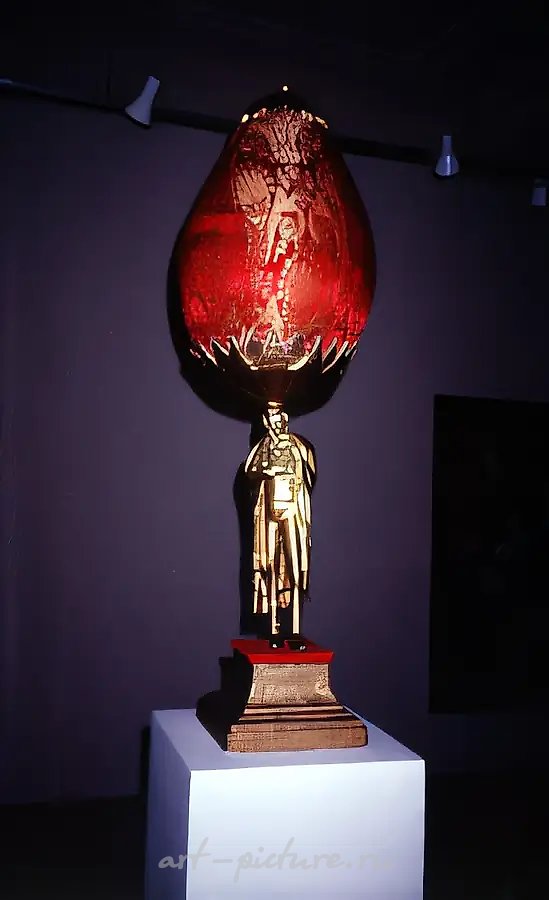
The Latin 'ab ovo' (literally 'from the egg', from the beginning) could become the motto of Masha Ovchinnikova's creative work, in which the egg serves as the fundamental, form-creating element. By means of this simple device, the artist is able to directly address the content—the contents of the egg—turning it inside out, and literally bringing to the surface the meanings hidden within it (as in an embryo). It is quite clear that the artist does not fear the risk of the 'eggshell theory', since for her the wholeness (integrity) of the egg as a symbolic form is beyond doubt. The manipulations performed do not have a destructive character—by simply breaking the shell scholastically, one does not solve the scholastic dilemma about the prerogative of the chicken over the egg or vice versa. It can be assumed that the author, appealing to the viewer's sensual experience and seeking to present the egg as a thing-for-us, preserves for herself its status as a thing-in-itself, a kind of Absolute.
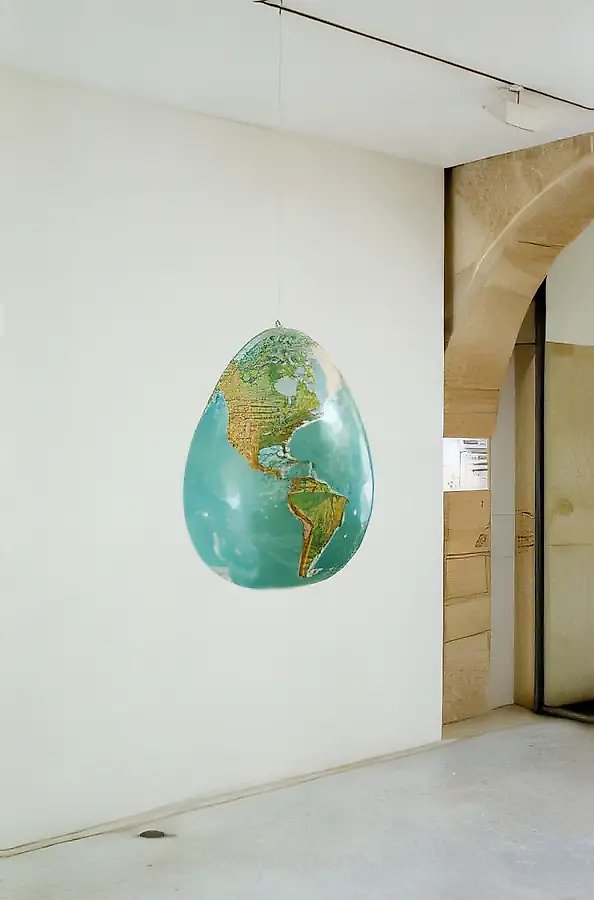
The global metamorphosis of the 'World Egg', which replaced the geometric sphericity of the exact science model with the irregular perfection of the egg-shaped archetype, should not, of course, be taken as a superficial ecological manifesto of planetary fragility; on the contrary, it can be regarded as a 'visual aid' to popular metaphysics based on unshakable faith in higher meaning and eternal life, justifying the artist's return from the post of intellectual incubator manager to the modest but honorable position of a hen laying Easter eggs.
M. Orlova. “Masha”. Catalog "Collection of Contemporary Art of Rinaco". Moscow, 1993
Works 11