
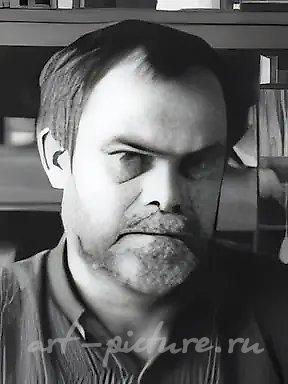
ORLOV Igor M.
Born in November, 10, 1935.
Works in collections
State Tretyakov Gallery, Moscow
Ministry of Culture of the Russian Federation, Moscow
Pushkin State Museum of Fine Arts, Moscow
Tyumen Art Gallery, Tyumen
Kaliningrad Art Gallery, Kaliningrad
Getty Art Center, Los Angeles, USA
Museum of Modern Art, Architecture and Photography, Berlin, Germany
Herentals Educational Center, Belgium
Exhibitions and auctions
SOLO EXHIBITIONS
1992 as part of the "Graphic Seasons" cycle. Tverskaya, 25 (Artists' Union Hall), Moscow
Gallery "Moscow Collection", Moscow
"Drawings." Gallery "STudio 20", Moscow
1994 as part of the III International Biennale of Easel Graphics, "Kaliningrad Koenigsberg 94". Kaliningrad
State Art Gallery, Novosibirsk
GROUP EXHIBITIONS
1972 "Drawing. Watercolor." Studio of I.I. Nivinsky, Moscow
1973 Exhibition of Young Artists. Studio of I.I. Nivinsky, Moscow
1974 Reporting Exhibition of the Art Studio of I.I. Nivinsky, Moscow
1975 X Youth Exhibition. House of Artists on Kuznetsky Most, Moscow
1977 Painting Exhibition. M. Gruzinskaya, 28, Moscow
1981 "VI All-Union Exhibition of Printmaking." Central House of Artists, Moscow
1989 Drawing Exhibition. House of Artists on Kuznetsky Most, Moscow
"Graphics of Moscow Artists: To the City and the World." Central House of Artists, Moscow
1990 All-Union Exhibition of the Artists' Union. Manege, Moscow
1991 "Printmaking Exhibition. Senezh." Central House of Artists, Moscow
"ART MYTH 2." Manege, Moscow
1992 "Letter to Bulgakov." Central House of Artists, Moscow
"Festival of Russian Art." Edinburgh, Scotland
"Kennen sie diese Namen?" Galerie Raissa, Erfurt, Germany
1992-93 "Humanitarian Aid, Parcels for Germany. 27 Moscow Artists." Central House of Artists, Moscow; "Humanitare Hilfe, Packchen fur Deutschland." Tranenpalast, Berlin, Germany
1993 "Moscow Artists. New Acquisitions." Pushkin State Museum of Fine Arts
"Avant-garde and Tradition. Books by Russian Artists of the 20th Century." Russian State Library, Moscow
"Livres d`artistes russes et sovietiques: 1910-1993", Espace Vezere, Uzerche, France
"ART MYTH 3." Manege, Moscow
"Graphics." Central House of Artists, Moscow
"Russian Art of the 60s-90s." Osnabrück, Germany
"Non-objective Tradition in Russian Art." National Museum of Painting and Sculpture, Ankara, Turkey
1994 "Abstract Graphics." Museum of Fine Arts, Orel
"Russian Contemporary Graphics." Central House of Artists, Moscow
"Entgegen der Schwerkraft." Erfurt, Germany
"Selectie Grafiek 1993." Frans Masereel Centrum Voor Grafiek, Belgium
"Seasons. Russian Graphic Art." Arts Center, Odense, Denmark
1995 "The Book Garden. Contemporary Russian Artists Books." Off-Centre Gallery, Bristol; The John Rylands University Library, Manchester; Glynn Vivian Art Gallery, Swansea; Aberystwyth Arts Centre; Stormont Rooms, Rye (96), United Kingdom
"Einblicke" (Werkstatt Moscow II). Galerie im Marstall, Akademie der Kunste am Hanseatenweg, Kunstlerhof Buch, Berlin, Germany
Author about himself
For me, artistic practice is something that arises from a sensual internal urge and the necessity to express that feeling.
It depends on the sensual state at the moment and can be defined within a framework of refined sophistication or wild brutality.
It is a part of my existence, my experience, and my perception of the environment.
The awareness of the brevity and unreliability of a fleeting life, the contradictions and paradoxes of human thoughts and actions, strengthen my desire to perceive as fully and vividly as possible what I am a witness to, and the desire to express this becomes a natural need, like breathing, hearing, or seeing.
Currently, I work with paper pulp. At the moment, it seems to me the most suitable material and medium for expressing my sensations. In it, I realize, in my opinion, my experiences with a certain fullness. I try to record what is passing with the help of visual, tactile, and acoustic characteristics.
Critic
Valery Orlov's place in Moscow graphics was, for many years, not very prominent, but it was worthy. And deservedly so. In his light drawings, slightly touched by delicate watercolor, there swirled a transparently misty depth of space, enveloping barely outlined, more guessed-at than read, objects of ascetically sparse still lifes or interiors. Sharply defined, strict, constructively built, they nevertheless remained airy, almost weightless. The artist ensured that objects within them were only elements of a compositional whole, precisely placed landmarks of their transparent environment, but they did not assert themselves in it, did not flaunt their individual separateness.
But a few years ago, the artist showed me his first attempts in a new, nontraditional technique. He began casting dense, rough sheets from paper pulp, embedding into them scraps of other paper, fragments of photographs, or his own old drawings.
And although, compared to his later works in the same technique, these first ones turned out to be quite tentative, there immediately appeared a certain new quality in them. Each sheet was now an object, not just an abstract graphic surface. It addressed the viewer with its unevenly molded thickness, the whole substance of its material, the entire complexity of its multilayered structure. The artist mastered paper from within, and if his drawings previously glided like a hazy drizzle over the whiteness of its surface, now the sheet itself becomes the work of art. It is whole; it is not an arbitrary cut from an unstructured, mechanically cast uniform strip. It is complete in itself due to the very method of its creation. The fuzzy, thinned edges of the sheet are physically different from its dense center. The irregularities of its mass, uneven surface, detached fibers and films, even tears and holes invading the substance of the sheet—these are all not defects, but living traces of the artist’s creative work.
Orlov's sheets provoke tactile perception, appealing, it seems, not so much to the eye as to the finest sensitivity of the fingers. We look at them much as at any other, but perceive and evaluate them not so much for their visual qualities as for their tactile ones. Hence there is a much closer sense of contact with them than with "ordinary" graphics, an acute experience of the physical concreteness of the work, its paper substance.
This magic of handcrafted material, the alchemy of subtly calculated mutual penetrations, alloys, and layers, captivates and fascinates in itself. Orlov is truly a virtuoso of graphic craftsmanship, endowed with an absolute sense for the expressiveness of graphic materials and techniques. A master and connoisseur of technical nuances, he is artistic in all varieties of graphics to which he has happened to turn. Graphic technologies are his element. Yet such skills today seem not in vogue. The main interest is in "concept," in something that cannot be embodied purely plastically, nor needs to be. This seems to place Orlov, with his subtle and complex handiwork, outside the mainstream of the newest artistic trends. Meanwhile, spiritualizing inert material, enriching it with thought and feeling, is at the very core of the visual arts. If they do not strive to animate dead matter, degeneration threatens them. This is again apparent, when returning to Orlov’s sheets from some sort of careless, loaded installation. Here there is the quality of authenticity. There is meaning, not denoted by the object, but inseparably merged with it, embodied in its very material structure.
Paper itself is already a universal cultural symbol. It is the "bread of culture," its universal material carrier, the main means of its dissemination and preservation, the guarantor of continuity. A field for signs. For any signs—hieroglyphic, alphabetic, musical, for symbols and emblems. Fields for sketches from life, for the impression from an etching plate: the natural material of graphic art, scrupulously, by sight and by feel, chosen by the artist for his work...
Orlov senses all these historical and cultural undertones of his material from within—these are meanings organically underlying his experiments with paper. That is why an "empty" sheet—without any inclusions or marks—is for him not simply a textured study, not merely a technological experiment. The uneven edge, irregular grainy texture are visible qualities of handwork, handcrafted molding. In these is a connection with the history of papermaking, with magnificent old sheets from museum folders. The artist further emphasizes this irregularity of texture, its "living" character. A dense sheet with a rough, rhino-hide-like wavy surface, warped, with delaminations and a bent edge, demonstrates the resilience of the material, the indestructible eternity of ancient linen papers that have conveyed to us the drawings of great masters and the impressions of early engravings. Compared to modern, even fine machine-made papers, the handmade one seems to bear an invisible "mark of quality," a high sample of durable craftsmanship always mindful of its worth.
An elegant fragment of an ancient Chinese book with its delicate, light weave of multicolored hieroglyphs; type characters of diverse shapes and sizes pressed into the rough mass of paper—black, red, or simply white, highlighted in relief; gossamer-thin layers of weightless Japanese papers dimly showing through one another; clear, densely colored geometric figures, dynamically juxtaposed according to the laws of suprematist compositions; scraps of music sheets with their mobile, nervous rhythms. Behind these simplest of signs are powerful layers of spiritual values: centuries, peoples, types of art.
Valery Orlov has a remarkable ability to reveal these deep layers: not simply to indicate them, but to rediscover them, make them tangible for us. Tangible in the literal sense of the word.
Yu. Gerchuk
Works 9
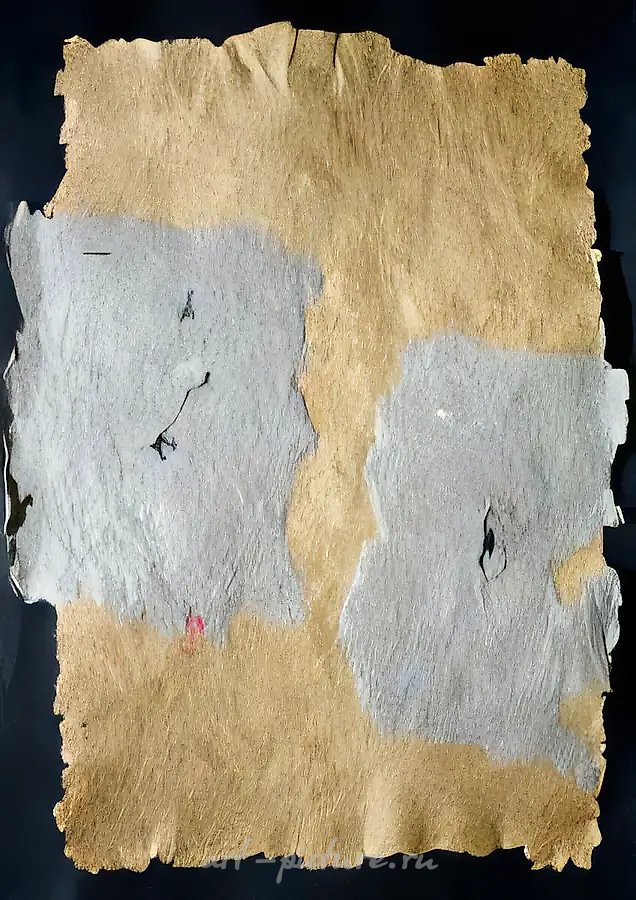
s casting, collage, 78x60 cm. Authors property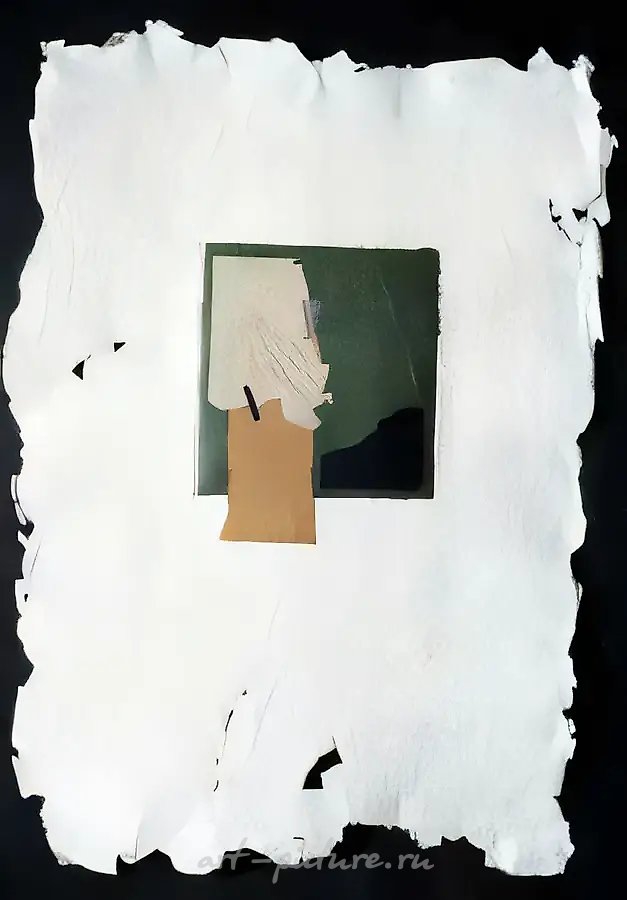
s book «Walks with I. Klyun», 1992, paper of authors casting, collage, print, 54x39 cm. Author`s property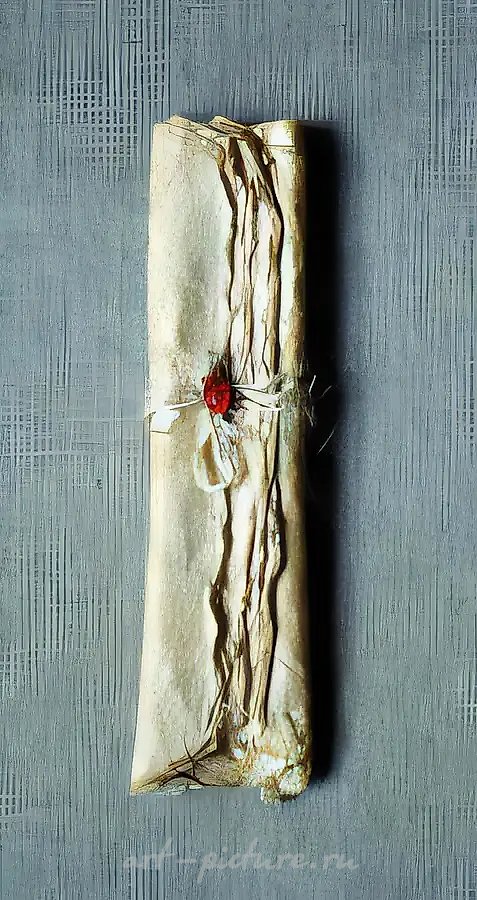
s casting, rope, sealing wax, 34x7 cm. Authors property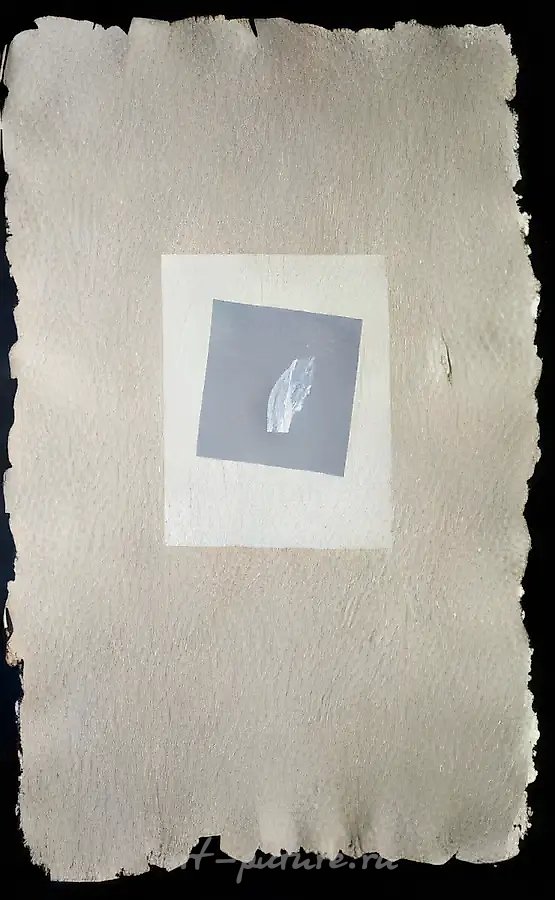
s Drawing Schools», 1993, paper of authors casting, collage, 89x58 cm. Author`s property
s book «I Wander Alone in the Wind», 1995, paper of authors casting, print, 34x24 cm. Author`s property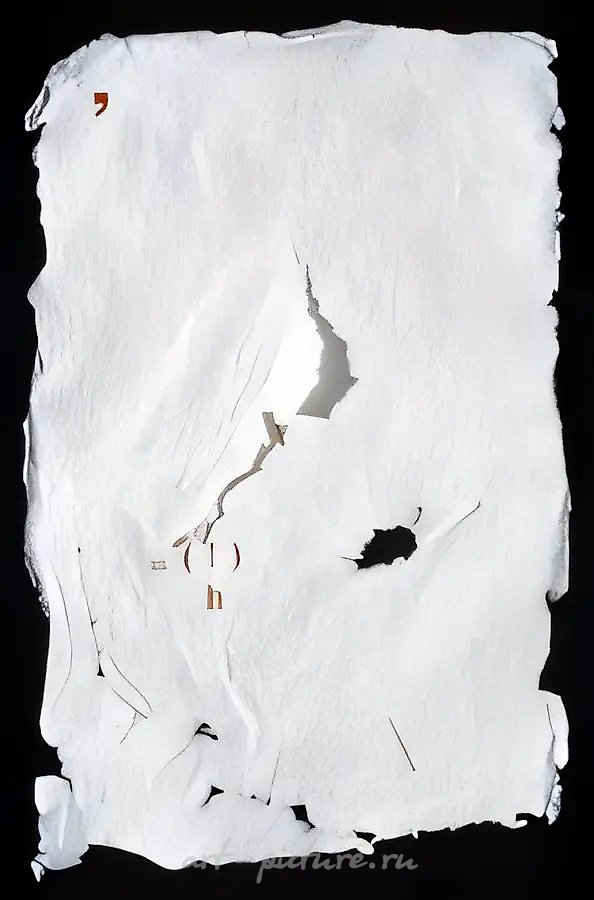
s book «I Wander Alone in the Wind», 1995, paper of authors casting, print, 34x24 cm. Author`s property
s book «Book of Abandoned Flowers», 1995, paper, authors casting, collage, print, 33x25 cm. Author`s property
s book «Book of Abandoned Flowers», 1995, paper of authors casting, collage, print, 33x25 cm. Author`s property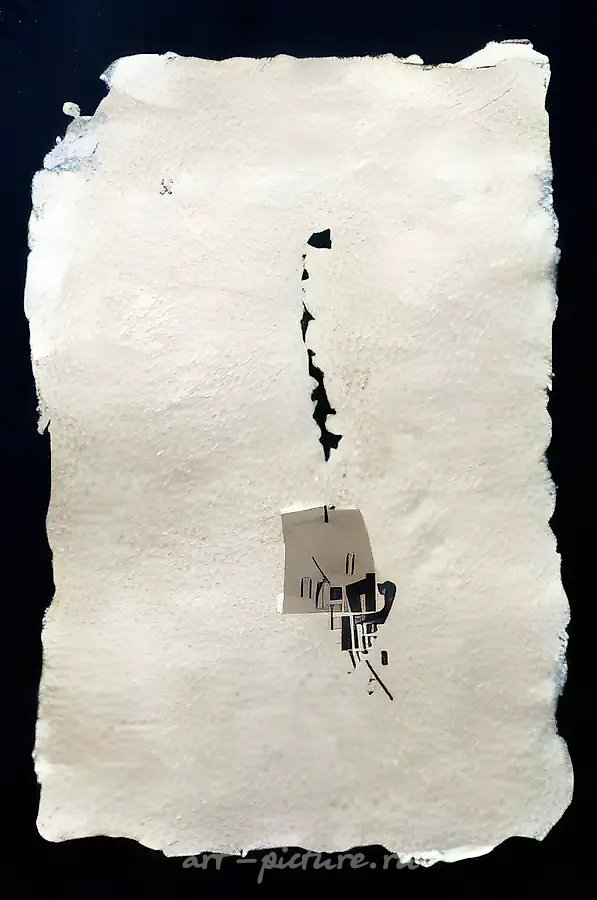
s book «Book of Abandoned Flowers», 1995, paper of authors casting, collage, print, 33x25 cm. Author`s property