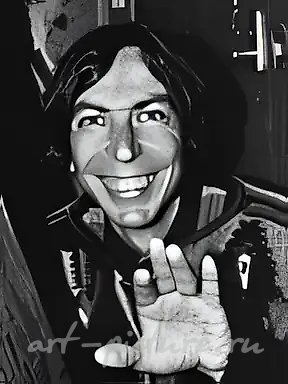
Leonid Alexandrovich Tishkov
Leonid Alexandrovich Tishkov (born May 4, 1953, Nizhnie Sergi, Sverdlovsk Oblast) is a Russian artist, a representative of contemporary art, working in various genres, and a writer.
Biography
He was born on May 4, 1953, in the city of Nizhnie Sergi, Sverdlovsk Oblast, into a family of teachers Alexander Ivanovich Tishkov and Raisa Alexandrovna Tyagunova. He is the younger brother of historian V. Tishkov. He graduated from the First Moscow Medical Institute named after I.M. Sechenov (1979). As a student, he began drawing cartoons, with his first publication appearing in periodical press in 1973. Since 1975, he has been a member of the Moscow City Committee of graphic artists, and participated in cartoonists' exhibitions from 1978. In the 1980s he illustrated books for the publishers "Iskusstvo" and "Kniga". Since 1982, he has worked as a freelance artist, close to the circle of Moscow conceptualism. He worked at the squat of the informal artists' union "Furmannyy Lane", later moving to studios on Chistye Prudy. In 1990, he organized the ephemeral publishing house "Dablus", where he published his own books and those of his friends and neighbors in small numbers. Notably, he published books by K. Zvezdochetov, Nikita Alekseev, Yulia Kisina, Rezo Gabriadze, Dmitry Krymov, poet Mikhail Sukhotin, Hamid Ismailov, and others. In the early 1990s, he drew comics, worked extensively in print graphics—etching and lithography—and published books and portfolios using these techniques in small runs. In 1992, the Getty Center acquired his publications and drawn books for its collection. In 2006, the "Still Lifes" portfolio of 16 color lithographs (1992), as well as other "Dablus" editions, were acquired by the Museum of Modern Art (New York) for their collection.
His first solo exhibition took place in 1991. He has held solo exhibitions at the State Center for Contemporary Art (GCSI), the Moscow Museum of Modern Art (MMOMA), Moscow galleries "Krokin" and others, as well as in museums of Yekaterinburg, Chelyabinsk, Novosibirsk, Krasnoyarsk, Yaroslavl, the USA, Germany, Sweden, and Venezuela. In 2003, he launched the "Private Moon" project, consisting of a mobile light installation in the shape of a crescent moon and photographic series, a project ongoing for more than twenty years. He is the author of many public art installations such as "Diver-Lighthouse" on Pushkin Embankment, "Mirror Moon" on Shelepikhinskaya Embankment, "Astronomer Fedor Bredikhin" in Zavolzhsk, "Cube of Cosmos", "Private Sun", and "Private Moon" in the Malevich Park.
He received the Innovation Prize for contemporary art as "Artist of the Year" (2017). He took part in the Singapore Biennale of Contemporary Art (2008), the Ichihara Triennale, Japan (2013, 2017, 2020), Setouchi Triennale, Japan (2019). He was included in the top 20 most influential artists in Russian art in 2017 by Artguide magazine.
In the mid-1980s, with his illustrations, the publishing house "Kniga" released books such as "War with the Newts" by Karel Čapek, "The Twelve Chairs" and "The Golden Calf" by Ilf and Petrov, "The Hunting of the Snark" by Lewis Carroll, "Works of Kozma Prutkov". He was among the first to illustrate the OBERIU poets—Daniil Kharms' "The Old Woman" and "Cases", Nikolai Oleynikov's "Volcano and Venus", "Christmas Tree at the Ivanovs'" by Al. Vvedensky (OGI publishing). He also illustrated his own books and those of his wife, writer Marina Moskvina.
His works include collections of early cartoons and picture stories, the three-volume "Divers", "Dabloids", and the book "How to Become a Brilliant Artist Without Having a Drop of Talent" (first published 2007, reissued in 2013 and 2017). He is the author of the children's book "Boy and Moon" (2013), reissued in Japanese in 2014. His novel "Look Upon Your House" was published in Znamya magazine (2019) and as a separate book in 2020 by NLO Publishing.
He has also performed as a curator, preparing exhibitions for Moscow's MuHA Gallery (2002), the "Avant-Garde and Tradition: Books by Russian Artists of the 20th Century" (Russian State Library, 1994), and "The True Story of the Life, Death, and Resurrection of Apothecary Kraft" (Tula Historical-Architectural Museum, 2014).
Tishkov has participated in numerous major group projects in the format of the livre d’artiste.
Works in collections
Pushkin State Museum of Fine Arts, Moscow
State Tretyakov Gallery, Moscow
Yekaterinburg Museum of Fine Arts, Yekaterinburg
Gallery "Moscow Palette", Moscow
Bank "Inkombank", Moscow
Duke University Museum of Art, Durham, USA
Mary and Leigh Block Gallery; Northwestern University Museum of Art, Illinois, USA
Artothek "Documenta", Kassel, Germany
Gallery "Lyric Cabinet", Munich, Germany
Levi-Dagan Gallery, Paris-Hamburg
Exhibitions and auctions
SOLO EXHIBITIONS
1992 "Not Only Dabloids". Alliance Gallery, Moscow
"Soft and Hard" (painting, graphics, lithographs, installations, music). Velta Gallery, Moscow
1993 "Creatures". Duke University Museum of Art, Durham, USA
1994 "Multiplication". Central House of Artists, Moscow
"Creaturas". Museo de Arte Contemporaneo Sofia Imber, Caracas, Venezuela
"Stomachs". L Gallery, Moscow
"Dabloid: la route du coeur". Galerie Epreuve d`Artiste, Lille, France
1995 "TVar". TV Gallery. CSI, Moscow
"Dabloids and Elephants". Mary and Leigh Block Gallery; Northwestern University Museum of Art, Illinois, USA
"Creatures". Museum of Fine Art, Yekaterinburg
1996 "Creatures". Novosibirsk Art Gallery, Novosibirsk; Center for Contemporary Art, Chelyabinsk
"Anatomy of Russia". Spider & Mouse Gallery, Moscow
1997 "Proto-Dabloids". TV Gallery, Moscow
GROUP EXHIBITIONS
1985 XVI Youth Exhibition. Artists' House on Kuznetsky Most, Moscow
1986 XVII Youth Exhibition. Artists' House on Kuznetsky Most, Moscow
1989 "IBA-89". Leipzig, Germany (Grand Prix for illustrations to the novel Y. Zamyatin's "We" - with Nikolai Kozlov)
"Soviet Avant-Garde 1920-1980s". Gallery "Moscow Palette". Palace of Arts, Minsk
1989 "Furmanny Zaulek". Dawne Zaklady Norblina, Warsaw, Poland
1990 "Six Soviet Painters Today". Mona Bismarck Foundation, Paris, France
"Artistes Russes Contemporains". City Gallery, Melbourne, Australia
"Concrete" (international exhibition of visual poetry). Municipal Museum, Gotha, Germany
"Transfutur". International exhibition of visual poetry. Kassel, Germany
"Graphomania". Drawings and texts in the program "Graphic Seasons". Tverskaya, 25, Moscow
"Three". Gallery "Moscow Palette". Central House of Artists, Moscow
1990-91 "The Pyramid Show". Gallery "Moscow Palette". Sydney, Adelaide, Australia
1991 "Artists of Furmannyy". Martigny, Switzerland
"Agasfer". Youth Palace, Moscow
"ART MYTH 2". Manege, Moscow
XI International Book Salon ("Dablus" editions). Paris, France
"With New, Comrades, Year!" Exhibition Hall of the Culture Fund, Moscow
1992 "Books by Russian Artists". Gallery "Lyric Cabinet", Munich, Germany
"Still Life of the End of the 20th...". Gallery "Moscow Palette". MARCHI, Moscow
"Poets and Artists" (author books). Museum of A. Akhmatova, St. Petersburg
"Message". Exlibris Museum, Moscow
"International Exhibition of Visual Poetry". Pankov Galerie, Berlin, Germany
"Dablus" in Scotland. Art College, Edinburgh, UK
1993 "ART MYTH 3". "Dablus" - ITI. Manege, Moscow
"Word and Image". Museum of A.S. Pushkin on the Moika, St. Petersburg
"Avant-Garde and Tradition". National Russian Library (formerly Lenin Library), Moscow
"Livres d'artistes russes et soviétiques. 1910-1993". Espace Vesere, Uzerche, France
"Still Life of the End of the 20th...". Gallery "Moscow Palette". Berlin, Germany
"New Territories of Art". State Art Museum, Krasnoyarsk
1994 "Drawings for Albertina". Gallery "Moscow Palette", Moscow
"Depository-2". Exhibition Hall on Solyanka, Moscow
"Seasons". Academy of Arts, Odense, Denmark
"Artists' Books". Art Museum, Yekaterinburg
"Paper Theatre-II". Museum of A. Akhmatova, St. Petersburg
SAGA 94. Alain Buyse Editeur, Paris, France
"Russian Avant-Garde Books". British Library, London, UK
"The Book Garden. Contemporary Russian Artists Books". The John Rylands University Library; Glynn Vivian Art Gallery, Manchester, UK
1995 SAGA 95 (FIAC). Alain Buyse Editeur, Paris, France
1996 "How to Draw a Horse (Part Two)". Central House of Artists, Moscow
"Nordgrafia 96". Gotland Konst Museum, Visby, Sweden
1997 "Portfolio from Portfolio Kunst". Albertina Museum, Vienna, Austria
"Dablus & DO press". UFSA University Library, Antwerp, Belgium
"Russian Silkscreens of Moscow Studio". Corcoran Art Gallery, Washington; Mimi Ferst Gallery, New York, USA
Dablus Publications:
Dabloids. Moscow. 1990
Gazelles. Moscow. 1990
Simple Actions D. Moscow. 1990
Life of the Little Man. Moscow. 1991
Fisherman's Dream. Moscow. 1991
Dabloids (in collaboration with IMA-Press). Moscow. 1991
New Songs. Moscow. 1992
Stomachs (in collaboration with IMA-Press). Moscow. 1993
Stomach in Grief. Moscow. 1994
Father-Mother. Moscow. 1994
Le foie en fleurs. Buyse Editeur. Lille. France. 1994
Churki (with IMA-Press). Moscow. 1995
Play "Dabloids" staged:
1993 Hip Pocket Theatre, Durham, USA
1995 Mussetter-Struble Theater, Evanston, USA
Author about himself
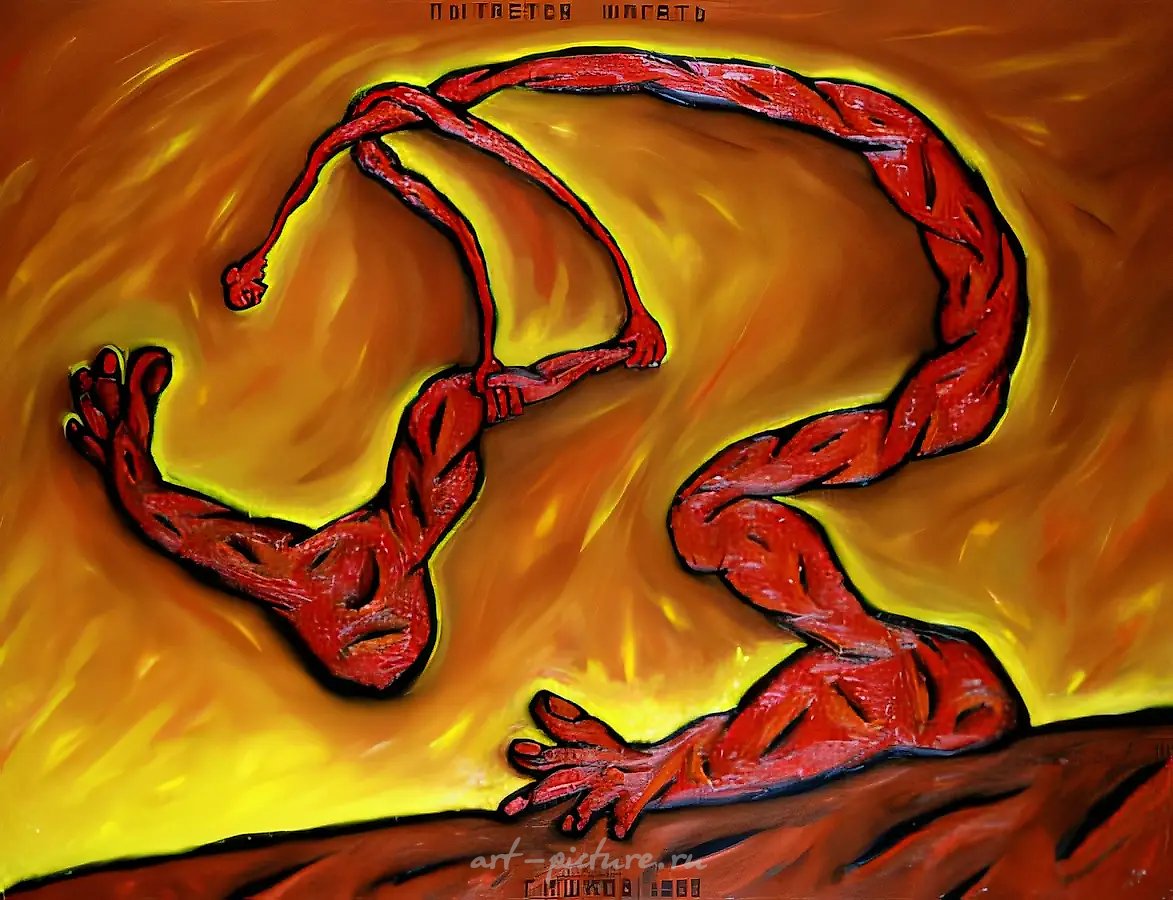
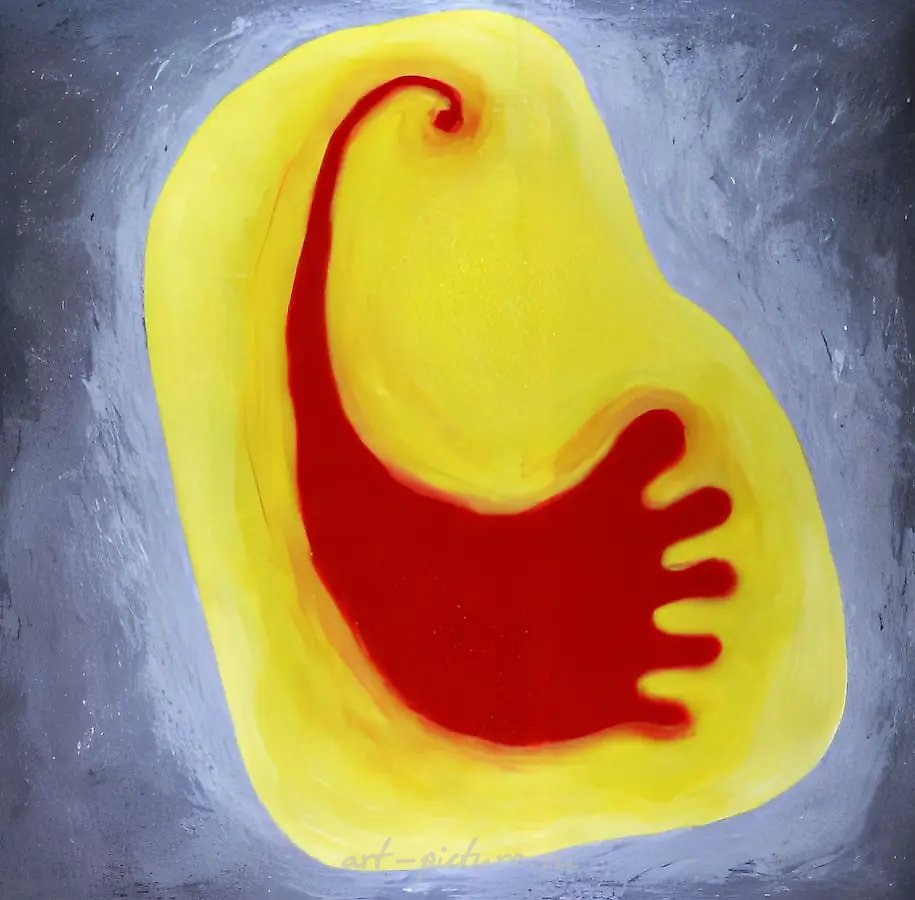
I was born in the Middle Urals. The two mountains, Kukan and Hospital, are the two lobes of the liver, home to the Great Soul of the Stomak, and the gallbladder is a lake in which my sky is reflected. Thus, one of my characters appeared – the Stomak, an autonomous, living and moving gastrointestinal tract, winding like the life path of a Russian person, tender as the mucous membrane of the small intestine, beautiful as a Christmas tree, mighty as the Ural mountain range. And on this U R A L, on this mythical fragrant Christmas tree, the arbor mundi, fabulous ornaments hang, reflecting the enthusiastic eyes of children. Above all is the Dabloid. It looks like a self-moving leg with a small head on top. It symbolizes the union of the high and low: head in the heavens, far away, therefore small; leg below – stable and large. The sign of Dao: yin and yang are two dabloids connected together. The Dao hieroglyph (way) consists of two hieroglyphs: leg and head. So, Dabloid is our path, its red color is life, its silence is our wisdom.
Where did these Dabloids come from? They were born from the round (rotundum) higher god – Dablus, the one and great. And this happened in the Urals, a land giving rise to myths, where I was lucky enough to be born. There are endless documentary evidences of Dablus' presence in the Middle Urals. This region is generally the richest in phenomena in Russia.
Observers usually confuse Dablus with UFOs. Oval shape, milky light emitted from a red-orange body, a feeling of fear among observers, the "birth" method of visitors: splitting in half and disappearing... All this indicates that the notorious Unidentified Objects are in fact a very definite and specific subject: the Great and Mighty Dablus. The shining androgynous – Father-Mother – this is what I called my book (published by Dablus in 1993), water and fire, the mandala, a phenomenon of epiphany.
I found Dablus depicted on old Russian icons of the Nativity. Usually, the Mother of God is reclining or sitting on an oval red object, sometimes called mutaka, a sitting cushion. Since in Byzantine or Orthodox icons everything is meaningful and icon painting is genuine conceptual art, this object clearly represents Dablus – female breasts joined together in red, the color of "life," symbolizing "eternal femininity," fertility, and in the icon – the Birth of Christ. Mary sitting on Dablus signifies Christianity trampling on paganism, and at the same time being born from it.
Like any strong psychical unconscious phenomenon arising from the depths of a people's consciousness, Dablus appeared in Russia during the transition from one political system to another, when society is in confusion, unrest, and perplexity. And so he appears to organize the psychic chaos, giving birth to Dabloids as instruments—the so-called "yantras" of Mahayana Buddhism, which normalize psychic order, replacing political and social myths with the Dabloid.
It should be noted that this is especially important for the Russian nation, whose inclination to chaos and psychopathic disposition are well known throughout the world. Turning from an abstract image into a soft warm "beloved" toy, the Dabloid becomes tame, and fear and aggression disappear like smoke. Imagine the picture: if a multitude of parties, social organizations, small groups replaced their symbols on flags and in consciousness with a single red sign—a dabloid on a yellow background? This Dabloid, this "idea of all things," sublimates both mass psychosis and the vague fears of a teenager, whether in the Urals or Texas.
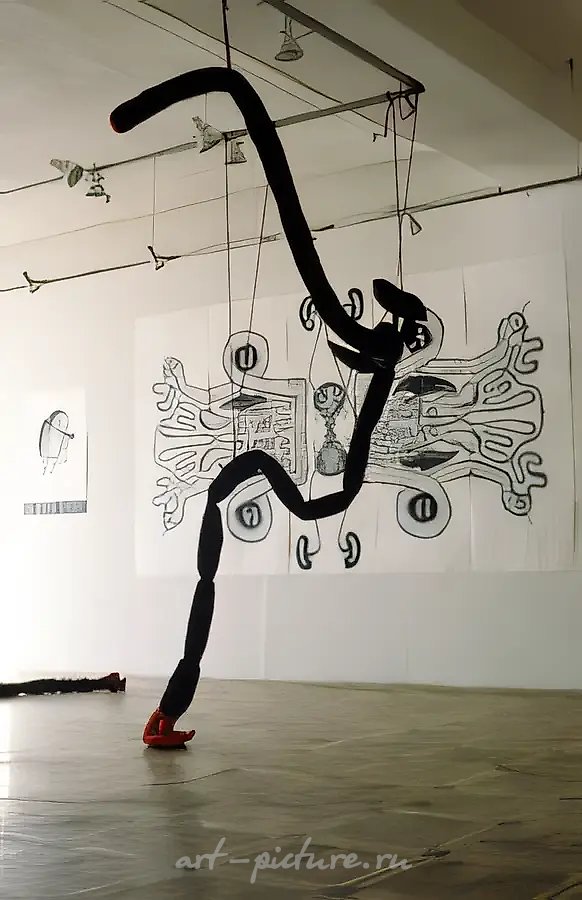
For the first time, I saw Divers on the lake shore when I was six years old; they emerged from the water holding their wet hearts, and their hoses plunged into the depths of the Ural subconscious. The divers were searching for drowned countrymen, who had perished drunk or asleep during swimming at weddings or farewells. Now divers stand inside the "Divers Library," illuminating open books with the light of their heads.
The black velvet of their skin, their suits, resembles plush teddy bears, the favorite toy of Russian children. The long hose is an endless umbilical cord, never cut, accompanying us all our lives, connecting us to the earth and eternity. And when the time comes to return, a gentle but strong hand will pull the rope. Look at this rug, a Ural folk craft: every family has these, laid at the threshold. It seems to me it is the placenta, the "afterbirth," from where the umbilical cord's roots come. My mother knitted this rug from our family's old clothes. Here is my father's shirt, my mother's dress, and my childhood clothes. All are cut into thin strips and woven into a single structure; many who wore these clothes have died, but their warmth is preserved in this rug, drawing strength or blood from the Ural earth and passing it through the invisible umbilical cord to you throughout your life. Another archetype present in every Ural home is the "runner" carpet, also woven from old clothes, which can be as long as a person's life, and just like a human life – now light, now dark, now joyful, now sad.
My fellow countrymen, the Uralians, built their mythological Cosmos in the image and likeness of the universe.
Critic
The work of Moscow artist Leonid Tishkov resists categorization by its very nature. Presenting him to the public, one cannot assign him to any particular art school or style. It's better to enumerate his works. Although Tishkov was trained as a physician, he is now a successful painter, publisher, illustrator, graphic artist, caricaturist, poet, playwright, sculptor, composer, and exhibition organizer.
To grasp the essence of his work amid this dazzling diversity, one should focus on the recurring groups of images he uses. One of his main features is transferring such images from one genre to another. Painted plots are later developed in books and conversations, watercolor images turn into three-dimensional sculptures. As a result, his work is full of internal cross-references, as all his ideas are deeply interconnected. To understand his painting, you must read his play "Dabloids" (1991), which helps clarify his broader context within Russian culture. Only in this way can a critic discern the main principle that unites all of Tishkov's work into a coherent artistic and philosophical system, and determine how this complex and eccentric-seeming system fits into the course of Russian culture.
Central to Tishkov's creativity is the image of Dablus—an archetype and symbol of fertility, thus connected to the myth of nativity. Its oval form reflects the androgynous nature of this being, uniting female and male principles—breast and phallus. Unified despite its duality, Dablus can be seen as a modern version of the search for the lost ideal of androgynous wholeness, in which the opposites have not yet separated.
Moreover, Dablus relates both to the sacred and the profane. In the first sense, Dablus corresponds to the cushion on which the Mother of God appears in Russian Nativity icons; in the second, it evokes bread and sausage, essential elements in the modern diet of Russian people, that is, the material, worldly human existence. The children of Dablus—red and foot-shaped—are called Dabloids. The name was formed using the morphological pattern Leon-Leonid, as is the artist's own name (see "Not Only Dabloids: Selected Dialogues Illustrated by the Author").
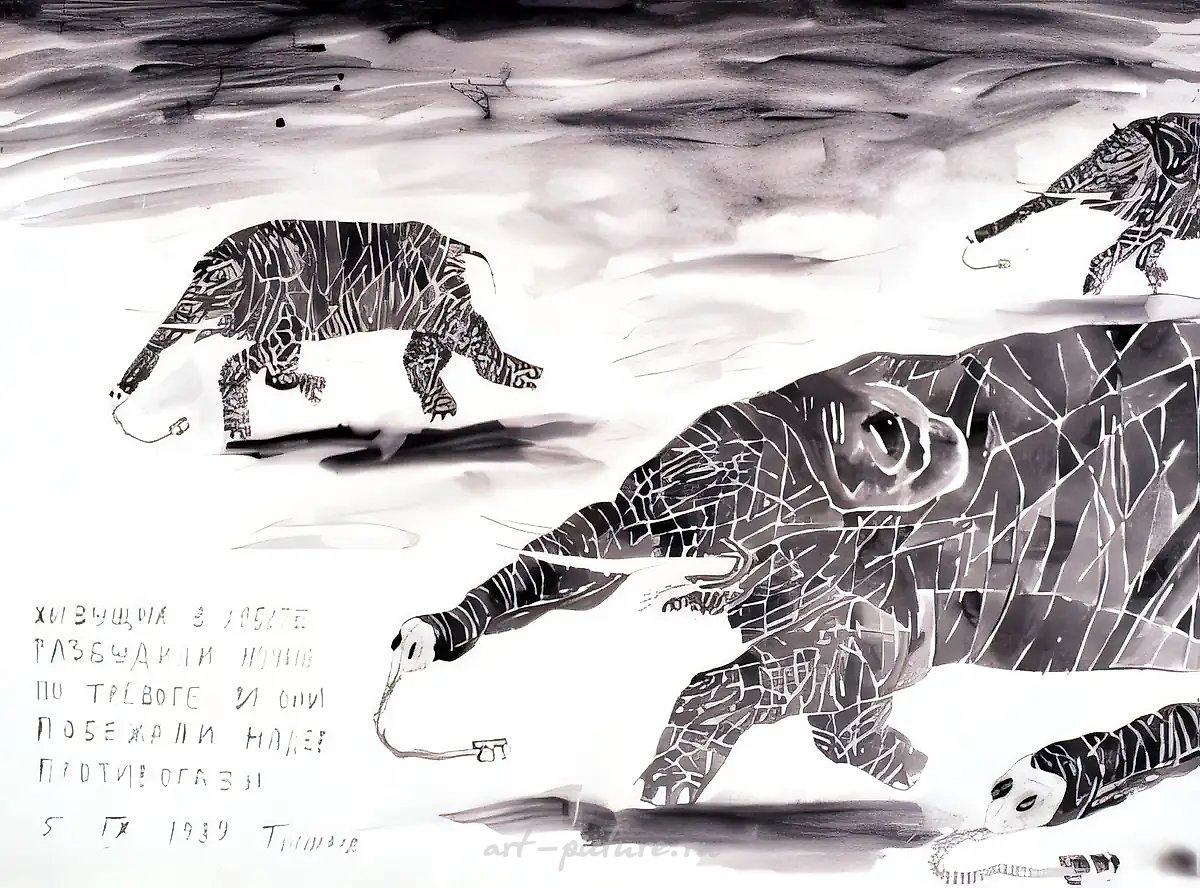
Besides the Dabloids, Tishkov's artistic world is populated by other creatures—Elephants, Divers, Churki, and Stomaks. Dabloids usually—but not always—embody human complexes, delusions, illusions, ignorance, stupidity, fear. Churki are close to them: they are arrogant and aggressive, offending lonely, shy, defenseless, naked Stomaks. Divers are hidden by their masks and entirely depend on hoses, which can be cut at any moment. Living in the elephant's trunk, these characters are inextricably bound to the space they inhabit and represent—the narrow and cramped space of our unconscious.
The book "Dabloids", published by Dablus in 1991 in 500 copies, gives us further information about these foot-shaped creatures. Its lithographed pages, handwritten in format, are almost empty on the left and overloaded on the right. On the left, there is an isolated image with a caption: on the first page, the "beautiful androgynous" Dablus, and on the next 13—parody versions of Soviet-type Dabloids. In Tishkov's writings and paintings, separate parts of human anatomy—foot, stomach, liver, heart, breast, phallus—become symbols.
Recently, Tishkov complemented his bookmaking with an interest in sculpture. His latest exhibitions include not only two-dimensional but also three-dimensional images of Dablus and Dabloids. At the center of his exhibits are foot-shaped sculptures of Dabloids, both symbolically and literally connected by a tangle of tubes to a large, busty Dablus. Dabloid figures of all kinds, colors, and sizes are labeled: "Touch me, I’m warm," "Children and women love me," "I love you," etc. A watercolor included in the installation explains how to make your own Dabloid out of, say, an old sock.
At the end of the show, a ritual ceremony is performed: the tubes connecting Dabloids to Dablus are cut, and they are left hanging, marking the rupture of the original unity.
To complement the sculpture, Tishkov accompanies his recent exhibitions with music composed by himself and performed on the organ, adding primitive sound improvisations—whispers, sighs, all sorts of other phonetic combinations producing an almost hypnotic effect, reminiscent of the fantastic linguistics of Kruchenykh—his "zaum", a spontaneous, uncodified language. This is also comparable to the ecstasy of religious sectarians when they begin "speaking in tongues."
Ultimately, Tishkov is as related to Russian culture as his Dabloids are to Dablus. Whether poetry, paintings, drawings, sculpture, music, book illustration, or caricature—all are born of this culture. However, while closely connected to Russian tradition, they also subtly parody it. Being a synthesis of affirmation and skeptical undermining of its symbols, they are open to dual interpretation. His illustrations can appear both silly and wise, his writings vulgar and lyrical, his worldview childish yet serious, his paintings ugly yet refined. But if they appear "unbeautiful," it is more because Tishkov is indifferent to traditional notions of beauty and style. In this sense, he is deeply rooted in Russian tradition, which, unlike the West, as James Billington noted, "was always more absorbed with the ideal behind a picture than with its artistry." Likewise, what matters most to Tishkov is not how the content is expressed, but what his work says.
L. Grubisic. "Tradition and Innovation in the Art of Leonid Tishkov." (abridged) From the book "L.Tishkov. Creatures", 1993
Works 12