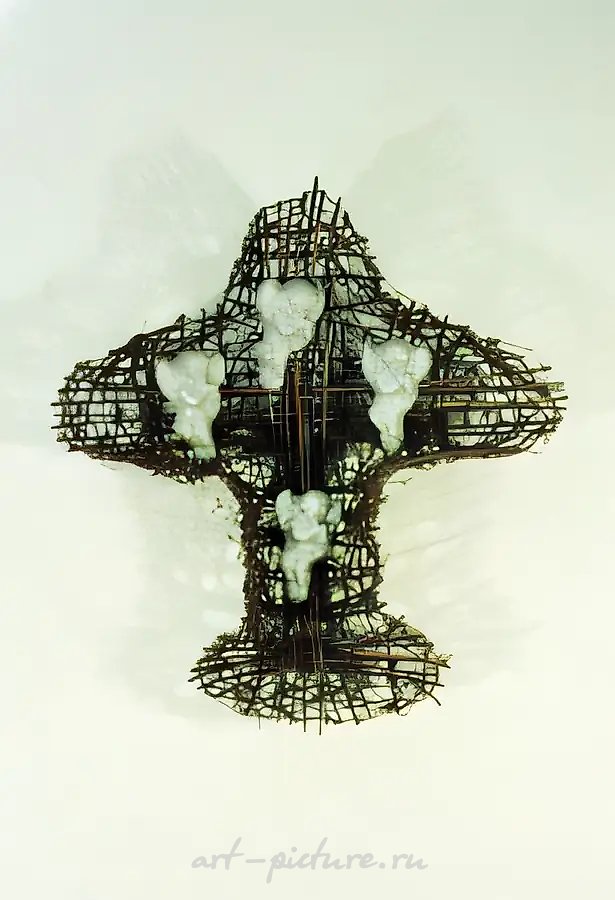

Vadim Vilenovich Fishkin
1965 Born in Penza.
1986 Graduated from MARHI (Faculty of Industrial Architecture).
1988-91 Member of the "World Champions" group
Since 1992 Cooperates with the "NSK" group (Neue Slovenische Kunst)
Since 1994 Member of the "Proektika" group
Works in collections
State Russian Museum, St. Petersburg
Incombank, Moscow
Migros Company, Zurich, Switzerland
J.-P. Brossard, Zurich, Switzerland
Exhibitions and auctions
SOLO EXHIBITIONS
1991 "La Russie est une Afrique blanche." Polaris Gallery, Paris, France
"Lighter than Air." Gallery on Trekhprudny Lane, Moscow
Boycott Gallery, Brussels, Belgium
1992 "Between Dog and Cow." Festival of Animalistic Projects. Regina Gallery, Moscow
School Gallery, Moscow
1993 "Orange Orbit." Gallery on Trekhprudny Lane, Moscow
"Twilight Orbit." School Gallery (in the premises of Gallery 1.0, Dar, Marat Gelman Gallery), Moscow
1994 "Orbit S." XL Gallery, Moscow
"Exchanged Heads" (with N. Kastens). Center for Contemporary Art, Moscow
"Proektika" (with A. Sumatokhin). Center for Contemporary Art, Moscow
1995 Dante Gallery. Umag, Croatia
GROUP EXHIBITIONS
1986 "The Artist and Children's Drawings." House of Artists on Kuznetsky Most, Moscow
1987 "Zaidel. Fishkin." Central House of Architects, Moscow
1988 "Geometry in Art." "Kashirka," Moscow
"Labyrinth." Palace of Youth, Moscow
XVIII Youth Exhibition. Manezh, Moscow
"Nature and Man." Exhibition Hall "House 100," Moscow
"Eidos." Palace of Youth, Moscow
1989 "Expensive Art." Palace of Youth, Moscow
"...up to 33." Palace of Youth, Moscow
"Exhibition of Unfinished Works." K. Zvezdochetov's Studio, Furmanniy Lane, Moscow
"Exhibition of Small Works." S. Shutov's Studio, Moscow
"Rauschenberg to us, we to Rauschenberg." First Gallery, Moscow
"Dialogue. Avant-Garde Russe et Art Contemporain Sovietique." Centre Boris Vian. Ville des Ulis, Paris, France
"Affordable Art." First Gallery, Moscow
"World Champions." Exhibition Hall of the Plekhanov Institute, Moscow
"Furmanny Zaulek." Dawne Zaklady Norblina, Warsaw, Poland
"Les Champions du Monde." Galerie Bernard Felli, Paris, France
"Artistes Russes Contemporains." City Gallery, Melbourne, Australia
"L'Art est libre. Livre comme l'art." C.Corre Gallery, Paris, France
"Outside Genre." Palace of Youth, Moscow
1990 "There - Here." Peresvetov Lane, Moscow
"Furmanyj in Factory: Soviet Avant-Garde Art." Kulturfabrik Salzmann, Kassel, Germany
"Jonge Kunst uit Oost-Europa." Rotterdam, Netherlands
"The Green Show." Exit Art, New York, USA
"F.I.A.C. 90" (Polaris Gallery booth), Paris, France
1991 "Moscow-Ticino." "PrimExpo," Lugano, Switzerland
"Mother-Cosmos." Propeller Gallery, Profsoyuznaya 100, Moscow
"Novecento." L Gallery, Central House of Artists, Moscow
"Moscow-Leningrad-Tbilisi." Nouveau Theatre d'Angers, Angers, France
1991-92 "Happy New Year, Comrades!" Culture Fund Exhibition Hall, Moscow
1992 "Art Firsthand, or Apology of Shyness." Regina Gallery, Moscow
"Still Life." Velta Gallery, Moscow
3rd International Istanbul Biennale, Istanbul, Turkey
1993 "Art as Power, Power as Art." Central House of Artists, Moscow
"Settlement" (project with I. Kaminik and A. Shchelokov). Marat Gelman Gallery, Moscow
"Monuments: Transformation for the Future." ICA, New York; ISI, Moscow; Central House of Artists, Moscow
"Exchange," Moscow
"ANIGRAF 93" ("Virtual Garden"). Institute of Art Technology, VDNH, Moscow
"European." Stadtmuseum, Kunstverein, Graz, Austria
1994 "Hamburg Project." Center for Contemporary Art, Moscow
"Contemporary Photography: Russia, Ukraine, Belarus." Central House of Artists, Moscow
"Transition." Medium Gallery, Bratislava, Slovakia; Budapest Gallery, Budapest, Hungary
"Europe-94." Munich, Germany
"Exchange II/Dacha." Almere, Flevoland, Netherlands
1994-95 "Neue Fotokunst aus Russland." Badischer Kunstverein, Karlsruhe; Galerie im Karmelitenkloster, Frankfurt am Main; Kunsthalle Faust, Hanover; Museum Volk und Wirtschaft, Düsseldorf; Neuer Berliner Kunstverein, Berlin; Hertener Fototage, Herten, Germany
1995 "ARS 95." Museum of Contemporary Art, Helsinki, Finland
Venice Biennale. Russian Pavilion, Venice, Italy
"Konjugation" (as part of the "Kraftmessen" project). Kunsthalle, Munich, Germany
"Einblicke" (Werkstatt Moscow II). Gallery in Marstall, Academy of Arts at Hanseatenweg, Kunstlerhof Buch, Berlin, Germany
"Interregnum." Kunsthalle Nurnberg, Nuremberg, Germany
SCENOGRAPHY
1992 Set design for the ballet "Nuyrdung." NSK, Ljubljana, Slovenia
1994 "1:10,000,000." Noordung Theater, NSK, Ljubljana, Slovenia
"1:1" ("Love and State"). 1995-2045. Noordung Theater, NSK, Ljubljana, Slovenia
Author about himself
An orbit implies the presence of a center. Outlining orbits is about setting milestones on the path to the center, but it is also a risk of getting stuck on certain trajectories. "Remember what's important!" – the naivety and fanaticism of this call pull us off yet another orbit in our attempt to approach the center.
Passion and faith have driven scientific theories seeking to discover new worlds. The wooden instruments of these theories combine warmth and madness. For me, the desire for fantastic leaps is more attractive than a gradual movement through the territory of pragmatic research.
Creating autonomous structures—how I envision my projects—is an attempt to model a global mechanism. And the urge to do this immediately leads to building models from the parts one can find here and now.
Critic
A characteristic feature of Vadim Fishkin's poetics is its indifference to linguistic issues. Language has never been an end in itself for him, but rather a tool, whose main requirements are informational capacity, communicative efficiency, and simplicity of use. In other words, Fishkin's poetics has never absolutized the phenomenon of art; on the contrary, it is primarily interested in everything outside its boundaries. Fishkin's subject of investigation is the phenomenon of being, to which he seeks to restore an ontological status through artistic creation.
The reconstruction of ontology in Fishkin's work occurs through recourse to creative acts—elementary, pure, archetypal ones. Creativity becomes possible only through a total reduction of the phenomenon of tradition, reflexive allusions, i.e., through reconstructing the act of creation itself. In other words, the new ontology of Vadim Fishkin reveals itself as a new simplicity, his art – a new craft, and he himself with his machinery – a new Kulibin (a legendary Russian inventor). Like any result of an original action, his works are self-contained, focused inward, comprehensible only from their inner essence. Thus, another characteristic of Fishkin's poetics is its complete indifference to the problem of context.
The reconstruction of ontology in Fishkin's work also occurs through an appeal to constructive processes; each of his works is a model—a model of the universe, his machines are prototypes of the machina mundi. The appeal to constructiveness and machinery in his work is positive: the mechanisms' operations reveal the process of universe formation, not disintegration. Fishkin's poetics is far from cultivating tautology, graphomania, or schizoid tendencies. In other words, another feature of his poetics is overcoming the strategy of deconstruction and actualizing a strategy of reconstruction.
The combination of primacy and constructiveness betrays Fishkin's ambition for absoluteness and universality. The imagery of his works, combining fragments of traditional cultures with normative archetypes, aspires to post-historical classicism. Finally, combining totality with positivity lends this poetics a utopian perspective. This machinery lays claim to a genetic link with Tatlin’s Tower of the III International.
Two features of Fishkin’s constructive poetics distinguish it from that of historical constructivism. The first is the technique of exposing the aesthetic convention: the utopian universe appears banalized, likened to a bead kaleidoscope. The goal here is not to reduce the pathos but to delineate the boundaries of the utterance. In other words, it is about confining utopia to the aesthetic sphere. The second feature is the disruption of one element of the poetic organism's integrity: in the utopian universe, a breach forms, through which other worlds, other utopias, gape. This time, the aim is not to reduce the pathos but to openly acknowledge the limits of the statement. In other words, without lapsing into dystopia, Vadim Fishkin recognizes the legitimacy of other utopian dimensions.
Insofar as Fishkin’s poetics appeals, on one hand, to acts of primordial creation and, on the other, to a post-historical state, its area of realization is the 'eternal present.' At the same time, insofar as his poetics appeals to constructive acts, it does not accept the mythologem of the 'eternal return of the similar,' but implies a positive mastering of this permanently actual present. Finally, insofar as his poetics is characterized by a utopian outlook, this "eternal present" inherently contains the prospect of a future, and a distant one at that. Naturally, "this future must be beautiful, otherwise it may not exist at all."
V. Miziano. "Soft Machines of Vadim Fishkin." From the catalog of V. Fishkin’s exhibition "Orbit S", XL Gallery, Moscow, February 1994.
Works 9