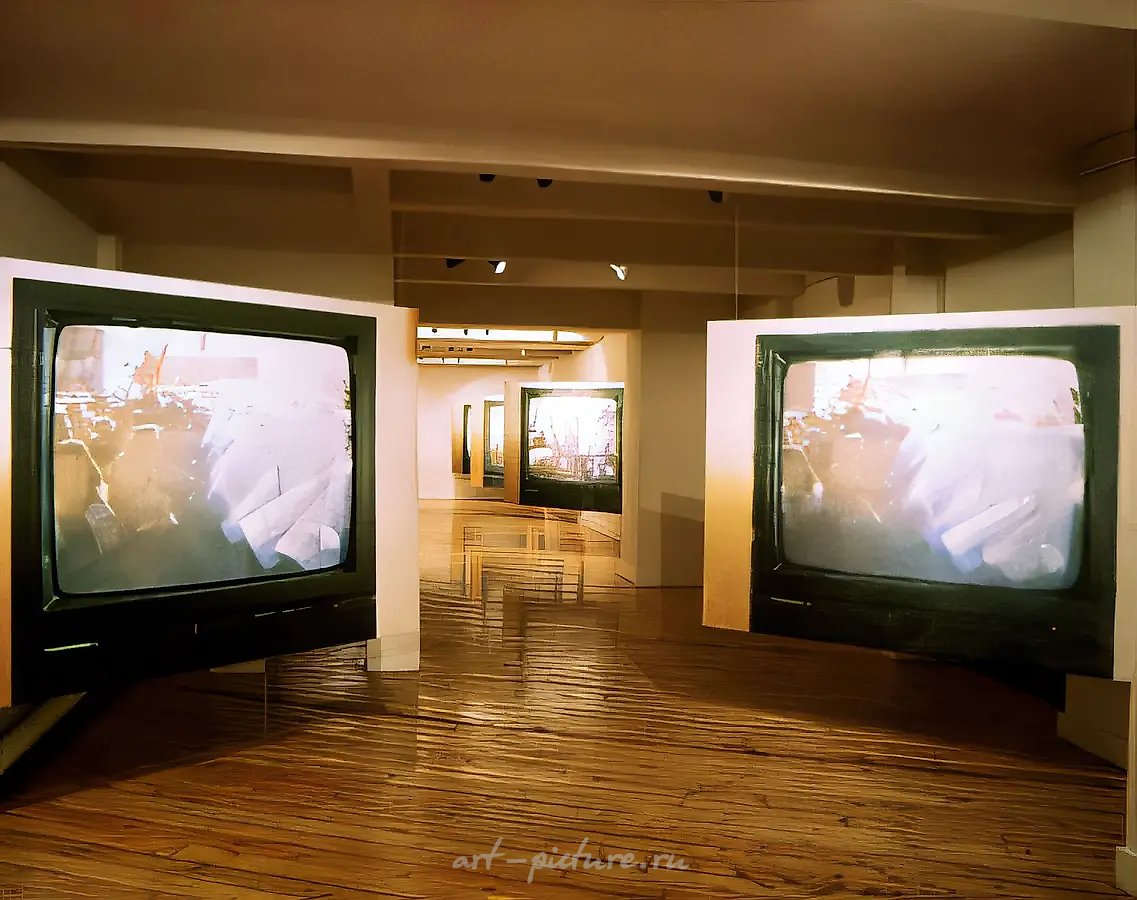

Semyon Faibisovich
1949 Born in Moscow.
1966-72 Studied at the Moscow Architectural Institute.
1977-89 Member of the City Committee of Graphic Artists (Gorkom Grafikov).
Lives and works in Moscow.
Works in collections
European Commercial Bank, Moscow
"Idigov Produkt" Company, Moscow
Phyllis Kind Gallery, Chicago, New York, USA
Struve Gallery, Chicago, USA
Museum Ludwig, Cologne, Germany
Neue Galerie Sammlung Ludwig, Aachen, Germany
Galerie Inge Baecker, Cologne, Germany
Kunsthalle in Emden, Emden, Germany
Museum of Contemporary Art, Lodz, Poland
Galleria P. Sprovieri, Rome, Italy
Time Magazine, New York, USA
Nancy and Norton Dodge Collection, Zimmerli Art Museum, Rutgers University, New Brunswick, New Jersey, USA
J. Stewart, A. Lobell, New York, USA
L. Pollock, Chicago, Boston, USA
Exhibitions and auctions
SOLO EXHIBITIONS
2010 — "Obviousness". Moscow Museum of Modern Art. Moscow.
2008 — Comeback. Regina Gallery. Moscow.
2003 — Lviv Through the Eyes of a Muscovite. Moscow-Kyiv-Lviv.
2002 — Pro Vision. II International Photography Festival. Nizhny Novgorod. Project "Earth and Sky".
2001 — "Returned Values". Regina Gallery. Moscow.
2001 — "To Everything its Time, to Everything its Place…". Sakharov Museum and Public Center.
2001 — "My Windows". Moscow House of Photography.
2001 — "Knot Under the Pines. Double Session". TV Gallery. Moscow
2000 — "Every Hunter Wants to Know…" XL Gallery. Moscow.
2000 — "The Living and the Dead" (memory of summer). Marat Guelman Gallery. Moscow
1999 — "Our Down". Zverev Center for Contemporary Art. Moscow.
1997 — "Coolness Runs Down the Collar". L-Gallery. Moscow
1995 — "Farewell Jubilee" (with B. Orlov). Regina Gallery. Moscow
1994 — "Chronicle of Current Events". Yakut Gallery. Moscow
1993 — "Obviousness". Regina Gallery. Moscow
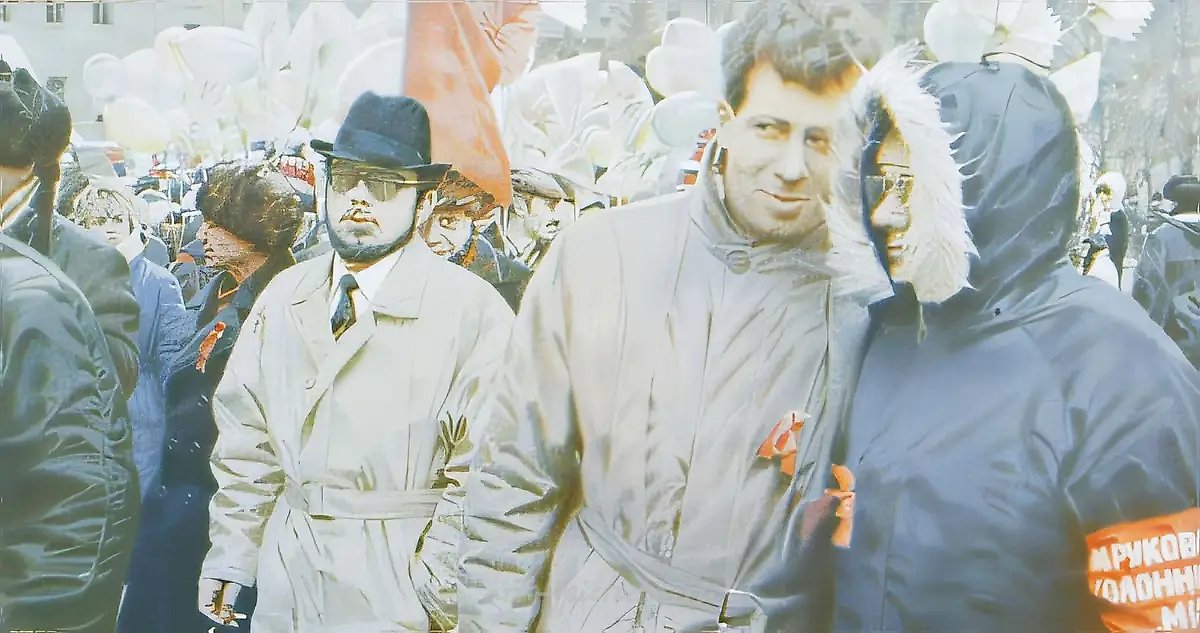
1992 — "The Last Demonstration". Regina Gallery. Moscow
1991 — Galerie Inge Baecker. Cologne. Germany
1990 — Phyllis Kind Gallery. New York. USA
1990 — First Gallery. Moscow
1989 — Phyllis Kind Gallery. Chicago. USA
1988 — Phyllis Kind Gallery. New York. USA
GROUP EXHIBITIONS (excerpt)
2007 - I Believe! Contemporary Art Center "Winzavod". Moscow
2004 - Moscow Berlin Berlin Moscow. 1950-2000. State Historical Museum.
- Nostalgic Conceptualization: Russian Version. Schimmel Center for the Arts, Pace University, New York.
- Through the Past to the Future. Art Hall of the Pacific Design Center - West Hollywood, Los Angeles, California.
- Writers Drawing. Painting and graphics by writers in the collection of the State Literary Museum. Moscow.
- Photobiennale 2004. Fifth International Month of Photography in Moscow. Project 'Rimu-Rim' and the 'Scooters' series. Petrovsky Passage.
[And many more; list is extensive and can be provided in detail upon request.]
Author about himself
What I have done so far breaks down into two main periods. The first—the seventies and eighties—was defined by existing within the gravitational force fields of attraction, suppression, and pressure inside the totalitarian power structure, a frozen mirage. The staged magic of everything around, any arbitrarily taken moment of space and time, hypnotized and provoked a staring contest, like the one between the rabbit and the boa. You could look away only by transferring your gaze to your own canvas. By expropriating, via a crude camera (sometimes at risk to health and safety), vibrating bits of bewildering reality and doing home appropriations. Achieving wholeness and unity was not among the artistic goals: reality itself, as high art should, offered an astonishing and total integrity. On the other hand, in this unity, there was something basic, in which any smallest fragment contained and carried the whole—its stamp, code, set of chromosomes, representing it like a drop of water. The second period is associated with a new visually psychological reality, which, by contrast to the previous one, is felt as fragmented, utterly insignificant, and there is no longer any need to rid oneself of obsessions—much that once appeared solid (but was actually only thick) has disappeared.
However, after the release of external tension, internal tension made itself felt—like a deep-water fish brought to shore. What do you look at with eyes popping from their sockets? What do you do if the tension is gone but the habit of intense, constant peering remains? Gradually, attention focused on visible manifestations of physiological processes occurring in my own eye. Like a word spoken repeatedly loses its usual meaning and acquires others in different dimensions, so constant peering at the surrounding world reveals the vibration of visual space, the presence of a kind of intermediate layer through which, and processed by which, visual impressions are transformed or even reveal another nature: constantly you can observe emerald-violet springs changing configuration and fleeing the field of vision, the mechanisms of residual vision projecting on the closed eyelid, as on a screen, negative-type versions of what the open eyes just saw, the morning or alcohol-induced multiplication of objects, etc.
In all these processes, OBviousness demonstrates indestructible subjectivity, putting its usual, everyday meaning into serious question. The products of uncontrived visual perception, realistic by definition, often appear abstract; objectness smoothly flows into its opposite, and the internal is engaged in perpetual swallowing of the external; a shimmering textual-contextual exchange hints at conceptualism and flatters postmodernism; the plastic nature of some results feigns surrealism, and altogether there arises an innovative field, including for the resolution of pictorial-spatial tasks.
Critic
Semyon Faibisovich is undoubtedly the most intellectual representative of painterly photorealism in Moscow. Within the movement, he is the only one interested not so much in rigorous work with photography as "source material," but in overcoming it, moving the chosen "object of study" into another context. A new reality is created by doubling the method: the "object," after being interpreted through a photographic focus, passes through painterly plasticity. The result—the creation of a new reality—is achieved not by photo-enlargement (blow up), but by the subtlest "diffusion" of focus. The image becomes multidimensional. Faibisovich seems to cast doubt on direct contact with reality; his canvases are philosophical interpretations of reality. His tendency towards philosophical statements certainly places his work in an internationally relevant context—one of the main postulates of which is that art in the second half of the 20th century substitutes for the functions of philosophy. Double estrangement enables Faibisovich, with an almost Buddhist calm, to touch both social discourse and the analysis of a person’s inner life, as well as to explore the landscape outside the window. Having been active in painting, recently Faibisovich has moved away from painting practice. At this stage, his tool for understanding reality is pure photography. This is logical for an artist who thinks in philosophical categories, because analyzing reality with a camera is not so much the final result (although Faibisovich’s photographic experiments deserve separate consideration), but, we hope, preparatory material for future painterly essays. Moreover, the artist has spoken more than once about the possibility of returning to the fold of current painting. At the exhibition, the viewer has a rare opportunity to become acquainted with works by the artist that have become classics of Russian contemporary painting.
Elena Selina
Text for the exhibition 'Current Russian Painting. 1992–2002.'
Although Faibisovich does not shy away from explicitly political imagery in his work, his approach is far from Sots Art. Like Komar and Melamid, he has marked this year as a great farewell to communism. But unlike them and his older friend Eric Bulatov—who also exposed and ridiculed the ideological roots of Soviet visual mythology—Faibisovich is fascinated by the organically visible manifestations of Soviet reality, its texture, its colors, its air (or its absence). Could even the very air be felt as Soviet? And even the paint in a suburban train car, wallpaper in an apartment, asphalt in the streets, house plaster be ideologically colored? The sky the color of a party flag? Faibisovich proves that this is exactly the case.
In his genre painting, there is nothing of Hogarth; for its subject is not social evil, but the air itself, the atmosphere of doomed optimism that prevailed on Soviet streets and in public places, an attitude evident not only in the grimaces of Soviet citizens’ faces, but primarily in that special light and color found nowhere else in the world.
Z. Zinik from the article "Pictures of My Moscow Friends", Modern Painters, England, Winter 1993
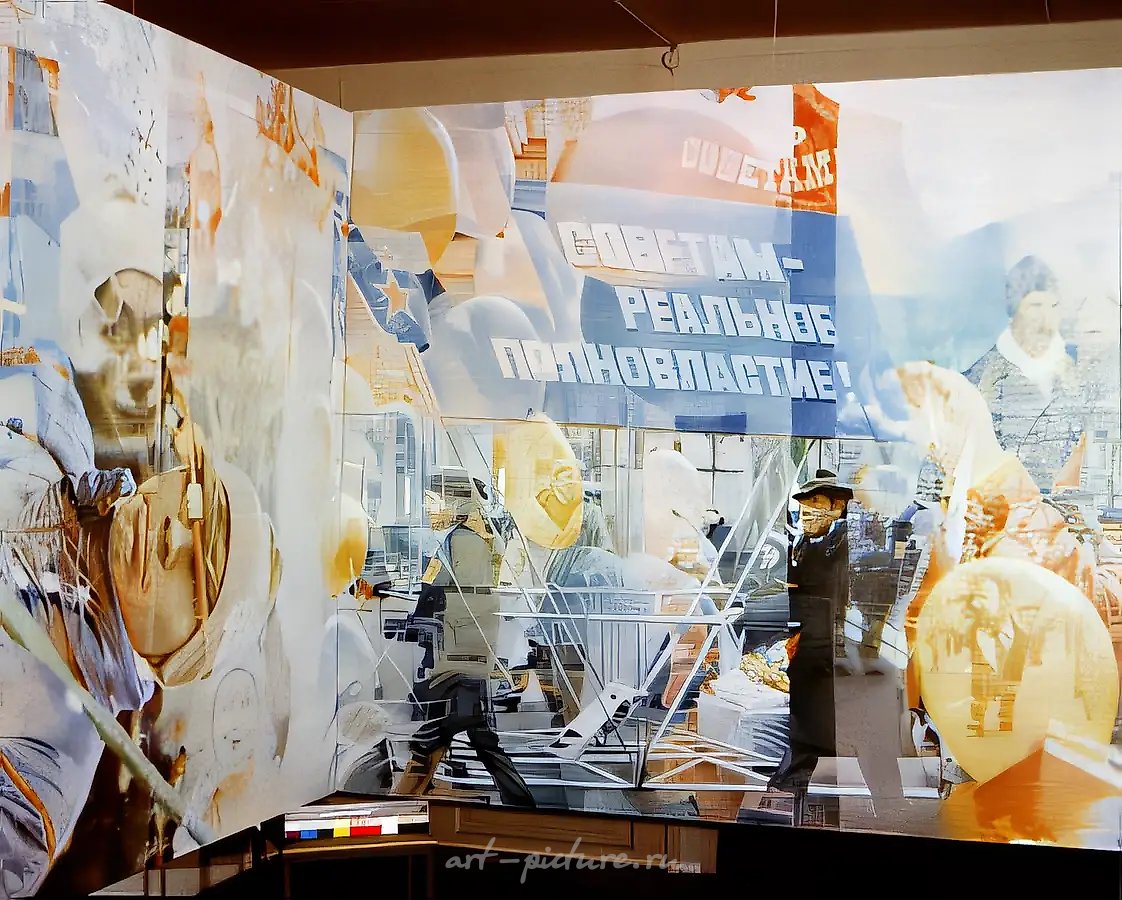
Through the painting, as through a window, absolute reality shines through—art inherits from life. But life inherits from art, too, and I believe that this life will often have the color and taste of Faibisovich’s transparent painting. Seeing through the unrestricted, multi-layered transparent screen becomes a necessary condition for perceiving the world.
L. Bredikhina, from the article "The Last Demonstration", "Regina": September 1990 – July 1993. Chronicle, Moscow, 1993
The struggle with life in its most concrete, most everyday, most ordinary expression begins when painting ceases to be deliberately "good," and starts being what it needs to be. When it arises by itself, it's hard to say from what. Who will win? Who will pull whom? In the duel between art and life, one must force the other to change its nature.
Why this hyper-attentiveness? Perhaps only in order to notice the diverging seams of visibility, of obviousness. To perceive how obviousness reveals its phantom nature and convey this plastically.
Overcoming material, overcoming materiality, objectness; ideally, non-objective painting.
M. Aizenberg, from the article "Vernissage against the background of a holiday", "Regina": September 1990 – July 1993. Chronicle, Moscow, 1993
Semyon Faibisovich certainly belongs to the field of so-called contemporary art—art of concept, interpretation, intense work with cultural meanings. However, he has always had an innate confidence in the value of plastic visual experience. From the perspective of the current artistic space, which resembles an interdisciplinary colloquium on philosophy, history, and cultural studies, such confidence has recently seemed somewhat archaic. But now, in the crisis of both plastic and conceptual art, Faibisovich’s language is felt the most current. His belief in the inexhaustibility of visual experience for art has allowed him to use all expressive means—photographic imagery, abstract and figurative painting—and by creating a complex field of interaction between different cultural-historical contexts, achieve an effect of integral emotional perception.
A. Medvedev, from the article "In Red on Black and White", Obshchaya Gazeta, No. 20, 1995.
Bibliography
- Kovalyov A. Name Index. — M.: NLO, 2005.
- Kikodze E. The Empty Television // Nezavisimaya Gazeta. — 2000. — Dec. 20.
Works 20
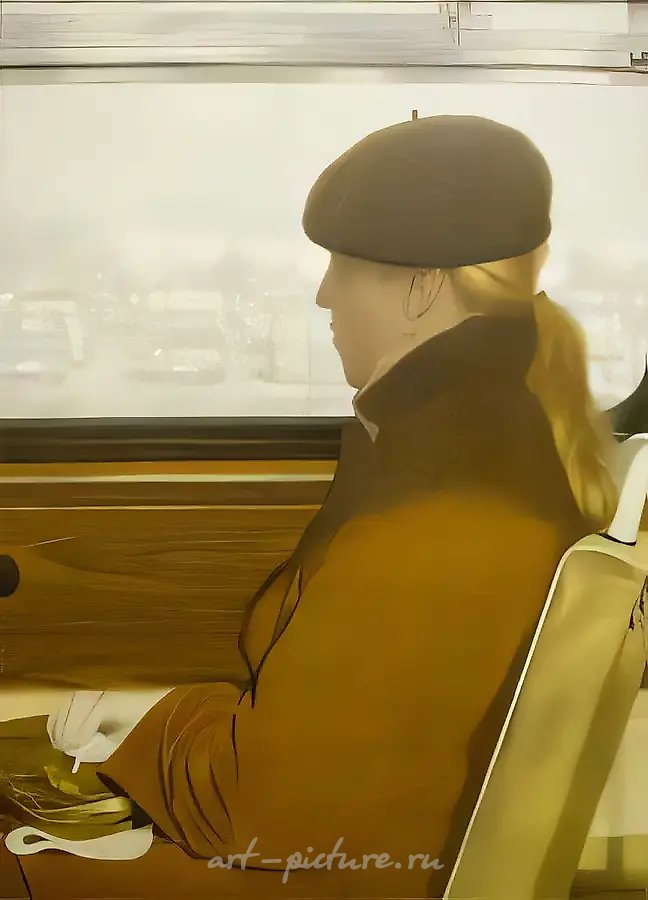

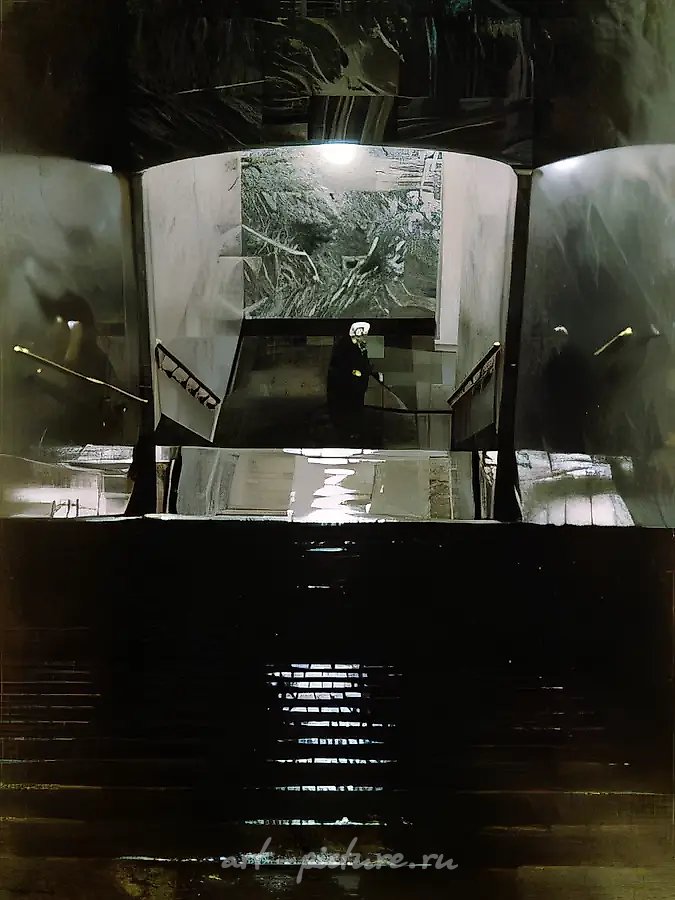
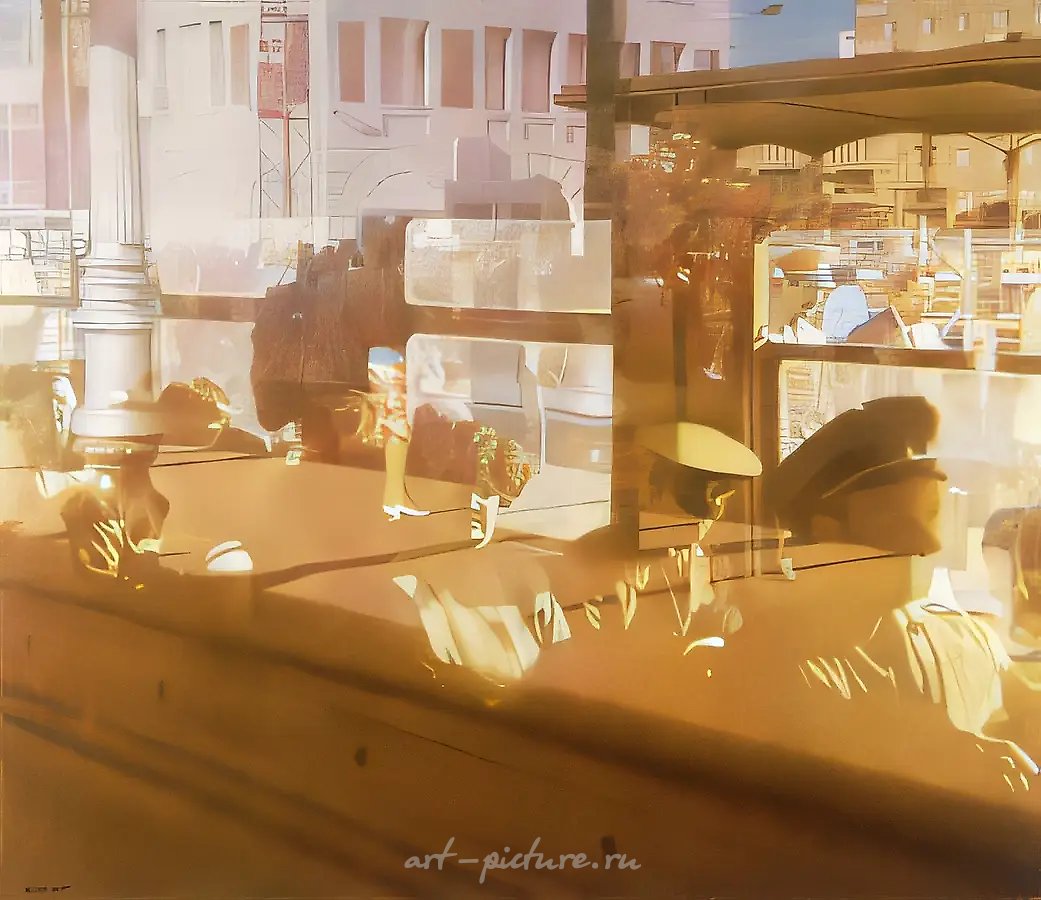




European Trading Bank`s property, Moscow