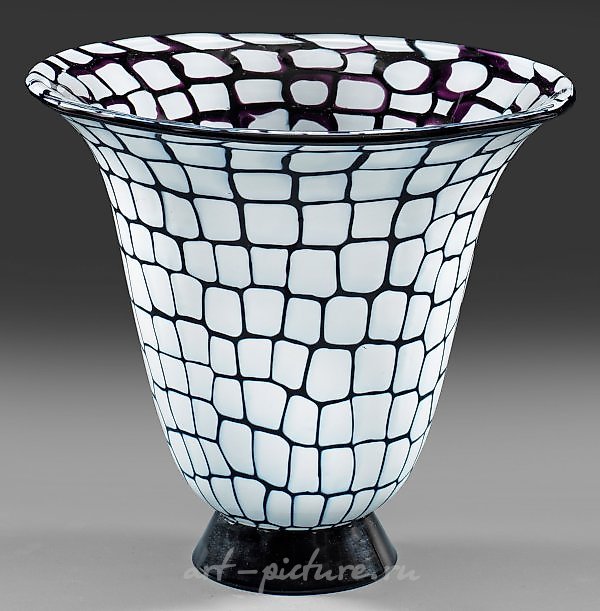
Deep bowl, below cylindrical, above bell-shaped or S-shaped swinging. Form developed by Carl Witzmann in 1913, commissioned by the Austrian Museum for Art and Industry or the Austrian Werkbund, Vienna. Glass with "creta Papillon" decoration. Green glass with melted silver-yellow flakes, reduced and iridescent. H. 16.5 cm; D. 23.3 cm. Carl Witzmann studied at the renowned Vienna School of Arts and Crafts under Josef Hoffmann, which brought him into connection with the Vienna Workshop. The bowl (in the version with geometric, etched, black and white decoration) was first shown in the winter exhibition in 1913/14 at the Austrian Museum for Art and Industry in Vienna, shortly thereafter at the important Cologne Werkbund exhibition organized by the Austrian Werkbund. It was produced by Loetz in two sizes. An example with black and white decoration is located in the Victoria & Albert Museum in London (Inv. No. C.252-1991). See cat. "Loetz - Bohemian Glass 1880-1940", Vol. 1, Fig. 336; Torsten Bröhan: "Glass Art of the Modern Era", Fig. 22. A rare, large flared iridescent Bohemian glass bowl with "creta Papillon" decor designed by Carl Witzmann and manufactured by Johann Loetz Widow. Bohemia. Klostermühle. Loetz Widow. 1913/14.