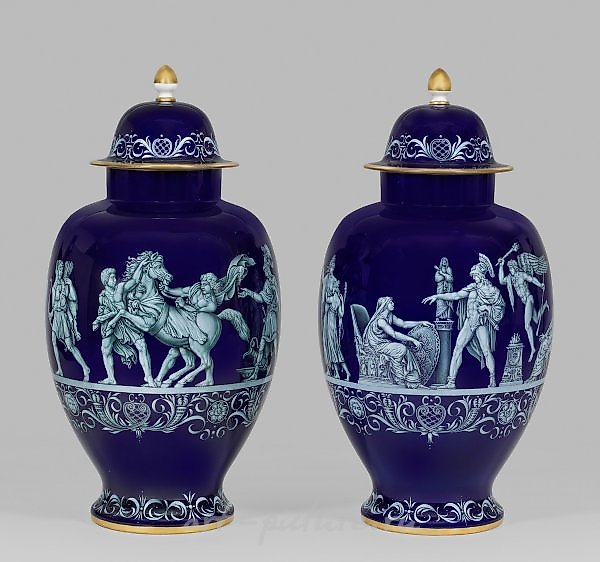
About an inserted standing baluster-shaped body with rounded shoulder and short, cylindrical neck. Surmounted by a domed, overhanging lid with stylized pinecone finial. Cobalt blue background. On the surrounding wall, an antique-style frieze with various freely composed representations from the so-called "Alexanderzug," arranged on a wide ornamental pedestal of voluted foliage with mascaron and flower medallions as well as flower horns. Based on the marble frieze by Bertel Thorvaldsen (1770-1844) in Christiansborg Palace in Copenhagen, as well as drawings and engravings by Johann Friedrich Overbeck and Samuel Amsler. The lid with a corresponding ornamental band. Relief-like, white enamel painting and partial gilding of the finial and gold rim. Sword mark. Height 64 cm. Plastically represented scenes in white enamel painting on a cobalt blue ground, creating an effective three-dimensional effect. Inspired by Sèvres and Royal Worcester porcelain, this technique was first executed in Meissen in 1865 and presented at the World Exhibition in Paris in 1867. These show scenic representations of Alexander the Great's entry into Babylon based on Thorvaldsen's designs. Thorvaldsen created the triumphal procession first for Napoleon Bonaparte, and then in 1829 for Christiansborg Palace in Copenhagen, from which Samuel Amsler made copper engravings based on Friedrich Overbeck's drawings. Amsler's engravings, which also appeared in Hermann Lücke's "Der Einzug Alexander des Grossen in Babylon: Marmorfries von B. Thorwaldsen," served as the motif basis for the depictions on the Meissen World Exhibition vases, as well as on these vases, where the motifs are rendered on a larger scale. See Jedding, Meissener Porzellan, color plate I and p. 86f., Berling, p. 91; Siemens, No. 42, p. 368, 377; Klassisches Meissen, p. 103; Thorvaldsen Museum, Copenhagen, Inv. No. E 35, 0; 10, 11, 14, 15. A splendid pair of monumental lidded porcelain vases with depictions of "Alexander the Great's entry into Babylon" after a marble frieze by Bertel Thorvaldsen, drawings by F. Overbeck, and engravings by Samuel Amsler, painted in white enamel in Limoges style on cobalt blue ground. Crossed swords mark. Meissen. Circa 1924-1934.