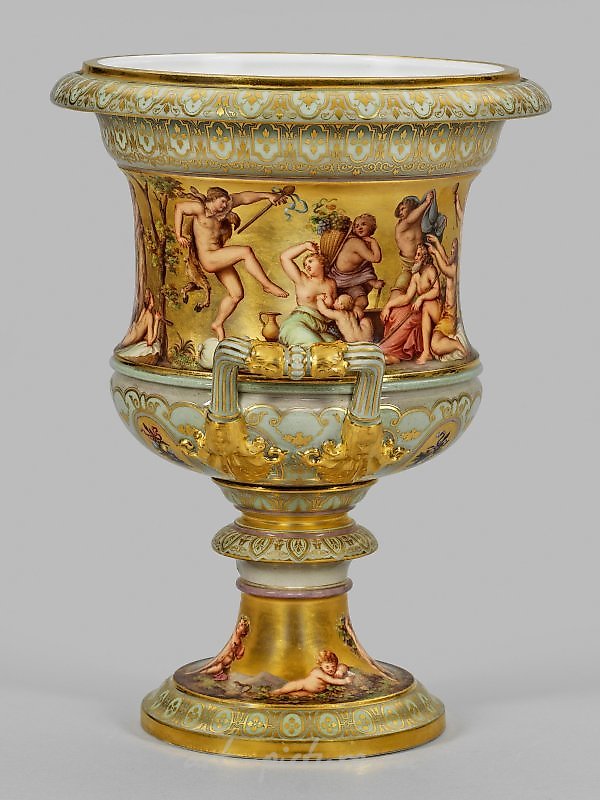
On a raised round foot with a nodus, a chalice-shaped, below bulging corpus, transitioning over a set profiled ring into a swinging wall and conically expanding rim with overhanging lip. Laterally curved, growing acanthus relief from deep beginnings, flatly channeled round rod handles with reliefed palmette decor. On the wall, a figurative frieze with various Bacchanalian scenes. In an indicated landscape, a depiction of the young, dancing Bacchus, Roman god of wine, with animal skin and thyrsus staff. His entourage with sitting, grape-carrying maenads, sileni, putti stomping wine grapes in a barrel, and a sitting couple on a swing. Various depictions of putti leaning on a wine goblet and wine jug respectively, or leaning against a wine barrel, carrying grapevines. Extremely fine, polychrome painting on a gold ground. Rich gold decor of various floral ornament friezes on a celadon-colored ground. Form - either Ernst August Leuteritz, 1865. Model No. G 116. Restored; sword mark. H. 30 cm. Ernst August Leuteritz (1818-1893) was the most successful modeler of the Meissen manufactory in the last third of the 19th century. This vase corresponds in form and decor to the Italian Renaissance style revived by Leuteritz in the course of Historicism. The Royal Saxon Porcelain Manufactory in Meissen presented this vase shape for the first time at the Paris World Exhibition in 1867 with the depiction of the abduction of Proserpina according to original compositions by Julius Schnorr von Carolsfeld. Cf. Berling, Festchrift, fig. 228, p. 88, 91; Jedding, p. 86f., fig., p. 39; Illustrated Catalog of the Paris Industrial Exhibition of 1867, p. 4; Exhibition Catalog Meissen Porcelain, 1710 to the Present, Austrian Museum of Applied Arts, 1982/1983, No. 66. A splendid crater-shaped porcelain vase, very finely polychrome painted with Bacchanalian scenes on golden ground. Modeled by E.A. Leuteritz in 1865. Restored. Crossed swords mark. Meissen. Circa 1865-1870.