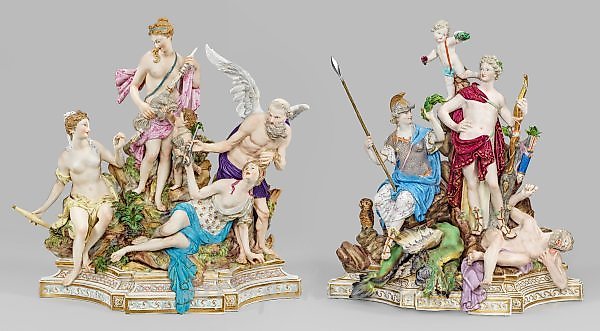
As counterparts, two-piece, screwed together. In the front, architecturally designed, with a sculpted base with relief ornament friezes. Composed over rocky terrain, a group of three Roman goddesses of fate, the so-called Parzen. In the center, standing elevated, accompanied by a putto with a bundle of wool, is Clotho, together with Lachesis sitting to the left, spinning the threads of human life. Chronos, the god of time, standing to the right, with Atropos lying before him, restraining her hair to prevent her from cutting the thread. As a counterpart, Apollo stands tall, the god of archery, in a proud pose. His left hand holding a bow, his right supported on his hip. Minerva stands beside him, the goddess of wisdom and war, with a helmet, armor, and spear. A perched owl at her feet as her attribute. Apollo stands with his left foot on an old man lying on the ground, personifying envy. Beside him, the slumped Python, a mythological dragon, which Apollo, according to legend, kills with an arrow. Above the group, a standing putto with a laurel wreath. Polychrome painting with rich gold staffage. Possibly by Johann Joachim Kaendler, 1774. Uncertain restoration; sword mark. Height 37 cm - 38 cm. Width 34 cm - 35 cm. Executions based on models from the so-called "Great Russian Order" for Tsarina Catherine II of Russia, named Catherine the Great, for the furnishing of the Oranienbaum Palace. Created by M.V. Acier, Kaendler produced numerous figurative groups of mythological themes to honor Tsarina Catherine II and her political successes. See Pietzsch, Catalogue Meissen for the Tsars, p. 105 with fig. 29 and no. 174; P. von Spee, Classical Porcelain Sculpture, (diss.), Bonn, 2004, cat. no. 104 and 105, p. 304f. A pair of large porcelain figure groups "Three Fates" and "Triumph of Apollo over Python" from the "Great Russian Order" for Tsarina Catherine II, so-called Catherine the Great. Two parts bolted. Insignificantly restored. Crossed swords mark. Meissen. 2nd half of the 19th century.