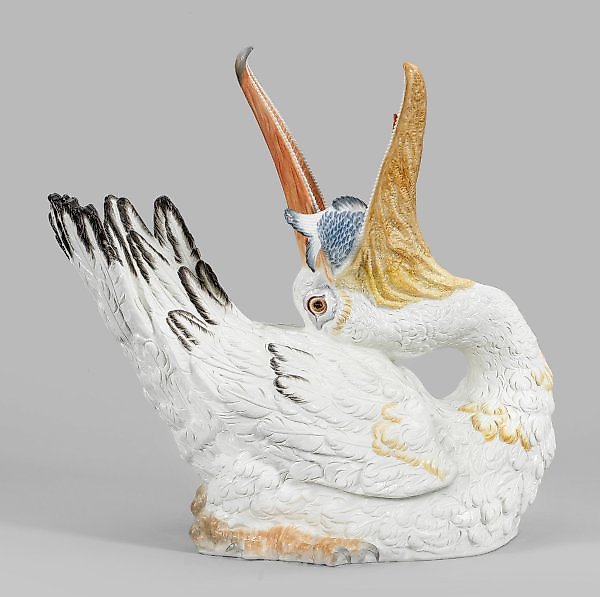
Seated pelican with a curved, long neck and a raised head, holding a carp in its wide-open beak. The sculpture is exceptionally naturalistic, with detailed modeling of the feathers, claws, beak, throat sac, tail, and fish scales. Possibly by Johann Joachim Kaendler, 1732. Accentuated, polychrome painting. Sword mark. Meissen. Circa 1924-1934. Height: 75 cm. Width: 76 cm. Depth: 44 cm. Expressive and masterfully modeled pelican, with its eyes open wide in the moment of devouring a fish. Indicated waves suggest that the artistic concept envisioned a pelican swimming in water. Johann Joachim Kaendler (1706-1775) created numerous life-size animal sculptures in the early 1730s, commissioned by August the Strong for his royal collection in the Japanese Palace, where they were intended to be exhibited for representational purposes. For this purpose, Kaendler studied every detail of the native and exotic animals housed in the court menageries, including their appearance, the texture of their feathers or fur, beak or mouth, as well as their characteristic posture and expression. Until 1735, six examples of the pelican sculpture, referred to as "large spoon goose" by Kaendler, were delivered. The original model from the 18th century is in the State Art Collections Dresden (Inv. No. PE 205). See Pietzsch, Meissen Porcelain Sculpture, No. 221; Sponsel, Cabinet Pieces of Meissen Porcelain, p. 96f. An exceptional life-size naturalistic molded porcelain figure of a pelican devouring a carp, modeled by J.J. Kaendler, originally made for the royal collection of August the Strong in the Japanese Palace. Crossed swords mark. Meissen. Circa 1924-1934.