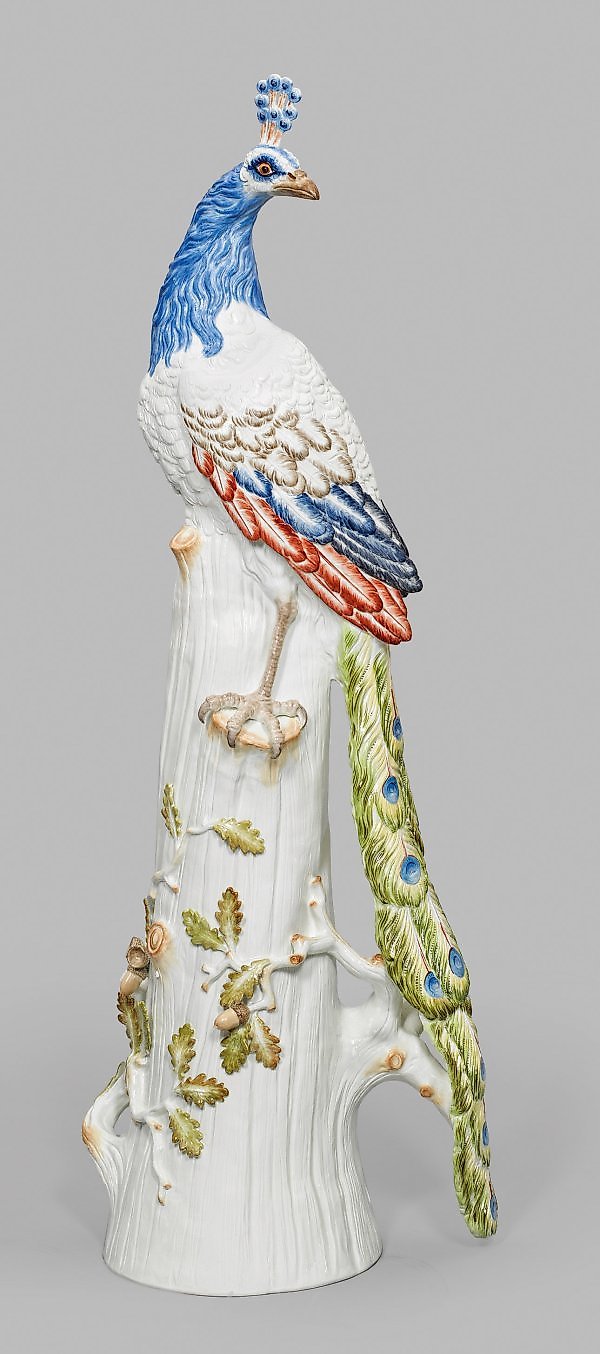
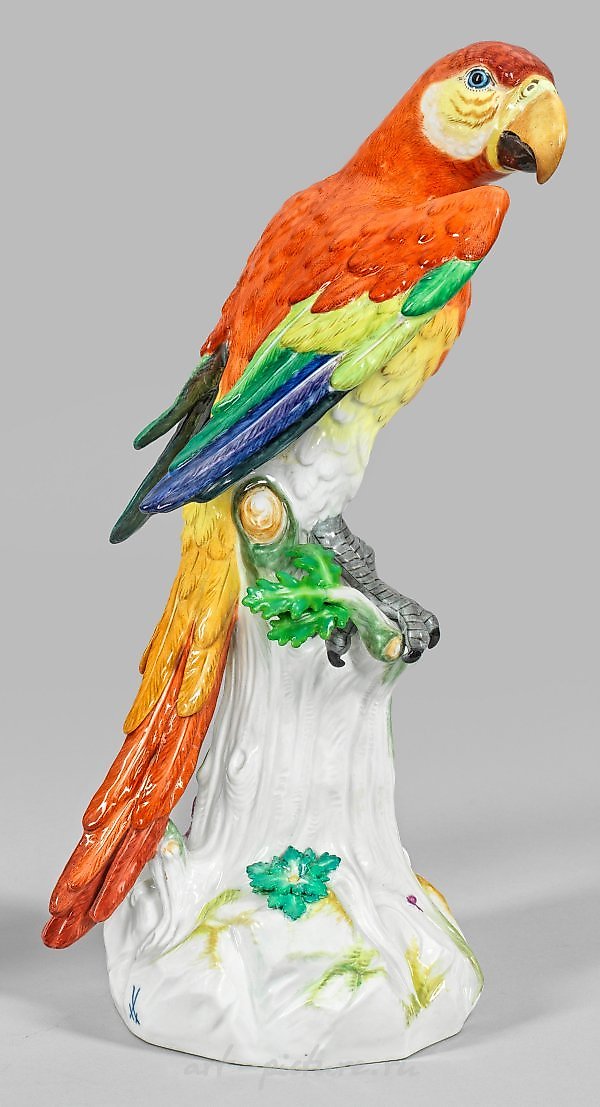
On a high, starkly sculpted branchwork, leaves and acorns adorn a majestic, fully sculpted figure of a male peacock with a trailing tail, the raised head with a magnificent feather crown gracefully turned to the side. Extremely naturalistic design after a natural model with relief sculpted plumage and accentuated, vibrant blue detailing of the neck and head, feathers, and tail feather with the characteristic "eyes". Polychrome painting. Either Johann Joachim Kaendler, 1734. Crossed swords mark. H. 118 cm. Commissioned by August the Strong for the Royal Collection in the Japanese Palace (so-called "Porcelain Palace") in Dresden, August the Strong commissioned a large number of different animal sculptures in the 1730s. In the succession of the modeler Johann Gottlieb Kirchner, Kaendler created several, partly life-size animal sculptures in an extremely naturalistic, strongly sculptural representation with minute reproduction of the exterior, the characteristic posture, and the distinctive features. August the Strong's passion for zoology and menageries, in which he kept all sorts of exotic animals, influenced the desire to translate these animals into porcelain. In addition, he financed expeditions and acquired various animal preparations for his zoological gardens and art chambers. In order to express the essence of an animal in the model, Kaendler studied and sketched the models in nature. Cf. Rücker, cat. Bayer. National Museum, p. 189f; Pietzsch, cat. Meissen Porcelain Sculpture, no. 265; Sponsel, cabinet pieces of Meissen porcelain, p. 101; Albiker, no. 44/45; State Art Collections Dresden, Inv. No. PE 188. An exceptional large porcelain figure of a peacock in a naturalistic molding, modeled by J.J. Kaendler, originally executed for the Royal Collection of August the Strong in the Japanese Palace. Crossed swords mark. Meissen. Circa 1924-1934.