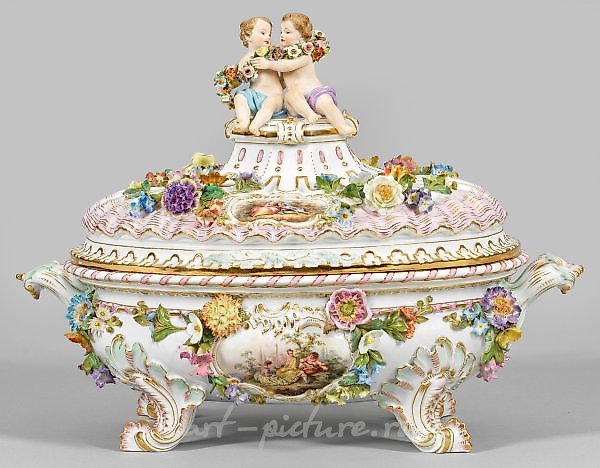
So-called "Drüselkästchen," originally designed for Maria Josepha of Austria, wife of King August III of Poland. It is a small, splendid tureen with a double-walled, oval-shaped body, supported by four paw feet and adorned with a plastic eagle. The body is intricately decorated with openwork banderole-like motifs. On the sides are handles in the form of a female bust with feathered headdress. The rich plastic decoration consists of small putti figures connected by floral garlands and drapery. The lid is correspondingly vaulted and tiered, with a plastic knob in the shape of a royal crown, carried by two putti. The lid is adorned with strongly relief-plastic cartouches depicting the Saxon-Polish coat of arms alternating with hunting and purple-colored trading scenes. On both sides of the wall, there is a rocaille cartouche crowned with palmette-like motifs and miner motifs. Scenic representations of two mountain men dressed in traditional attire are depicted in conversation in front of an architectural and tree-filled landscape backdrop. The inside of the lid is decorated with colored relief flowers. Fine polychrome painting with rich gold decoration. Gilded interior walls. Possibly by Johann Joachim Kaendler, 1738. Model number 81615. Sword mark. Height 21 cm. This splendid tureen served as a so-called "Drüselkästchen" with a lid for "storing plucked threads and other materials for embroidery, etc." The commission, addressed to Maria Josepha of Austria (1699-1757), wife of August III, mentions Kaendler 1738 in his reports with the following words: "1 very laborious Drüsel Kästgen, which was ordered for her Majesty the Queen." See Zimmerman, Meissen Porcelain, 1924, p. 140; Jedding, Cat. Meissen Porcelain, Hamburg Private Collection, No. 142; Ducret, Porcelain of the 18th Century, Fig. 16, p. 31. A small royal splendid tureen, originally made for Maria Josepha of Austria, wife of King August III of Poland. Crossed swords mark. Meissen. After 2000.