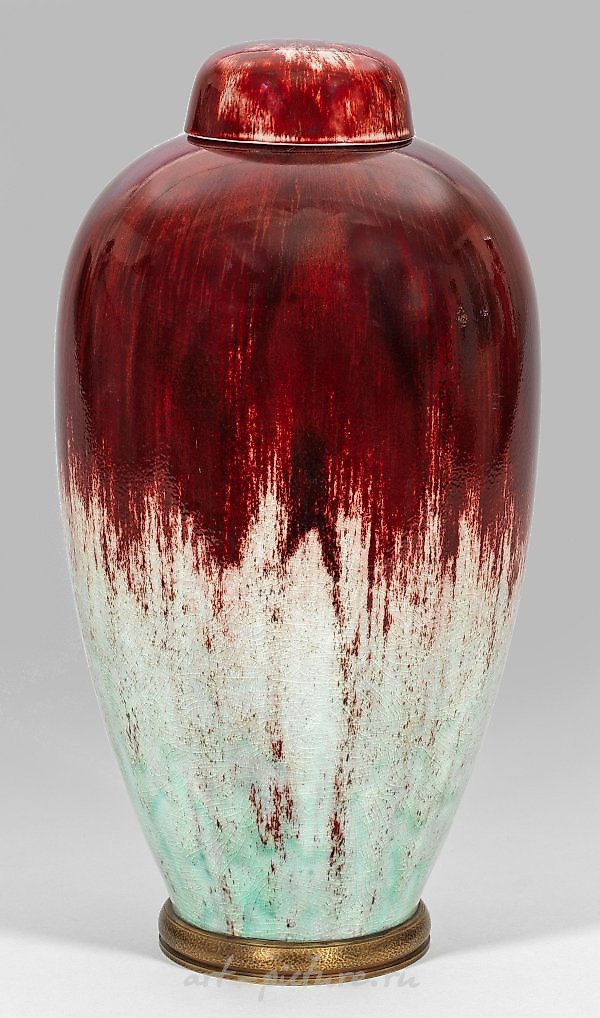
Stretched, ovoid body with rounded shoulders and a short neck. Overarching, semi-spherical lid. Celadon-colored and flame-red running glaze (so-called Sang de Boeuf or Ochsenblut glaze) with crackle, following the example of Chinese porcelain vases. Base with profiled metal mounting. Manufacture mark with the year 1925 and "DN" (pâte dure nouvelle), marked "Made in France". Height: 48 cm. Based on the model of East Asian ceramics, various European porcelain manufactures, including Berlin, Copenhagen, Meissen, and Sèvres, developed the diversity and beauty of reduction glazes, specifically the Ochsenblut glaze, from around 1880. Between 1900 and the 1920s, numerous porcelain pieces with precious and technically extremely difficult to produce art glazes were created in the Sèvres manufacture. Catalogue Bröhan-Museum, Vol. II, p. 330f; p. 350. A French metal-mounted lidded porcelain vase with Sang-de-Boeuf glaze. Dated 1925. Manufacturer's mark. France, Sèvres, 1925.