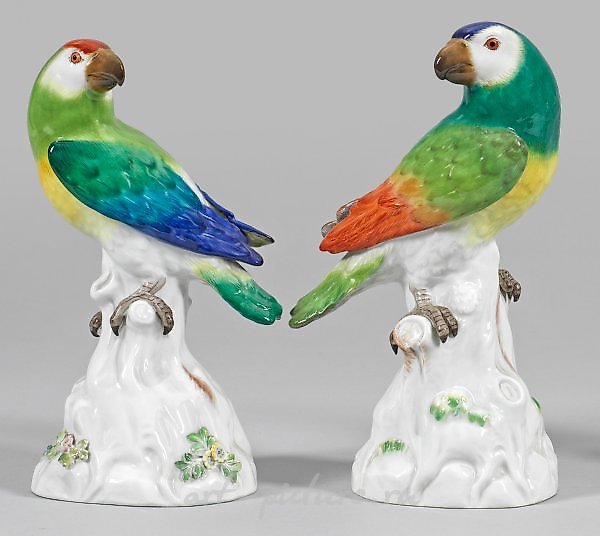
On a high, relief-sculpted, foaming wave, there is an upright swimming duck bird, cleaning its feathers with its beak. The artwork is characterized by vibrant, polychrome glaze painting. It is possibly by the artist Hugo Meisel, as indicated by the monogram "HM" and minimal restoration. The height of the piece is 84 cm. The model was created in connection with the famous group of 16 monumental animal sculptures by modelers Hugo Meisel and Arthur Storch. The oldest Volkstedt porcelain manufactory in 1921 caused a great sensation when it participated in the design of the "Porcelain Palace" in Leipzig, which was initially used as a trade fair house under the direction of architect Hans Poelzig. Due to their extraordinary size, the production of these sculptures posed a special technical challenge. Even today, they are considered as masterpieces of artistic and technical craftsmanship. Only a small series of approximately 10 variations per model were produced. The majority remained unpainted, while some pieces were colorfully decorated. A comparative example can be found at the Grassi Museum in Leipzig. See catalog Schwarzburger Werkstätten, p. 272ff; Fritzsche, Aelteste Volkstedter Porzellanmanufaktur, p. 211f; Zimmermann, in Deutsche Kunst und Dekoration, Vol. 49, 1921-1922, p. 46ff; Porzellandland Thüringen, p. 243ff, Grassi Museum, Jugendstil, p. 58. Provenance: From the estate of a significant North German private collection. A rare monumental Thuringian porcelain figure of a bird-of-paradise modeled by H. Meisel. Minor restoration. Manufacturer's mark. Thuringia, Volkstedt-Rudolstadt. Aelteste Volkstedter Porzellanfabrik. 1920s.