
Porcelain
Porcelain factory
Dagoty Manufactory Dagoty (Porcelain)
This manufactory is one of the most famous Parisian porcelain enterprises of the first quarter of the 19th century in Russia. The Dagoty surname unites three brothers: Pierre-Louis, Jean-Baptiste Étienne, and Messidor. The most renowned among them is—
Pierre-Louis (1771—1840), the son of a portrait painter who served Marie Antoinette, and the grandson of anatomist Gutiér Dagoty. The Dagoty brothers were apprentices of Dihl and Guérhard at the manufactory of the Duke of Angoulême, where they mastered the art of porcelain making. Additionally, they engaged in commerce. As entrepreneurs, the Dagoty brothers attempted to make their fortune producing porcelain, settling in 1790 in a small shop on the Boulevard Poissonnière. At this address, Jean-Baptiste Étienne Gutiér Dagoty, a porcelain artist, had a shop and workshop where he practiced his craft with his elder brother Pierre. After Jean-Baptiste's death, Pierre-Louis Dagoty bought out the factory and the shop in 1804, quickly achieving great success. By 1807, the Dagoty enterprise led all Parisian manufactories in production. It employed between 100 and 120 workers. With his business flourishing, the owner decided to expand and acquire a full-scale factory. The choice fell on the Roger Manufactory in Montparnasse on Rue de Chevreuse, which he acquired around 1815.
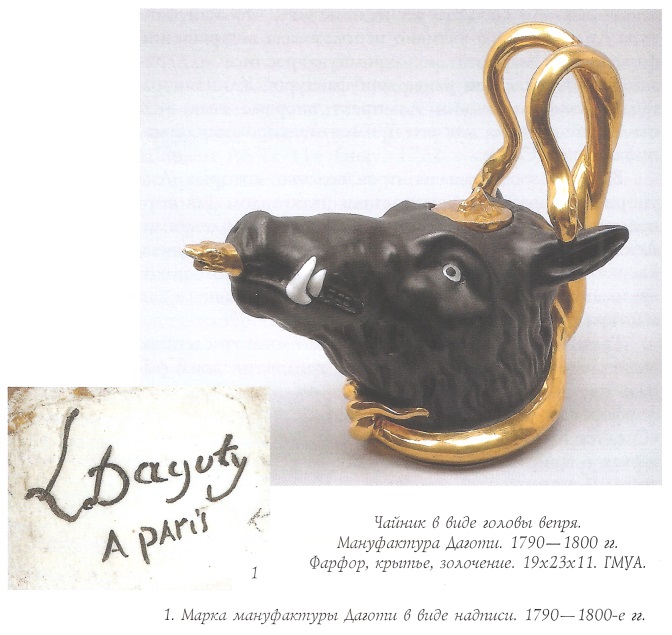
An example from the early period of the Dagoty manufactory is a porcelain teapot in the shape of a boar's head, imitating bronze ware. At the turn of the 18th–19th centuries in Western Europe, and especially in France in the Directory era, works of decorative bronze that combined patinated and gilt details and elements were highly popular. The teapot should be dated to the years 1790–1800, as evidenced by its mark—one of the early marks of the manufactory. Over its history, the Dagoty manufactory altered its mark, its script, and its color several times, allowing for more precise dating of its wares.
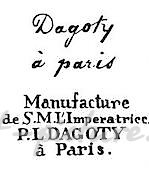
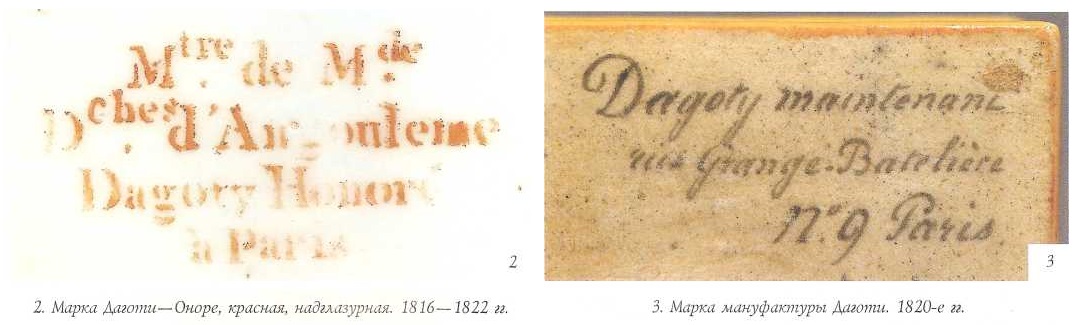
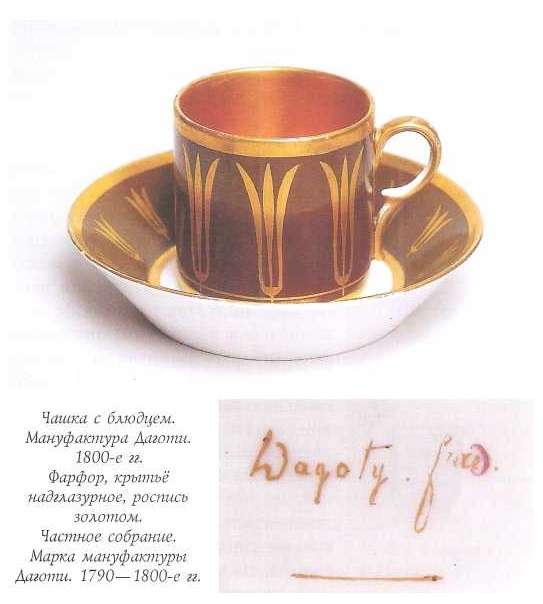
Initially, Dagoty marked its products with a simple inscription—a full name: "P.L.Dagoty" or, even more often, "Dagoty a Paris," written in gold or red cursive, sometimes incised into the paste or applied in black. During the Dagoty–Honoré partnership, porcelain was marked with a stenciled inscription in red: "Manufre de Madame / Duchesse d'Angouleme / P.L.Dagoty—E. Honore." Such a mark can be found, for example, on dishes preserved with a green mesh on the border.
After the partnership dissolved, the Honoré brothers retained the house on Boulevard Poissonnière, while Dagoty kept the one on the Seine, with a warehouse at 2 Rue de la Grange-Batelière. The mark from this period reads "P.L.Dagoty maintenant a Paris rue Grange Batielere, No 9." This mark is found on a book-shaped paperweight. According to Madame de Plenval, it is less commonly encountered than others.
In the early 19th century, it became fashionable to acquire something from Dagoty as an elegant gift or souvenir. "Fine porcelain items are offered as New Year or holiday gifts in the Dagoty shop on the Boulevard Montmartre," said a contemporary (a document published in 1813, cited in Madame de Plenval's book). "Here you can find beautiful table services combining elegance of form, color splendor, and picture-like decoration, vases for anemones, elegant writing sets, coffee-making accessories, and even sophisticated equipment for conducting chemical, physical, and pneumatic experiments." It is worth noting that many Parisian factories made ware for medical purposes. Most often, cylindrical shapes with relief on top and bottom and with a concave lid were used. Another model was a half-oval on a foot.
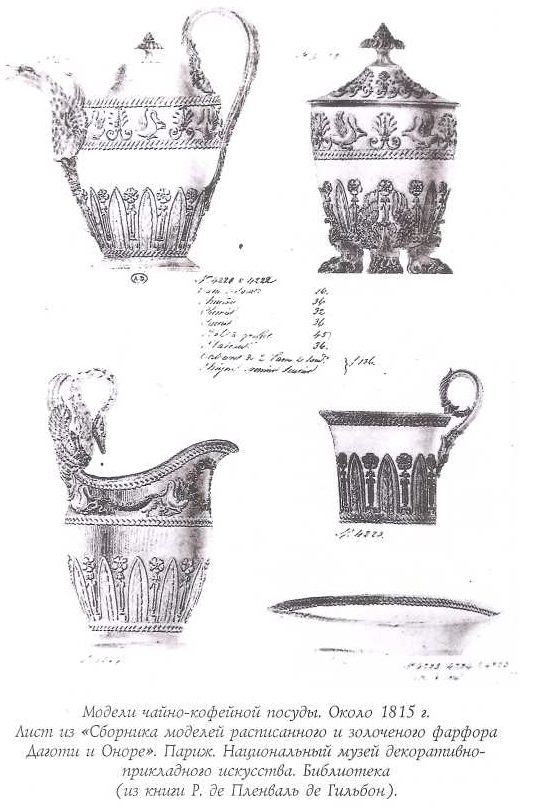
In January 1816, the factories of Dagoty and Honoré merged into a single powerful enterprise. The Dagoty–Honoré partnership was established by contract for 20 years but lasted only until 1820 (according to some sources, 1822). After the split, their ways parted without substantially affecting the porcelain production of either manufactory. Dagoty produced hard-paste, beautifully glazed white porcelain for tea and dinner services, vases, writing sets, clocks, bas-reliefs, statues, and large decorative elements for dinnerware. The décor of most items was in the Empire style. The National Museum of Decorative Arts in Paris holds a "Collection of Models of Painted and Gilded Porcelain by Dagoty and Honoré" (circa 1815). An indispensable document for studying these manufactories’ output, it consists of 60 hand-drawn gouache illustrations. Madame R. de Plenval de Guilbon's book presents several illustrations from this collection. They provide insight into the great variety of shapes and decorative styles: especially finely made dessert, tea, and coffee services, individual cups, and bowls of both traditional and contemporary Empire forms.
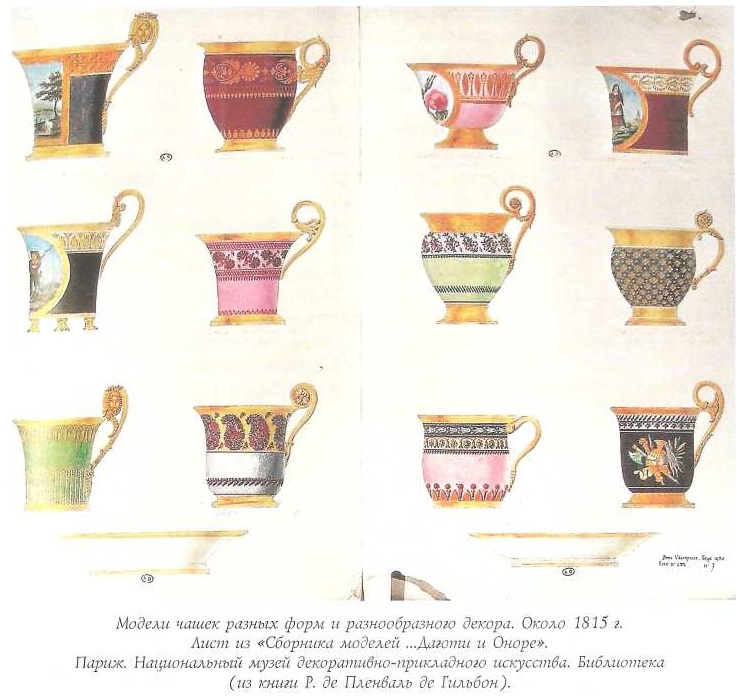
From the late 18th century, cup shapes began to change. In the first half of the 19th century, numerous new and increasingly sophisticated forms were invented: the cup became a plaything and followed the overall trend of refinement. The number of different cup forms listed in the Pouyat catalog of 1826 is impressive: cups on feet, with spurs and pearls, Etruscan, curved like a swan's neck (cups of this type bearing the Dagoty mark have survived), shell or round shell shapes, snail form. There were tea cups, serrated tea cups, footed, beaker-shaped with relief and feet, milk cups, chocolate cups—Etruscan and pear-shaped, English, and more. Numerous Parisian manufactories produced all these. Such a diversity of shapes broadened the range of decorative motifs used to emphasize or veil a piece’s form. Drawings from the "Collection of Models of Painted and Gilded Porcelain by Dagoty and Honoré" clearly show this variety of shapes and décor.
The overall trend of the first quarter of the 19th century was the richness of sculptural decoration, especially in details. Objects were often set on feet. Handles of vases, cups, and other wares were adorned with sculptural motifs arranged prominently—usually on the upper part of the piece. Decorations began with a sculptural base or palmette at the handle's root and ended with a female bust, chimera, or an animal's head, sometimes curled at the top forming leaf scrolls, rosettes, or human masks.
Lid handles were in the form of charming buds or butterflies, spouts of teapots and coffeepots in the form of a bird's beak or an animal head. The Dagoty–Honoré album features a range of classic vase forms—egg-shaped, amphora-like, "Medici" krater vases, and others. Antiquized forms were also used for tea and coffee ware: creamers as antique helmets, semi-oval sugar bowls standing on three feet. The décor was varied and meticulous not only in drawings but in actual pieces, as seen in surviving services. The richest pieces received a double layer of gilding.

In the first half of the 19th century, gold use in decoration became increasingly widespread. Borders, backs, and relief parts of the most luxurious items were entirely gilt. In addition to plain gold decoration on a white ground and polychrome on gold—both appearing in the 18th century—after 1800 another technique emerged: burnished gold decoration, or, more precisely, applying glossy designs to a matt gilt surface (cirage). This made ornamental borders around medallions—depicting portraits or miniature reproductions of famous paintings—appear even richer. Some special pieces were entirely gilt, such as two monumental Dagoty vases from 1804 and 1814, decorated with medallions featuring antique characters—real paintings executed with unsurpassed virtuosity.
In decorating his porcelain, Dagoty employed already traditional techniques: monochrome "à la cameo" painting, sepia landscapes, antique subjects, hunting scenes. Pieces were also decorated with polychrome landscapes, frieze-like around the cups and other items. Especially carefully made and original are wares combining biscuit with glazed surfaces and details. The model collection includes depictions of handles and spouts shaped as swans with wings and sinuous necks: cups, a creamer, etc. Madame R. de Plenval de Guilbon’s book has an illustration of a cup made according to one model, and the Museum of the Applied Arts collection has a creamer based on a published model from the collection.
Some items from the Dagoty–Honoré manufactory reveal decorators' exuberant imagination, seen in the free treatment of details dominated by sculptural forms: mounts supported by cupids, winged putti adorning inkwells and other writing set components. Among writing set models in the "Collection... Dagoty and Honoré" is a Russian-style model, directly inspired by contemporary wares produced at the Imperial Porcelain Factory in St. Petersburg. Writing sets were often accompanied by a matching paperweight and sometimes even a magnifying glass mounted in porcelain.
Dagoty and the Dagoty–Honoré partnership’s production was always in high demand. Entries in Empress Josephine’s account book of 1805 and 1807 testify to orders, designs, and payments for pieces from the Dagoty manufactory. Items marked for the short-lived Dagoty–Honoré partnership are obviously few and hardly differ from earlier wares. Among them is a dessert service made in 1816 for the royal ambassador to Vienna, Duke de Caraman. The decoration features deep blue, red, and green hues combined with gilding. Also from this period are two services for Presidents of the United States—Madison (1809–1817), a service with an elegant green mesh, and Monroe (1817–1825), a dinner service whose plates feature an eagle with outstretched wings.
In some Dagoty and Dagoty–Honoré wares, there is a clear attempt to imitate Wedgwood porcelain. At the 1819 exhibition, the partners received a silver medal for vases adorned with Wedgwood-style relief and for reproducing a reduced copy of the "Fountain of the Innocents" or "Fountain of the Nymphs" by Jean Goujon. Interest in biscuit techniques was quite pronounced at Dagoty–Honoré. Interestingly, Honoré in the early 19th century purchased a biscuit flower manufacturing enterprise that became the basis of his factory.
After the partnership split, Dagoty sold his manufactory (in 1823) to Daniel, while in 1824 Honoré moved his production to Champroux, where there were kaolin deposits, and took on many foreign orders. Edouard Honoré died in 1855, soon followed by his son. In 1865, the factory passed to Ernest Rengo.