
VALSUANI BRONZE WORKS. Claude Valsuani Foundry.
The VALSUANI Dynasty. VALSUANI BRONZE WORKS. Claude Valsuani Foundry.
The first: VALSUANI Marcello
I – 1) VALSUANI Claude – son of Marcello
I – 2) VALSUANI Marcel – son of Claude
II – AFTER VALSUANI
II – 1) Demeurisse-Sokolowski
II – 2) Taube-Lebel Foundry
II – 3) Taube Foundry
II – 4) Plaine Foundry
II – 5) Airaindor
II – 6) Art Brass
II – 7) Airaindor-Valsuani Art Studio
II – 8) Parisian Bronze and Sculpture Company – Painting (BPBS)
Most recently, the company “CEPIMEX” has appeared, dealing with import and export.
III – 1) VALSUANI Attilio – son of Marcello
III – 2) VALSUANI Lucien – son of Attilio
III – 3) VALSUANI Claude – son of Lucien
III – 4) VALSUANI Thierry – son of Claude
IV – AFTER VALSUANI: DELVAL
– – –
I – 1) VALSUANI Claude – Died 9 September 1923 – Son of Marcello
Period of company existence: 1908–1981
Nationality: French
Address: 74 rue des Plantes, Paris XIV (Plaisance district)
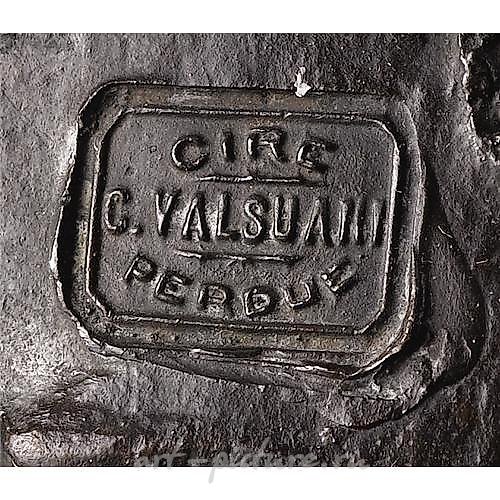
Mark: CIRE / C. VALSUANI / LOST
(The postal mark has belonged to Airaindor-Atelier des arts since 1981)
On castings made by Leonardo Benatov after 1981, the stamps are either identical to the old one, or slightly enlarged at the client's request.
Marcello Valsuani emigrated from Italy, likely as a specialist in lost wax casting and blowtorch patination, at the request of Hébrard for the opening of his foundry in 1902. Marcello Valsuani probably preceded, sometimes replaced, and sometimes assisted, as technical director or workshop manager, Albino Palazzolo, whom Hébrard only hired in 1903 and who returned to Italy during World War I.
The collection includes a bronze sculpture by Rembrandt Bugatti, who died in 1916, all of whose works were cast by Hébrard under an exclusive contract and dedicated “To my friend Valsuani.” Rembrandt Bugatti, feeling highly constrained by his contract with Hébrard, was rumored to be considering breaking it and having his works cast by Marcello Valsuani, which prompted Valsuani to start his own venture. But possibly it was thanks to the persistence of Bugatti and other artists, wishing to take advantage of the family's expertise without dealing with Hébrard's contracts, that Claude, Marcello's son, opened his foundry in Paris in 1908 at 74 rue des Plantes.
It is said that Claude Valsuani demonstrated his lost wax casting method for engine components to the car companies Bugatti (created by the sculptor's brother) and Renault.
Valsuani took over premises formerly occupied in the late 19th century by Pierre Bingen, a noted lost wax casting specialist. However, Valsuani did not use Bingen’s premises, instead moving into a newer building: a small house in which he lived, adjoining a 400 m² workshop.
Claude Valsuani practiced hot patination using a blowtorch — a technique that only became widespread with the advent of gas torches that left no soot deposit — a technique mastered by Italians in the early 20th century. He achieved results of extraordinary beauty. The Valsuani foundry was also famous for its “Italian style” cores and its “cow dung patina” (see explanation of this technique in LEBON, p. 256, bottom of column 2 and p. 261, note 7) — a slow but economical process yielding remarkably fine results. Around 1910, he employed four to five workers.
Following Hébrard’s example, Valsuani adopted the practice of numbering bronze sculptures, though perhaps not systematically at first. On his castings, he indicated the number of each piece in relation to the total number of casts planned, which neither Hébrard nor Rudier did at the time. He appears to have been the first to employ this method, likely at the suggestion of sculptors who, based on Hébrard’s example, chose unambiguous numbering. This type of numbering gradually spread and ultimately became the prevailing legal standard.
The editions of bronzes created at Valsuani were often limited to 10 pieces or fewer. While not mandatory, this standard was seemingly adopted by sculptors wishing to limit their production from the early 20th century until the 1968 regulations were enacted.
At the beginning of his career, Claude did not systematically stamp his works.
He quickly established a reputation as an excellent lost wax founder. Artists mindful of quality were drawn to him. Never acting as a dealer, he was always willing to offer assistance. Working alone in his foundry at the end of hostilities in April 1918, he continued single-handedly.
In 1919, he was involved in the Rodin forgeries case against Montagutelli. His good faith was acknowledged, and he was not prosecuted.
The sculptor Pierre Bouret worked at the foundry as a retoucher until the mid-1930s. Turridu Clementi, a young orphan and son of the founder Tullio Clementi, served part of his apprenticeship with Claude Valsuani (from 1927 to 1932).
Attilio (died ca. 1960), Claude’s younger brother, probably worked with him, since when Claude died suddenly, Attilio was the one to notify clients and announce the need for extraordinary measures. However, he did not take over the business and set up his own lost wax foundry by 1926 at the latest.
I – 2) VALSUANI Marcel – 1924–1974
In 1923, the business was managed by Claude’s widow. Then in 1924, his son Marcel (named after his grandfather) interrupted his medical studies to replace his father. He retained the Claude Valsuani stamp and maintained the foundry’s excellent reputation.
Under both Claude and Marcel, the foundry attracted the most prestigious and demanding sculptors. The “Claude Valsuani” stamp became synonymous with outstanding quality and remarkable patinas. The “Valsuani black” is one of the most famous patinas produced by this company.
Valsuani is sometimes mentioned as a publisher during the interwar period, for example with Pompon. However, he should not be considered a publisher in the same sense as Susse or Barbedienne: no contracts were signed with the artists, who retained all rights and controlled their own production. Valsuani was simply their founder.
Like most of his peers, Marcel Valsuani saw his business decline in the 1930s. He was mobilized for the entire war. The foundry only resumed in 1947.
In December 1950, Marcel Valsuani purchased the land and buildings at 74 rue des Plantes. The company employed 6 people in 1952, increasing to about twenty in the mid-1970s.
Sometimes Valsuani subcontracted sand castings to Susse or Georges Rudier. The castings were then delivered unfinished to Valsuani, who was responsible for the final work (they bore the stamp “C. Valsuani”).
In 1973, Marcel Valsuani retired and moved to Nice, leaving the company in the hands of technical director Antoine Tamburro.
Claude Valsuani authored a text titled: Modern processes of lost wax casting, reprinted in Devaux, p. 301.
II – AFTER VALSUANI
II – 1) DEMEURISSE-SOKOLOWSKI – 1974-1977
By 1974 at the latest, the business was sold to Anne Demeurisse, daughter of the sole heir of sculptor Pompon, who entrusted its management to her husband, Jacques Sokolowski, an insurance broker whose ambitions arrived at an inopportune period during a recession. The firm incurred heavy losses; some practices drew industry hostility, and in 1977, the company was declared bankrupt.
The firm was taken over in 1977 by sculptor Olivier Brice (famous for creating Bokassa's throne!), who managed it from 1977 to 1980. Part of the team then left the foundry to help create a new foundry named:
II – 2) Taube-Lebel Foundry – 1977–ca.1981
Lost wax
In 1977, Jean Lebel, former project manager at the Claude Valsuani foundry, partnered with Taube to create “Taube-Lebel Foundry” at La Plaine-Saint-Denis. The technical team was led by D. Jolivot and J. Rosini, former Valsuani foundry workers from 1974.
II – 3) Taube Foundry – ca. 1981–24 March 1984
Lost wax
Jean Lebel left the company around 1981.
Mark: . WAX . / TAUBE / (in the center, a tree) / PARIS / LOST
Only Lebel’s name was removed from the mark.
The Taube foundry ceased operations on 24 March 1984.
II – 4) PLAINE FOUNDRY – 1984-1985
Lost wax
Address: 6 rue Proudhon, 93210, La Plaine-Saint-Denis.
Stamp (hexagonal): FOUNDRY / OF / THE PLAINE / (in the center: sun) / LOST WAX
The company’s assets were immediately taken over by D. Jolivot and J. Rosini, who created the LLC “Fonderie de La Plaine.”
Sometimes molding is subcontracted. Wax models, casting, chasing, and patination are done by the company itself.
II – 5) AIRAINDOR – 1985-1992
Mark: WAX / AIRAINDOR / LOST
Airaindor Foundry opened in Chevreuse in 1985. As far back as 1981, its founder, sculptor Leonardo Bounatian-Benatov, known as Benatov (1942–), son of the Russian-Armenian painter Leonardo Bounatian-Benatov (1899–1972), relocated the foundry, establishing Airaindor Valsuani in Chevreuse. He acquired the “CIRE/C.VALSUANI/LOST” stamp at a candle auction, which he uses either as-is or in a slightly enlarged, more squared version at a client’s request or to differentiate his works from those of the famous foundry on rue des Plantes. In 1989, Benatov was formally recognized, and again on appeal in 1991 in proceedings he himself began against Michel Toselli, as owner of the registered “Valsuani” trademark. However, in 1997 he lost his final appeal to Thierry Valsuani (great-grandson of Attilio Valsuani and himself a founder), who, after Michel Toselli, became owner of the “Attilio Valsuani” stamp and defended his right to use the family name in court.
The foundry specializes in vacuum casting for monumental one-pour pieces. In June 1992, Airaindor was placed under court-ordered administration.
Mr. Benatov recreated the company:
II – 6) ART BRASS – 1993
Subsequently, the foundry changed its name several times, as dating is somewhat uncertain...
II – 7) AIRAINDOR-VALSUANI ART STUDIO – active after 1993
Address:
– 72 bis, rue de la Porte de Paris, 78460 – Chevreuse
– La Croix Saint-Lubin, rue Fabre d’Églantine, 78460 – Chevreuse
II – 8) PARISIAN BRONZE AND SCULPTURE COMPANY – PAINTING (BPBS)
Most recently, company “CEPIMEX” has appeared for import and export.
In the early 1990s, the foundry was closely associated with the ART et ART gallery, 204 boulevard Saint-Germain, Paris.
On 6 January 2012, Benatov received the “Living Heritage Company” label from Frédéric Lefebvre, Secretary of State for Crafts, and Valérie Pécresse, then Government spokesman.
III – 1) VALSUANI Attilio – Died ca. 1960 – Son of Marcello
Period of company existence: before 1927 (1926?)–1981
Nationality: ?
Address: 1 rue Gustave Tricard (= 108 avenue Aristide Bruand = 108 route d’Orléans = 1 rue Bertie-Albrecht), Bagneux (Hauts-de-Seine)
Stamps:
– WAX / A.VALSUANI / LOST
– Lost wax / A. Valsuani / Paris (only one example)
Marcello Valsuani arrived in France in the early 20th century, apparently at the behest of Hébrard, who made him workshop manager when his foundry opened in 1902. Attilio’s two sons arrived with him or shortly after: Claude, who started his foundry on rue des Plantes in 1908, and Attilio, living in Paris by 1910.
Attilio may at first have assisted his brother. Despite a few stamps, nothing definitively proves the existence of a foundry run by Attilio in Paris. Did he use the misleading but more prestigious designation “Paris” before setting up in Bagneux? The exact date of his move to Bagneux is unclear. Sculptor Gualterio Busato reports that his father, Mario Busato, before opening his own foundry in 1932, worked as a wax retoucher at Attilio Valsuani’s from 1923 to 1931. Visiting this foundry up until its closure, Busato records that it always operated in very precarious conditions.
In Bagneux, Attilio Valsuani appears as the owner of a workshop at 1 rue Gustave Tricard starting in 1929, a house on rue de Limours, and a small house at 44 route d’Orléans from 1934.
Records indicate that he was a founder established in Bagneux by 1926, 1929, or 1931 at the latest. He began under very precarious conditions, likely around 1926 or slightly earlier, if his establishment coincided with the death of his brother Claude in 1923.
Attilio’s foundry appears in the business directory only in 1933: from 1933 to 1935 as “New Art Foundry, Lost Wax”, and from 1936 as “Valsuani, Lost Wax Casting.”
Between 1950 and 1956, Mrs. Valsuani, née Alice Siran, is listed as owner and pays property taxes. Attilio died around 1960.
Attilio handled demanding sculptors as clients. He made his molds using cow dung (see explanation of this technique in “Lebon”, p. 256, bottom of column 2 and p. 261, note 7). He always used a low copper alloy that produced a very yellow metal. After careful chasing, he applied a high-quality hot patina.
III – 2) VALSUANI Lucien
The foundry was taken over by Attilio’s son, Lucien; he is listed as owner in 1972, residing at 2 avenue de Touraine in Sceaux.
III – 3) VALSUANI Claude – son of Lucien
Claude succeeded Lucien as company head at an unknown date (not to be confused with his great-uncle; see previous entry). Gifted at creating patinas, he was less adept at management, and his passion for luxury led to his ruin.
In 1977, the business tax was paid by “Établissements Valsuani et fils SARL,” which oddly described itself as a custom lead foundry.
Claude suffered from an incurable illness, and his foundry was in critical financial state when an unexplained fire destroyed it in September 1981. All company records and many molds were lost in the fire. Claude closed the company and in December 1981 sold the “Attilio Valsuani” stamp to Michel Toselli for a symbolic sum. (Between 1989 and 1997, there was litigation between Michel Toselli and Leonardo Benatov – see: III.- 5 – over the Valsuani stamps).
Claude then financially supported the creation of a new foundry headed by his former workshop manager Gérard Delmas (see paragraph IV).
Claude died in October 1985.
III – 4) VALSUANI Thierry – son of Claude
After an extended period abroad, he joined the Delval company in 1983. In 1986, he separated from Gérard Delmas and opened his own foundry in Paunat, Dordogne, working under the mark “T. Valsuani.”
Gérard Delmas then became the sole owner of the company Delval (see IV).
IV – AFTER VALSUANI: DELVAL
This foundry, named “Delval” from the contraction of Delmas-Valsuani, was established in Antony, rue des Rabats. Gérard Delmas reused some machines saved from the fire and relied on the former clientele of the Bagneux foundry.
He was also supported by artists who had been clients of A. Valsuani, who encouraged him to create a new company. In 1986, he and his sons Olivier and Arnaud moved to Antony and began using their own stamp.
A “Delval” stamp was immediately created and used. (Except during the period when the Delval foundry produced casts for Michel Toselli, owner of the “A. Valsuani” stamp, mainly for numerous works by Camille Claudel).
Activity began: 1982, active period
Address: rue des Rabats in Antony
The foundry does not keep a record of the pieces cast or their numbering. On the contrary, responsibility for numbering the casts, the year stamped, and the sculptor’s signature is systematically transferred to the client commissioning the casts. Thus, the foundry tries to absolve itself from any responsibility for irregularities. Casting, chasing, and patination are practiced in this foundry; there is no mold-making workshop.
Sources and external links
Sources: 1) Yves Devaux, “The World of Bronzes…”, Paris, 1978, p. 301. - 2) Jean-Charles Hachet, “Illustrated Dictionary of Animal Sculptors and Founders from Antiquity to the Present”, 2 vols., 18,000 pages, 2005. “Founders”, vol. II, pp. 885–886. - 3) Pierre Kjellberg, “Bronzes of the 19th Century (Dictionary of Sculptors)”, Paris, Les Éditions de l’Amateur, 1989, p. 678. 4) Elisabeth Lebon, “Dictionary of Founders”, 2003, pp. 256–263.
