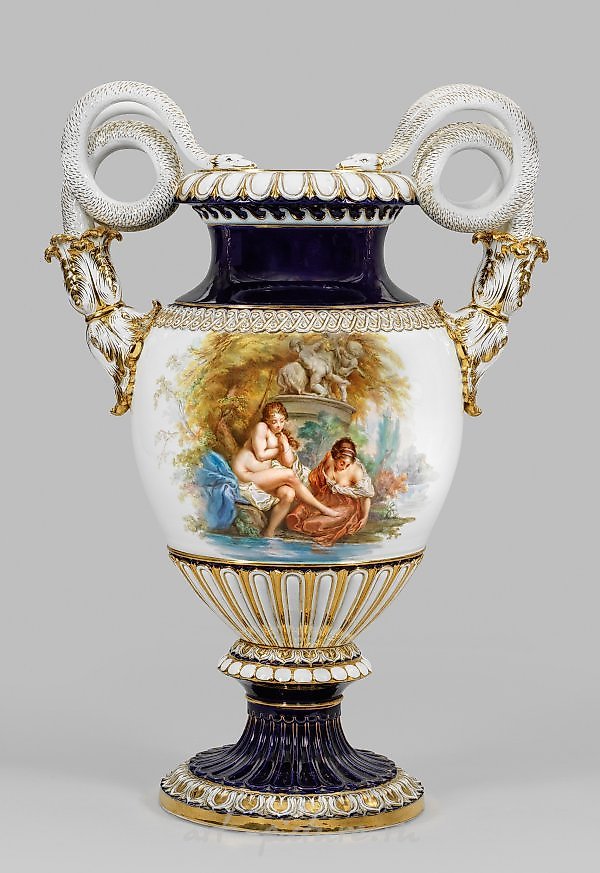
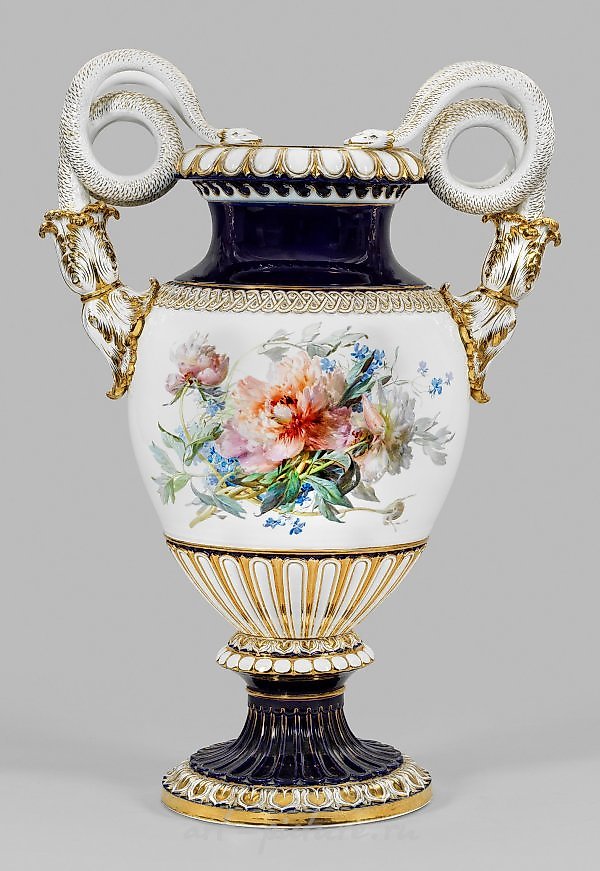
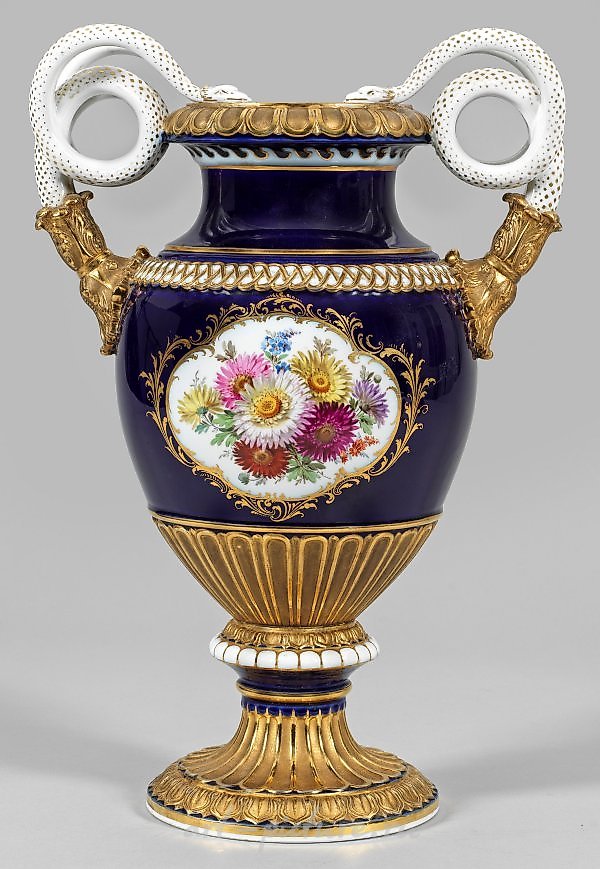
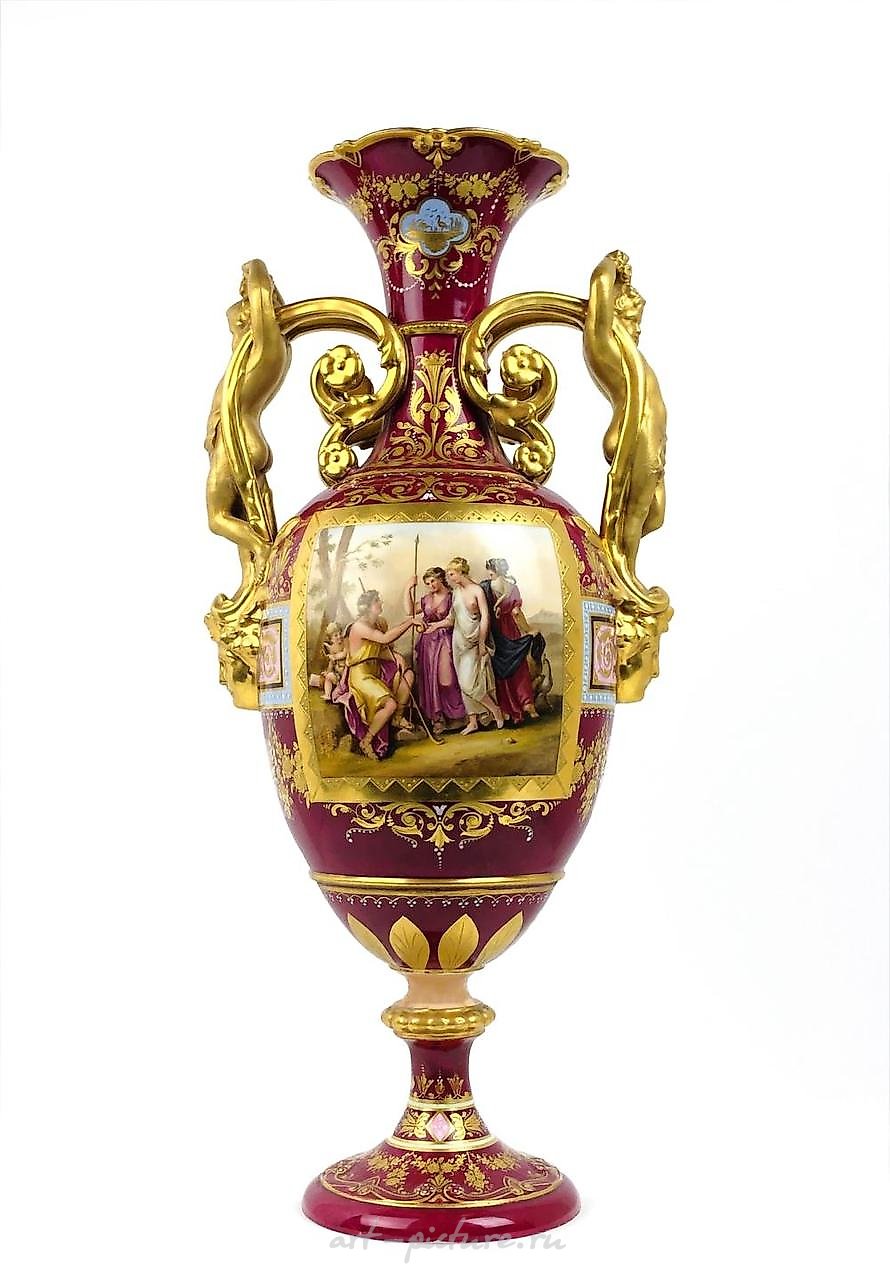
About highly elevated rounded foot with nodus ovoid body with drawn-in neck, transitioning into wide swinging mouth rim. Circumferential ornamental relief borders made of egg rod, tongue leaf as well as wave and braid bands, partially on cobalt blue background. Two strongly relief-plastic acanthus leaves ascend from the rounded shoulder, spirally rolled snakes' handles. On both sides of the wall, a large-scale depiction is applied, "Les douceurs de l'été" ("The Pleasures of Summer") after François Boucher and copperplate engraving by Pierre Etienne Moitte or impressionistic flower arrangement of peonies. Virtuoso soft painting, executed by the Meissen figure painter Paul Voigt, active since 1898 or probably Prof. Julius Eduard Braunsdorf or student. Rich gold staffage. Possibly Ernst August Leuteritz. In the bottom, respectively "Les douceurs de l'été" after Boucher / Paul Voigt. Minimal condition/bearing; crossed swords mark. Height 76 cm. J.E. Braunsdorf (1841-1922), active as a flower painter since 1862, broke away from traditional Meissen bouquet painting and developed towards the end of the 19th century a typical, impressionistic, soft style, which he sustainably influenced as a subsequent manufacturer painter as well as the Meissen flower painting. He was appointed professor in 1900 and retired in 1906. Paul Voigt (1872-1945), brother of the Meissen manufacturer painters Georg and Otto Eduard Voigt, was known for his masterful copies of paintings from the Dresden Painting Gallery. The painter, who was referred to as a "self-inventing artist" since 1910, was awarded two gold medals for his works. See Jedding, p. 144, 170; Berling, Festschrift, p. 109, Neuwirth, Vol. I, p. 166, Vol. II, p. 323ff; Keramos 223/2014, p. 75f; Sächsische Biografie, ed. Institute for Saxon History and Folklore. A monumental snake-handled porcelain vase with depiction after F. Boucher painted by Paul Voigt (active in Meissen since 1898) and an arrangement of peonies probably by Prof. J.E. Braunsdorf or student. Minor chipped/rubbed. Crossed swords mark. Meissen. Circa 1900.