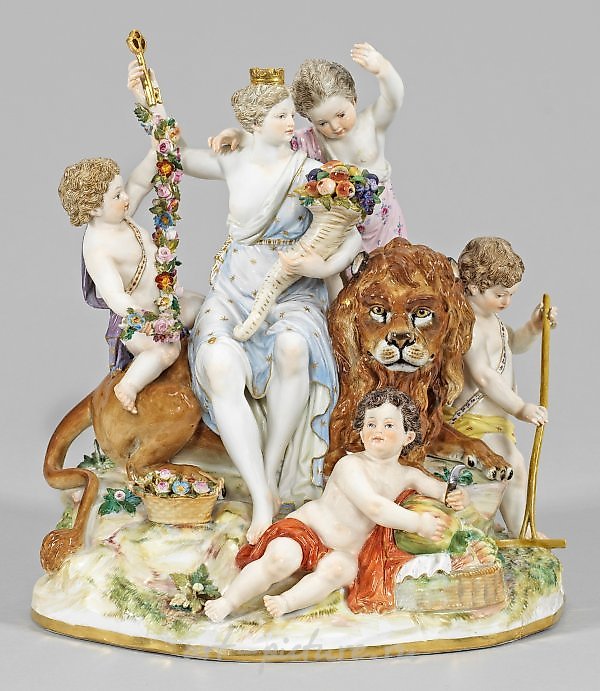
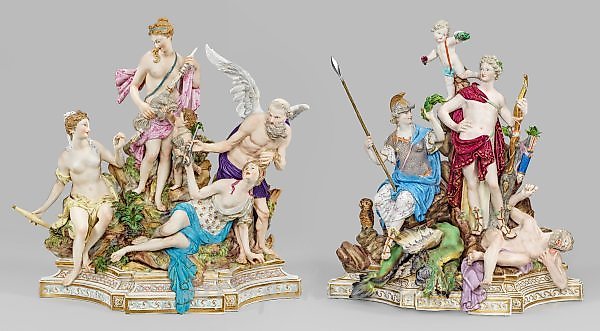
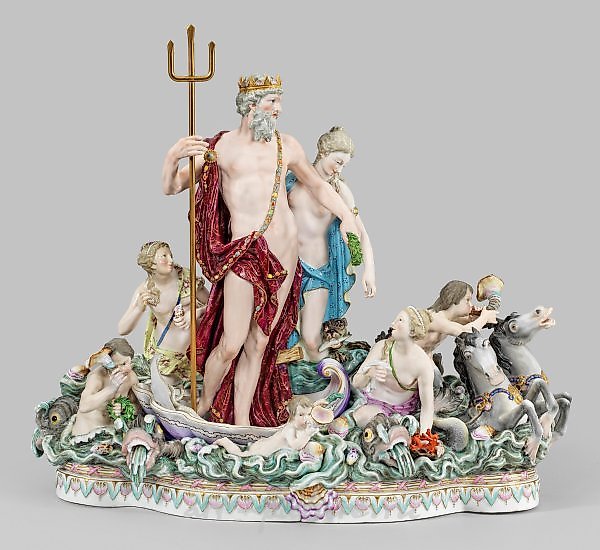
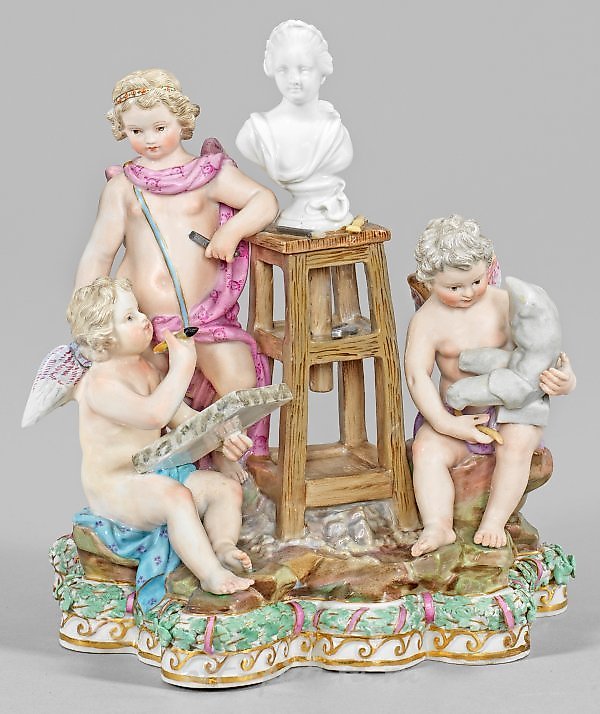
As an allegory of Saxony, originally part of the centerpiece for Elector Frederick Augustus III of Saxony, this composition is mounted on a blackened wooden base. The central group of figures is set against a rocky terrain. Standing on a marble column is Mercury, the god of commerce, wearing a winged helmet and winged shoes, holding a golden herald's staff in his right hand. To the side, a winged genius gazes out. Various figures are grouped around the main group. A young woman, possibly Ceres, is depicted in profile, wearing an antique-style garment and sitting on sheaves of wheat, supporting herself with her left arm on the plow standing to her side. To her left, two sitting cupids, one shearing a sheep and the other spinning wool, represent agriculture. Nearby, a family of chickens can be seen. In the background, a river god sits on a ship's prow with tied-up balls, symbolizing the Elbe River. On the reverse side, mining putti are depicted in the mine shaft, extracting silver and gold, along with a side miner's apprentice. Next to them, a young vineyard worker sits with a wine goblet and jug on a wine barrel. The polychrome painting is richly gilded. Possibly by Michel Victor Acier, around 1775-1776. Partially restored. Height: 44 cm. Approximately 41 cm x 33 cm. The Meissen Manufactory created a multi-piece centerpiece, measuring seven meters, with an extensive figure program for Elector Frederick Augustus III, as a gift presented to him on the occasion of his 26th birthday in December 1776. Many pieces are now destroyed. This group represents the status of Saxony and the abundance and fertility of the land, where agriculture, the wealth of the Saxon mines, and trade are united. See P. von Spee, Klassizistische Porzellanplastik (Diss.), Bonn, 2004, Cat. No. 46, pp. 247f., 251. An exceptional large multi-piece mounted porcelain figural composition on wooden base as allegory of Saxony, originally part of the centerpiece for Frederick Augustus III of Saxony. Partly restored. Meissen. Circa 1880.