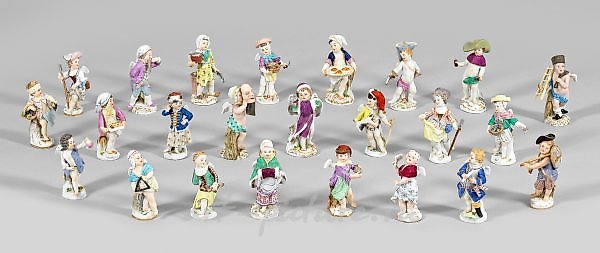
2 2 - t l g . ; On a relief Rocaille base, twenty-one standing and sitting figures of a chapel master, violinists, bass violinists, clarinetists, a harpist, a timpanist and -bearer, trumpeters, French horn players, triangle players, bagpipe players, bassoon players, flutists, guitarists, drummers, a hurdy-gurdy player, a pianist, and four female singers, as well as a music stand. Polychrome painting with gold staffage. Either by Johann Joachim Kaendler and Peter Reinicke. Partially restored; sword marks. Height 9 cm - 17 cm. The different monkeys of the orchestra are mentioned in the work reports of Johann Joachim Kaendler in the period from 1749 to 1766. Already in 1753, Kaendler designed an ensemble of music-playing monkey figures in colorful clothing with affectation, which he reworked in collaboration with Peter Reinicke around 1765/1766. Depictions of animals with human characteristics and behaviors were particularly popular due to the great interest in fable illustrations in the 18th century, especially in the so-called "singerie" of French artists, which showed curious, scenic representations of monkeys acting as humans in various situations. See Rücker, Cat. Bayer. National Museum, p. 192, Sonntag, Monkey Orchestra from Meissen Porcelain, p. 29ff. A complete 22-piece collection of porcelain figures from the "monkey orchestra" modeled by J.J. Kaendler and P. Reinicke. Partly minor restored. Crossed swords mark. Meissen. 2nd half of the 20th century.