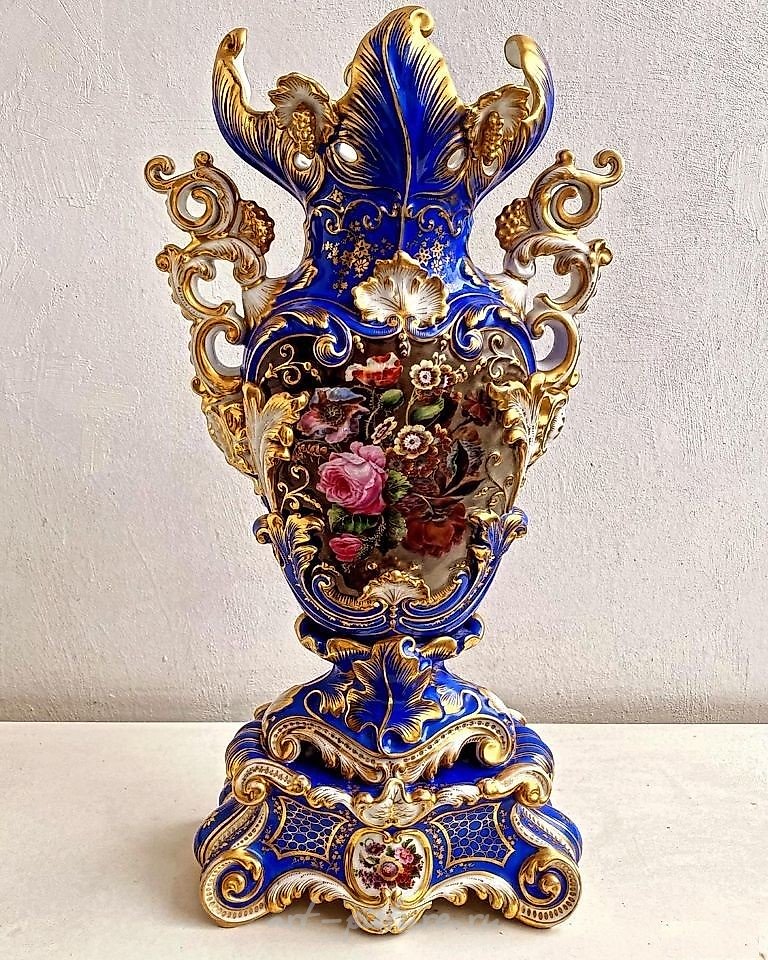
The A.G. Popov Factory occupies one of the leading positions among private porcelain enterprises in Russia in the first half of the 19th century.
The A.G. Popov Factory takes one of the leading positions among private porcelain enterprises in Russia in the first half of the 19th century. In terms of artistic level, quality of porcelain body, and whiteness of the material, this factory’s products stand alongside the renowned porcelain of Gardner, the works of the Kornilov Brothers’ St. Petersburg factory, and the Imperial Porcelain Factory.
Production at the Popov Porcelain Factory developed on the foundation of an enterprise created by Karl Melli—formerly Gardner’s agent—in the village of Gorbunovo in Dmitrovsky District of Moscow Province in 1804. In 1811, Alexey Gavrilovich Popov purchased the factory from Melli, thus for a time becoming the successor to Gardner’s technical achievements, although from the start he strived for artistic independence.
From the very beginning, this was a fairly large enterprise: in the 1810s–1840s, it averaged 250 workers (about the same as the Imperial Porcelain Factory and the Kornilov Brothers’ factory). The Popov Factory produced only high-quality porcelain. Its output was diverse: dinner and tea services, vases, inkwells, tavern ware, porcelain figurines, narrative compositions, animal sculptures, and other elegant household items.
In the 1810s, the Popov Factory drew on German and French prototypes, mainly for sculpture and vessel forms. By the 1820s, the factory had developed its own distinctive features unique to Popov porcelain. The composition of the porcelain body used at this factory was especially famous. As for themes and decorative style, they followed the general trends in Russian porcelain of the 19th century.
The factory’s own paint palette, notable for its richness and refinement of hues and developed by its laboratory, played a significant role in the success of Popov’s products. The items from the Popov Factory exhibit masterful decorativeness, a fine sense of color, a love for bright, strong, pure colors, for large decorative spots, and for bold, expressive designs.
The fame of the artisans at the Popov Factory accounts for the popularity of its porcelain. It is known that for work at the porcelain factory in Arkhangelskoye, Prince Yusupov invited turners and porcelain molding and turning masters from the Popov Factory. Ready-to-paint forms—mainly cups with saucers, numerous déjeuner sets for one or two persons, as well as Easter eggs—were also supplied to Arkhangelskoye from this production.
In 1831, at the first Moscow Exhibition of Domestic Industry Products, "the factory of nobleman Alexey Gavrilovich Popov and his son Dmitry Alexeyevich," as listed in the catalog, presented its products to the general public for the first time. The newspaper "Moskovskie Vedomosti" wrote at the time: "A hall adorned with porcelain from the Popov and Gardner factories transports the imagination into the realm of magic... Here, beauty is united with utility, the item is elevated to the level of fine art; here, the brilliance of painting, correctness, harmony, and taste in the shapes’ casting transform coarse substances—sand and clay—into objects of refined luxury, and items for daily and universal use into precious adornments for magnificent palaces." At this exhibition, Popov Factory porcelain was awarded the small gold medal. Beginning in 1831, the Popov Factory participated in all exhibitions of Russian manufactured goods in Moscow and St. Petersburg. In 1833, Alexey Gavrilovich Popov received the Order of St. Stanislaus, 4th Class, and in 1839 and 1841 his son Dmitry Alexeyevich was awarded the Orders of St. Anna, 3rd Class, and St. Vladimir, 4th Class, for their participation in exhibitions.
It should be noted that already in the first half of the 19th century, Popov porcelain was very expensive. For example, dinner services in 1831 cost from 1,000 to 1,550 rubles, prices comparable to the products of the Imperial Porcelain Factory, which worked exclusively for the imperial court. It is not surprising that such high-level items, usually intended for particularly special occasions, were produced by the Popov Factory only by special order. At the same time, porcelain for everyday use was eagerly purchased by residents and guests of Moscow.
After the death of Alexey Gavrilovich, the enterprise passed to his children, Dmitry and Tatyana, and soon after to Dmitry’s sons. The last owner of the factory in 1875 was merchant Fomichev. The plaster molds for producing figures and tableware were sold to the Ikonnikov Factory, and the paint recipes were sold to the Kornilov Brothers’ Factory.