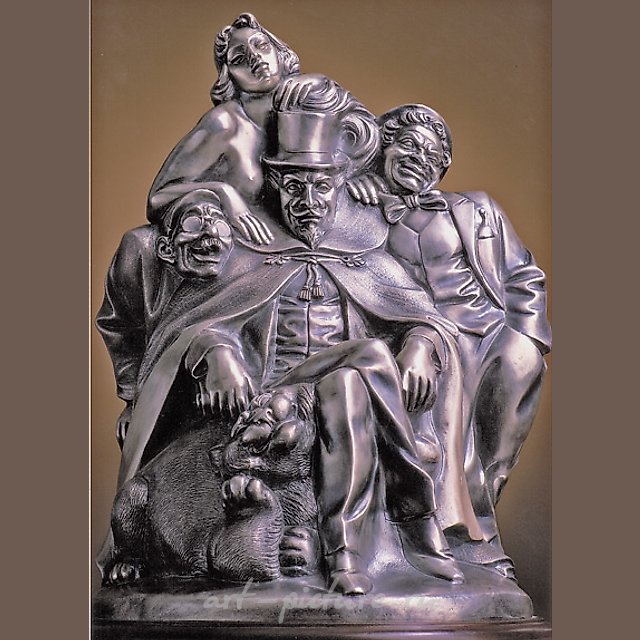
Born in Leningrad on May 26, 1947. Graduated from the Central Secondary Art School named after Johannson at the Academy of Arts. It was located within the walls of the Academy, and graduates of that generation were called “Tsshshatniks.” The CSHS admitted students from the 5th grade, prior to which was the Palace of Pioneers. After the CSHS, he entered the Tavricheskoye Art School. There were two departments: painting and decorative-applied arts. The program lasted five years. In terms of level, it was the third art institution in Leningrad, after the Academy and Mukhina School. In 1968, it was named after the president of the Academy of Arts of the USSR, V. A. Serov, and now bears the name of N. K. Roerich. The school's level has since fallen to that of a lyceum, if not a vocational school. In 1971, after graduating from the Serov Art School, he was assigned to work in Yaroslavl as the chief artist of the puppet theater. He wanted to break free from parental care. Over the course of a year, he staged three performances. Upon returning to Leningrad, he worked for two years at the Painting and Art Combine under the Art Fund. Then, from 1971–1977, he studied at the Leningrad Higher School of Art and Industry named after V. I. Mukhina, Faculty of Architectural and Decorative Arts. Specialty: sculptor. Specialization — small sculpture.
He began his artistic pursuits at the age of six and always engaged in sculpting. While at the Palace, he was the winner of a city exhibition. He considers his years of study to be 19 years in total. His teachers include: first and foremost, his father. At the Art School — the famous graphic artist Yuri Alekseevich Vasnetsov; at the Palace of Pioneers — Ekaterina Ivanovna Popova. In CSHS — Valentina Nikolaevna Kitaigorodskaya; in Tavricheskoye School, Lev Konstantinovich Waltz; at the Mukhina School — professors Valentina Alekseevna Rybalko (wife of E. E. Moiseenko), Petr Fedorovich Kulikov, Anton Gordeevich Dema, and instructor Pavel Antonovich Yakimovich.
All — sculptors. Among St. Petersburg sculptors, I will mention Pavel Pavlovich Vandyshchev (b. 1937) and his wife Ekaterina Volkova. Both graduated from the Mukhina School and worked at “Russian Gems,” as did the sculptor Rybka.
His grandfather worked at the Leningrad Porcelain Factory — painting, gilding. Another grandfather was an engineer: Geichenko, born 1901. Childhood memories: a letter from the Old Believers of the Academy of Arts in his hands. His father and brother had a house in Peterhof, in the village of Luizino.
Dostoevsky: “Many civilians love to write about military affairs, and generals love to discuss enlightenment.”
Mikhail Bulgakov: “He has golden hands, but whatever he picks up, he breaks.”
Chess.
Ashikhmin — maternal grandfather. In 1915, the chief accountant of the State Duma’s guards. Part of the family went to England. Grandfather would say: “Strive to be, rather than to seem.” Now, “a game in a previous, ‘earlier’ life.”
“Déjà vu.” Hungary, looking at walls.
Writer and ideas. Stephen King (b. 1947). “Where does time go?”
Metaphysics of Petersburg.
Position of a Soviet person. “Skomorokhi.”
In 1986, prosecuted for parasitism, like a poet
Brodsky
Member of the Union of Artists since 1990.
“Small form sculpture is a cascade of ideas.”
(From his creative autobiography)
Small cast silver figurines have always been a favorite interior decoration. Today, works by Russian master jewelers of the second half of the 19th to early 20th centuries, created in a realistic manner, attract exceptional interest. Antique dealers all over the world make great efforts to acquire small sculptural compositions from firms such as Fabergé, Khlebnikov, Sazikov, Ovchinnikov, the Grachev Brothers, and others. The glorious traditions of renowned Russian masters are superbly reflected in the unique works of silver sculpture by Alexey Baranov.
Baranov’s collection of silver miniatures is extensive and varied. It includes beloved heroes of Russian folklore, recognizable literary characters, touching animal figurines, but especially vivid and expressive are the sculptural groups from the series “Scenes of Folk Life.” In these pieces, fidelity to the traditions of Russian realistic art is felt most clearly. Connoisseurs of jewelry sculpture are already familiar with his magnificent works in this genre from previous years: these include the compositions Cunning Caresses, Tenderness, Everything for Home, and others. In each of these works, the author — sculptor Alexey Georgievich Baranov, member of the Russian Union of Artists — along with master executors Sergey Vladimirov, M. Kh. Kattaev, V. A. Kirillov, and A. I. Korenkov, demonstrated a rare skill for creating full-blooded artistic images through the means of sculpture and silver casting, making them close and understandable to the viewer.
These features became even more pronounced in Baranov’s new works, executed by the same creative team: in the genre compositions Teatime and Kamarinskaya, and in the figurines of hunters — The Dashing, The Poor Shot, and The Cunning One. Exceedingly three-dimensional and colorful, all these works literally breathe the poetry of folk life.
This poetry is felt especially vividly in the two-figure desk composition Kamarinskaya. In this piece, silver figurines placed on a brightly polished jade pedestal depict a cheerfully dancing couple. The swirling dress of the dancer and the rakish pose of the jovial harmonica player convey the irrepressible energy of motion, as if governed by the rhythms of a swift folk dance. The dynamism of the composition is further enhanced by deep contrasts of light and shadow. Skillfully executed by sculptor Baranov, Kamarinskaya virtually radiates the vital force and reckless spirit of the Russian national character.
Typically folk images appear before us in the series of miniature silver sculptures “Hunters.” Each has its own character: The Dashing, proud of his hunting successes; The Poor Shot, embarrassed by a missed shot; The Cunning One, a wily dreamer. With warm humor, using realistic modeling of the forms, the author conveys the expressions and poses of his characters, utilizing diverse textural finishes for the metal, meticulously reproducing their clothing and equipment, and accurately depicting their loyal companions — the hunting dogs. Creating such colorful images by means of sculpture and embodying them in metal is a great art, one in which Alexey Baranov excels flawlessly.
The artistic solution of the genre, multi-factured composition Teatime reflects a contemporary outlook on our ancestors’ traditional way of life — simultaneously sad and cheerful, condescending and loving. The sculpture depicts a merchant and his wife seated at a tea table, with a cat and dog playing at their feet. The storyline conjures associations with the famous paintings of Boris Kustodiev. With equal heartfelt sensitivity and genial humor, he recreates the atmosphere and attributes of merchant life.
It seems that you have inadvertently become a witness to a soulful family event, whose main characters are inherently Russian types dressed in attire characteristic of their class. The plasticity of the figures, skillfully accentuated with oxide, is rendered expressively and with great attention to detail.
Equal care is devoted to all items on the table: a table covered with a green jade tablecloth; chairs with red jasper seats inlaid with mother-of-pearl; a silver samovar with gilded handles and faucet; dishes made of the whitest quartz; golden bagels and cookies of chalcedony; “amber” honey of orange carnelian. The entire scene is further accented with a petrified wood pedestal recreating the pattern of parquet flooring. Silver and colored stone complement each other, lending the piece new tints and a picturesque quality. Despite the abundance of details, the sculpture leaves a holistic and vivid impression. Undoubtedly, Teatime is a masterfully executed, original work of art.
In the miniature silver sculptures of Alexey Baranov, the complex yet extraordinarily expressive art of jewelry sculpture attains the highest artistic standard. They combine mature mastery with fresh interpretation, artistic modeling with truly jeweler-level finishing. One can confidently say that in this form of artistic creation, Alexey Baranov currently has no equal.
Thoughts on the subject
Ural stone carvers — a purely craft-based direction. Boring. Mannequins dressed up at a local history museum. Recent works (“World of Stone,” December 2006): a dull Cowboy — neither cheerful, nor funny, nor scary — just bland. No authorial attitude. The destiny of these items is to increase in value. A good investment in stone. The craft exists; the guys know how to handle stone. They work with weak professional designers. They were taught to cut stone; carving becomes the goal, but it should only be a means. There are no good, well-designed models. Stone has immense possibilities. The lack of intellectual development is striking; intellect is not at work. There is no understanding of mythology, and yet mythology does not mean biblical subjects. An object should be a toy for the mind.
The European approach — creator, maker, sculptor. One must know plasticity, sculpt from life. The principle concerns how the object was created. People ask:
“What to give as a present?” In Europe, attention is paid to zodiac signs, the eastern calendar, mythological subjects are promoted.
Therefore, one must
know in which month a person was born, for whom the gift is intended, which stones are “indicated” (a medical term) for the individual. To see the image of the person for whom the gift is intended. Here is the figurine of Leda and the Egg, which she laid after meeting the Swan. In the egg, as is known, are twins. But I am a Gemini by zodiac. This is my gift. Sometimes a gift from stone is made that is contraindicated (when one wishes to spite with a present). We create a treasure, and one must not forget this. A treasure should possess a secret, a riddle, a myth — something to be passed down through generations in the family. I create objects that, over time, will acquire a legend. This legend, along with the jewelry piece, will be passed down as an heirloom. Shymansky reads books — that’s good — there is philosophy in the pieces.
Are there similar figurines in the West? Not now, because all that has already happened. For example, in Florence. We are children compared to Western culture, which is why foreigners are curious about our creations; they have forgotten their own jewelry tradition.