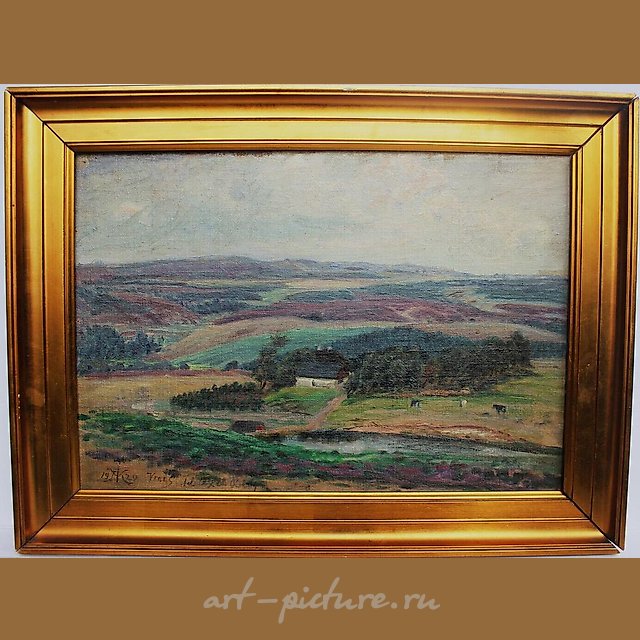
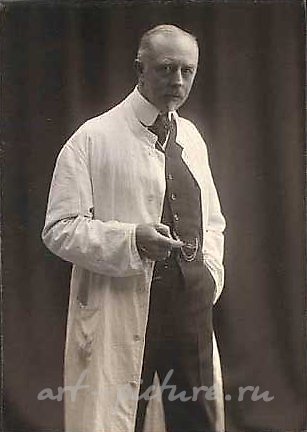
Arnold Emil Krog (Danish: Arnold Emil Krog; March 18, 1856, Frederiksværk – June 7, 1931, Tisvildeleje) was a Danish architect, painter, ceramic artist, and graphic artist of the Art Nouveau period. He had a significant influence on the art of Danish porcelain, heading the Royal Copenhagen Porcelain Manufactory from 1885 to 1916.
Arnold Emil Krog was born in Frederiksværk (island of Zealand, in the Capital Region), into the family of factory inspector and later factory owner Hans Jacob Grøgaard Krog and Jenny F. Meyer, the sister of Supreme Court judge Fritz Meyer. After passing his exam in 1871, Arnold apprenticed with master mason K. Winberg Eft. In the winter of 1872–1873, he studied at Nielsen’s drawing school and in the summer of 1873 became an apprentice to mason Krause. In March 1874, he was admitted to the general preparatory class of the Royal Danish Academy of Fine Arts in Copenhagen and in March 1880 graduated as an architect. He further trained in the studio of Ludvig Fenger and later with Ferdinand Meldahl. From 1878 to 1881, he participated under the direction of Ferdinand Meldahl and Heinrich Hansen in the interior decoration of Fredensborg (Riddersal and Kongefløj), initially together with Kampmann, later as the head of the drawing office. In 1883, he worked in Henrik Hagemann’s design studio, decorated the Moorish Hall in the Panopticon building, and fulfilled private commissions for administrative and residential interiors.
During his stay in Italy in 1882–1883, Krog studied the architecture of Venice, Rome, and ancient Pompeii, as well as the art of the Italian Renaissance. In October 1884, on the recommendation of wood engraver F. Hendriksen, Arnold Krog was accepted as an artist at the "Aluminia" faience manufactory and the Royal Copenhagen Porcelain Manufactory, where in January 1885 he was confirmed as artistic director, and from 1910, served as director.
Krog had no other precondition for working with porcelain than his own artistic intuition, and thus he immediately departed from the conventional perceptions of what royal porcelain should look like. At that time, after the management of Danish architect and painter Gustav Friedrich von Hetsch, the factory was carrying on a modest existence, relying on classicist traditions of overglaze polychrome painting.
In 1886, during a trip to Paris with William Salomonsen, Krog became acquainted with Siegfried Bing’s collection of Japanese porcelain, which inspired him to reproduce, in porcelain, similarly to Japanese wares, characteristic images of Danish landscapes.
Together with his colleagues, Krog developed a special painterly technique where the intrinsic beauty of the porcelain and the landscape motifs of the subdued northern nature were highlighted by a delicate "northern" coloration and slightly blurred contours in faded gray-blue, greenish, and violet tones of underglaze painting. Krog also moved away from the stiff, broken lines of older models from the Empire period and began to use simple, “flowing forms” with smooth outlines, which allowed more freedom for painting. These innovations matched the trends and tastes of the Art Nouveau period. Altogether, this ensured the extraordinary popularity of the products of the Copenhagen manufactory, which became an essential addition to residential interiors in many European countries.
This was an artistic renewal of porcelain art that brought international fame to the Danish art industry. At the 1889 Exposition Universelle in Paris, Danish masters presented animal figures made of white porcelain—polar bears on ice floes—which enjoyed enormous success. At the 1900 Exposition Universelle, also in Paris, the manufactory won the Grand Prix and Danish porcelain again became the main event of the exhibition. Soon, the expression “Danish style” became synonymous with “Art Nouveau style” in artistic porcelain.
Krog engaged young artists in his work. He also developed furniture designs, metalwork, and book cover illustrations. In 1910, he visited the island of Ceylon and then went to southern France. Krog left the manufactory in 1916 and thereafter lived in Tisvilde, where he painted and worked in printmaking.
In 1892, he was appointed titular professor and became a Knight of the Order of the Dannebrog and of the Legion of Honor. He was a jury member at the Exposition Universelle held in Paris in 1889, a member of the plenary assembly of the Royal Danish Academy of Fine Arts in 1911, a member of the Academy’s Methodological Council from 1911–1914, of the Academy Council from 1911–1919, and of the committee of the American-Scandinavian Foundation in 1914.