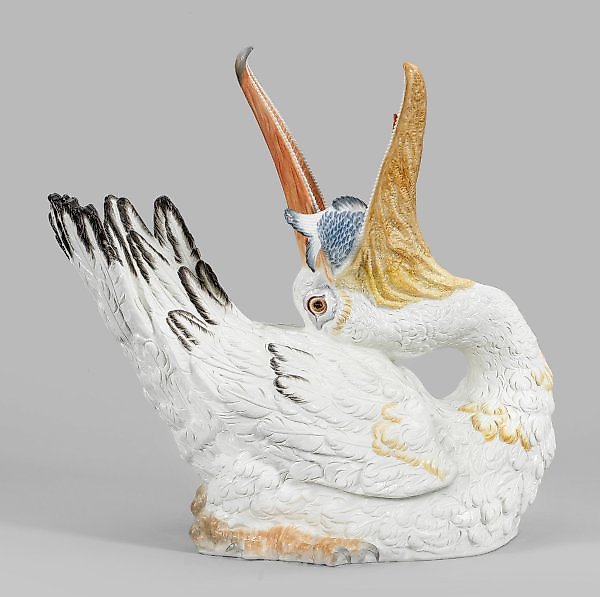
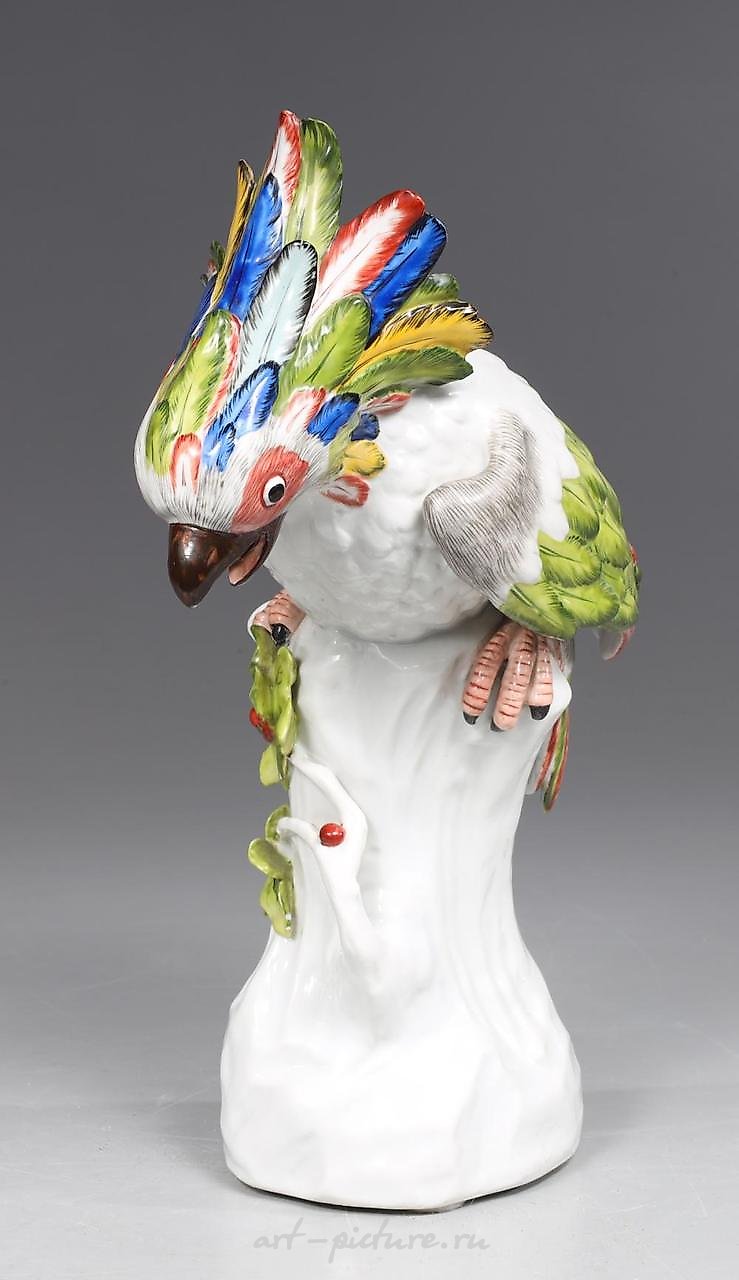
Fully sculpted, majestically graceful figure of a cassowary, standing on a tree stump adorned with sculpted branches, with an undaunted, upright neck and raised head crowned by a circular comb. The pointed, tapering, curved beak is slightly open. The extremely naturalistic design features strongly reliefed feathers and accentuated, brightly colored decoration, which suggests the colorful plumage of the helmet cassowary found in nature. Polychrome painting. Possibly by Johann Joachim Kaendler, 1732. Crossed swords mark. Height 128 cm. Magnificent example based on a naturalistic model. August the Strong showed a pronounced interest in zoology. He maintained menageries, financed expeditions to Africa, and acquired various bird specimens for his Kunstkammer. He commissioned a series of large animal sculptures for the Royal Collection in the Japanese Palace in Dresden in the 1730s. Johann Joachim Kaendler studied and sketched the so-called exotic animals in the menagerie. In the tradition of Kirchner, Kaendler modeled the characteristic posture and expression of the animals in great detail, not only in terms of their external appearance. The attempt to depict the animals in life size in porcelain was successfully realized, among other bird models. Nevertheless, in the 18th century, it presented a great technical challenge. In a report by the manufacturing inspector Reinhard, Kaendler made "the bird Casuarius, in life size (...)" . The inventories from 1770 and 1779 list four versions of this model. See Rückert, Cat. Bayer. Nationalmuseum, p. 189f .; Pietzsch, Cat. Meissen Porcelain Sculpture, No. 222; Sponsel, Cabinet Pieces of Meissen Porcelain, p. 96; Albiker, No. 25; Staatl. Kunstsammlungen Dresden, Inv. No. PE 188. An exceptional life-size modelled porcelain figure of a cassowary in naturalistic moulding by J.J. Kaendler, originally executed for the Royal Collection of August the Strong in the Japanese Palace. Crossed swords mark. Meissen. Circa 1924-1934.