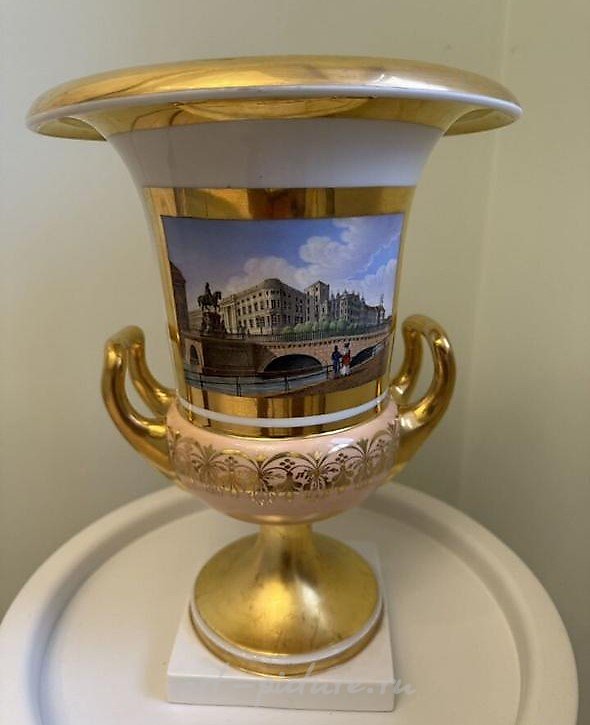
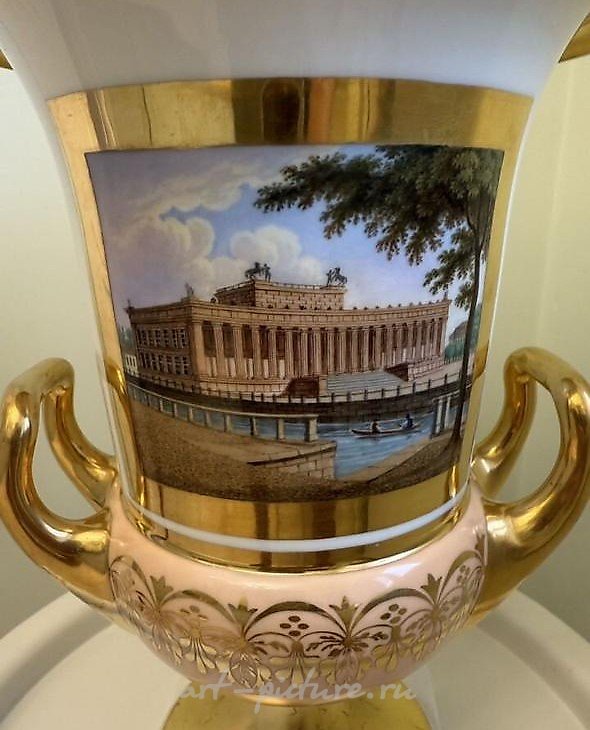
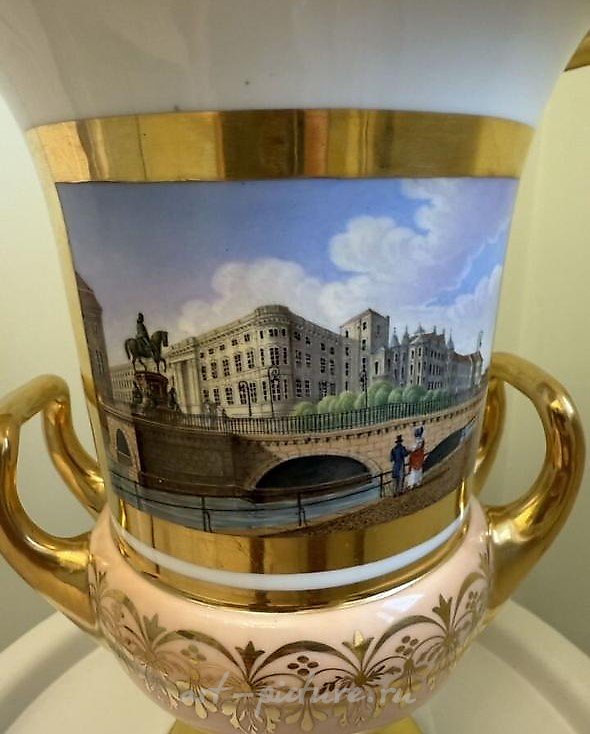
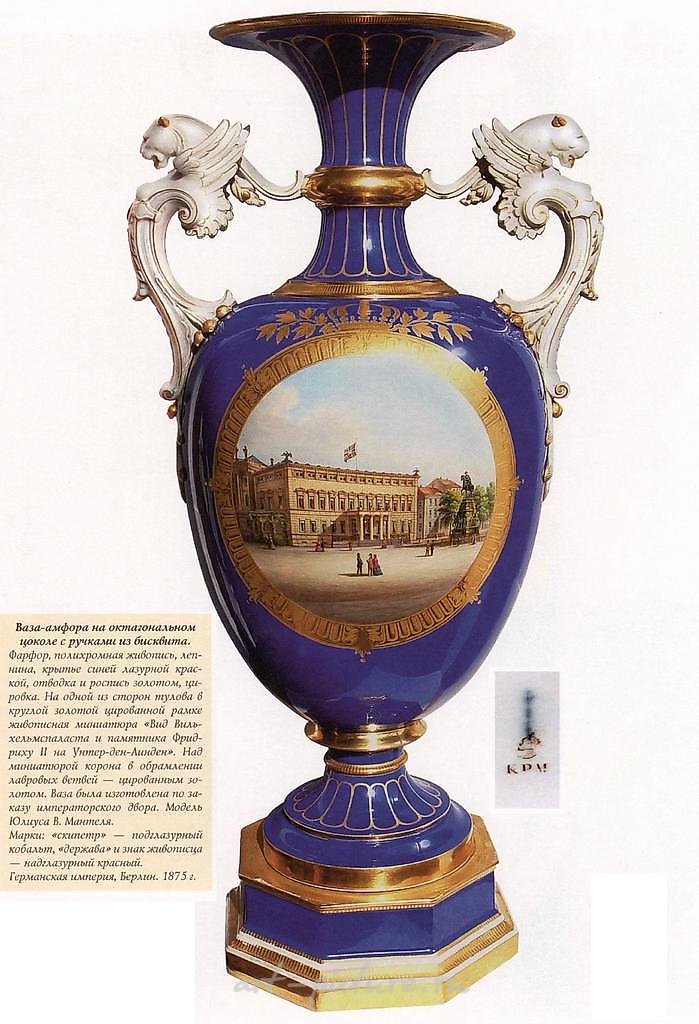
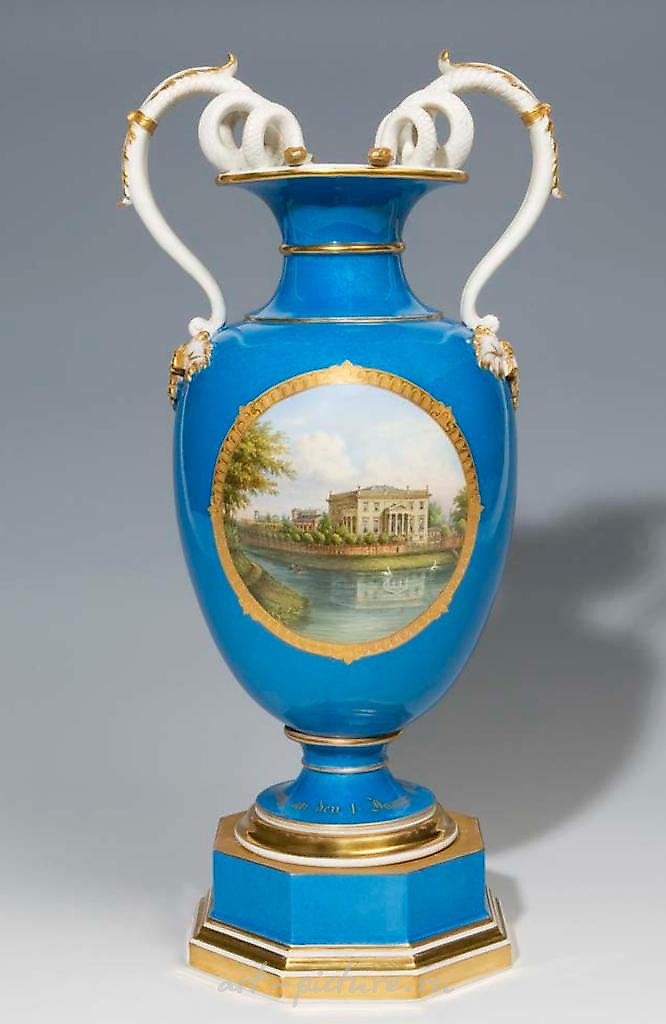
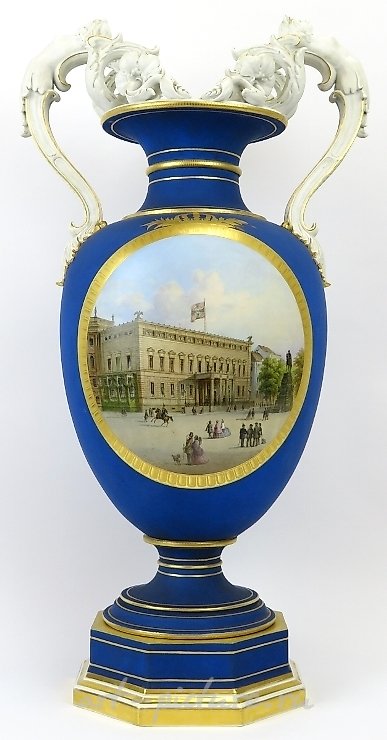
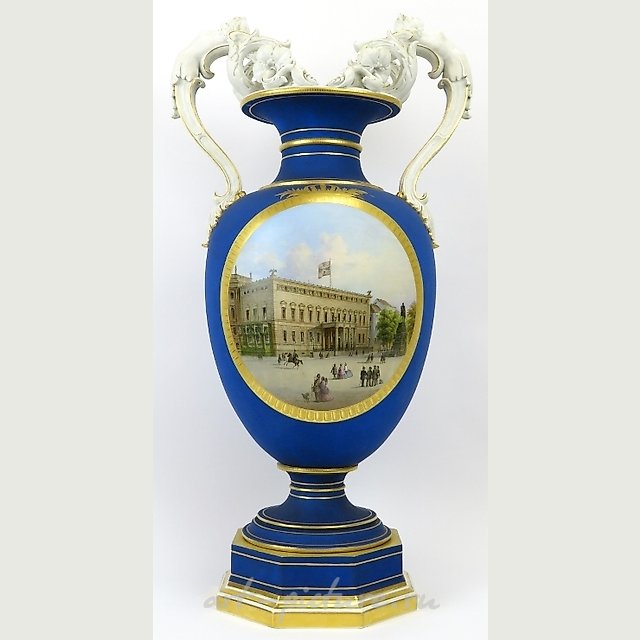
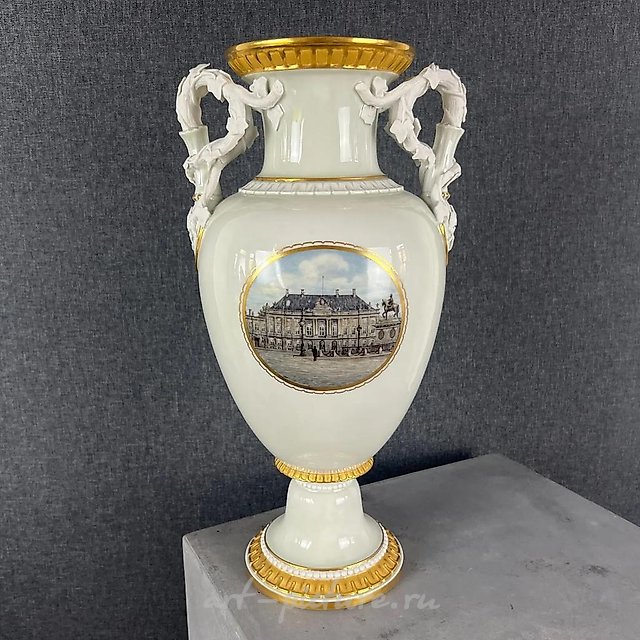
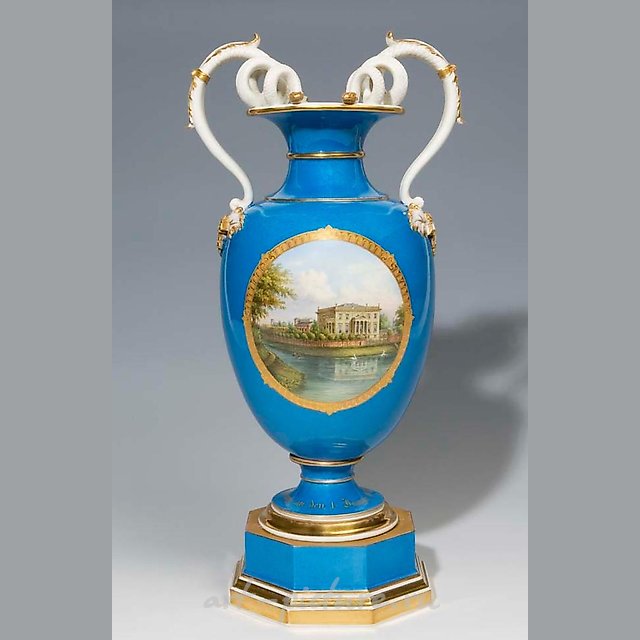
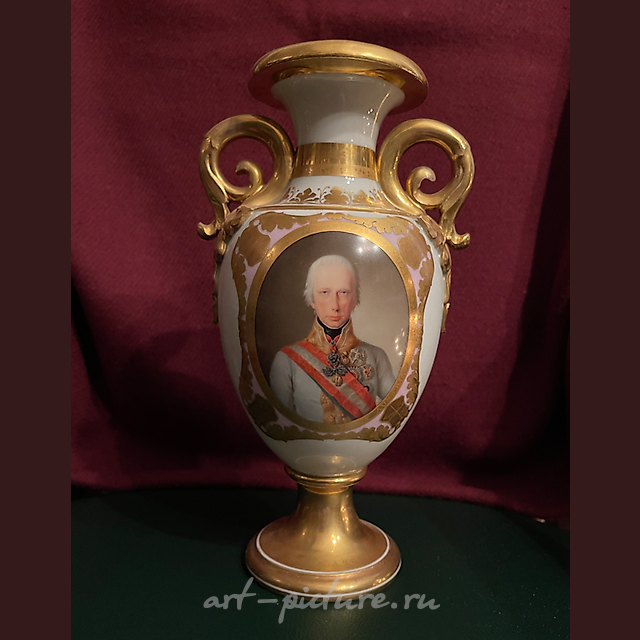
Decorative vase with an antiquated shape (krater form), adorned on both sides of the white body with miniature painting in the 'veduta' genre (architectural landscapes). The outward-bent rim, handles, and round foot are gilded. The lower spherical part of the body is painted in a delicate pinkish-yellow tone and decorated with gilt painting resembling a stylized garland of palmettes.
Porcelain, polychrome miniature painting (hand-painted), gilding, colored glaze, gilt decoration. Dimensions: total height - 31 cm.
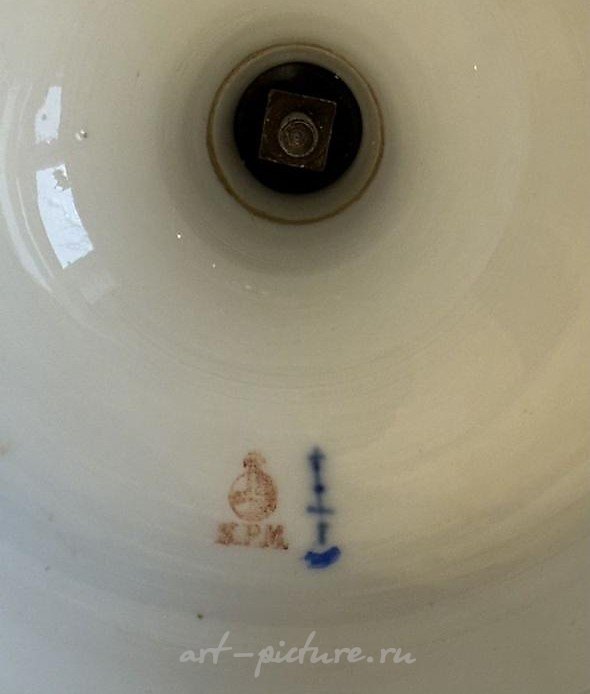
Marks: on the inner part of the foot base - the manufacturer's underglaze mark of a blue cobalt-painted scepter and an overglaze red stamp in the form of an "orb" with the abbreviation "KPM".
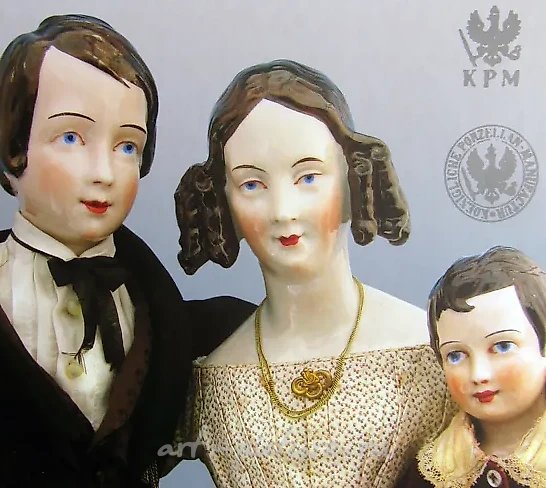
Germany, Royal Porcelain Manufactory, Berlin.
The presented decorative vase with architectural landscapes on the body belongs to objects of distinctly interior character, which were traditionally considered works of decorative and applied art, intended to emphasize the respectability of the home environment. This vase stands out for its high artistic and technical execution, excellent condition, and high-quality gilded miniature painting. Based on visual analysis and the existing mark, the decorative vase can be attributed to the products of the famous Berlin Royal Porcelain Manufactory. The item was made in the neoclassical tradition of the manufactory's artistic range of the second quarter of the 19th century (1830-1850), a period when the main stylistic feature remained an appeal to forms of antique art, the predominance of clear contours, and a striving for proportionate harmony, but at the same time, the painting of many items already bore traces of the new style of the Historicism era - Biedermeier. Especially popular among Berlin’s production of this period were decorative vases with miniature architectural landscape paintings (vedute – views of cities, individual buildings, and city monuments) of Berlin, depicting the most famous architectural and historical monuments and city landmarks. The vase’s surface, according to European traditions of porcelain decoration, was considered a canvas on which the miniaturist would paint a reduced or slightly modified version of a painting or engraving.
In the early 20th century, the manufactory continued to produce articles in the Classicism and Empire styles (German neoclassicism, late 19th–early 20th century), and public interest in such works from one of Europe’s oldest and most renowned manufactories remained strong. This decorative vase clearly illustrates this fact. Thus, one side of the vase's body in a golden cartouche frame depicts the Old Museum building in Berlin, done with some modifications after the engraving "Old Museum" by German artist F.A. Thiele, 1830. On the other side is a view from the city embankment of the bronze monument to Elector Friedrich Wilhelm in Berlin, which was one of the most famous landmarks of the German capital.
Rich gilding on the rim, handles, and foot, ornamental gilding in the lower part of the vase, along with the skillfully executed architectural landscape miniatures, give the piece a luxurious and refined look. Such items splendidly decorated the interiors of private studies or drawing rooms, were placed on the mantelpiece of expensive bourgeois apartments, delighting the eye with their aesthetic perfection. German-made decorative vases have not lost their appeal to this day, remaining collectible, high-quality handmade porcelain.
This vase has antique, historical, artistic, and cultural significance.
KPM Porcelain Market Overview
Evaluating the porcelain market is rather challenging. Pricing is influenced by many factors: the era of creation, uniqueness and rarity, the quality of painting, and, finally, the condition of the item. As is known, for market analysis, many collectors rely on catalogues of Western auction sales. But auction valuation is by no means an absolute price indicator, as the auction is a third party. Most items are typically sold and bought by dealers who are more than willing to invest in good pieces. Frequently, items bought by dealers are resold to collectors at much higher prices—figures not found in any catalogue!
In recent years, interest in works of art has markedly increased in Russia. In any country experiencing rapid economic growth, wealthy individuals who have satisfied their primary needs often turn their attention to art. At first, major buyers in the antiques market included Arabs and Japanese, then Indians and, soon after, Russians. Now Europe is experiencing a new trend—Chinese. The "new" Chinese are buying literally everything they believe can suit the interiors of their mini-Versailles! In a short period, a colossal number of items have "washed out" from the antiques market. Tourists have played an important part in this, as they purchased cups or plates as souvenirs while traveling in Europe—when, just 10–15 years ago, prices for porcelain were entirely different. Now it is impossible to buy view cups even in Vienna—not only from the Vienna manufactory, but even "Vienna style" pieces are gone! The same is true for France and Germany, not to mention Russia. If, in the 1990s, supply in the Russian antique market far exceeded demand, the situation has now changed drastically. Acquiring a fine item for a collection has become a rare and highly costly success.
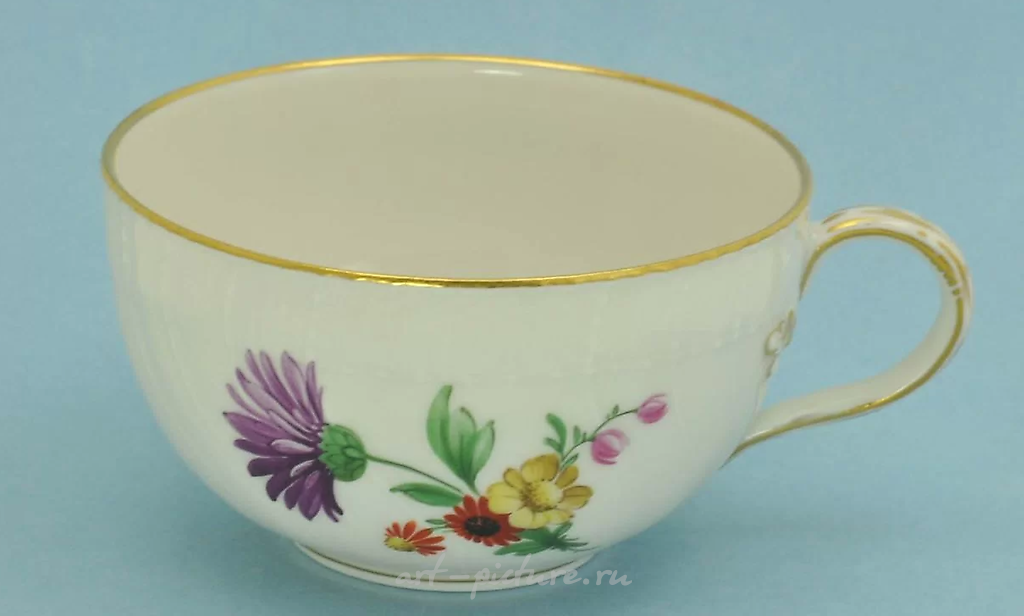
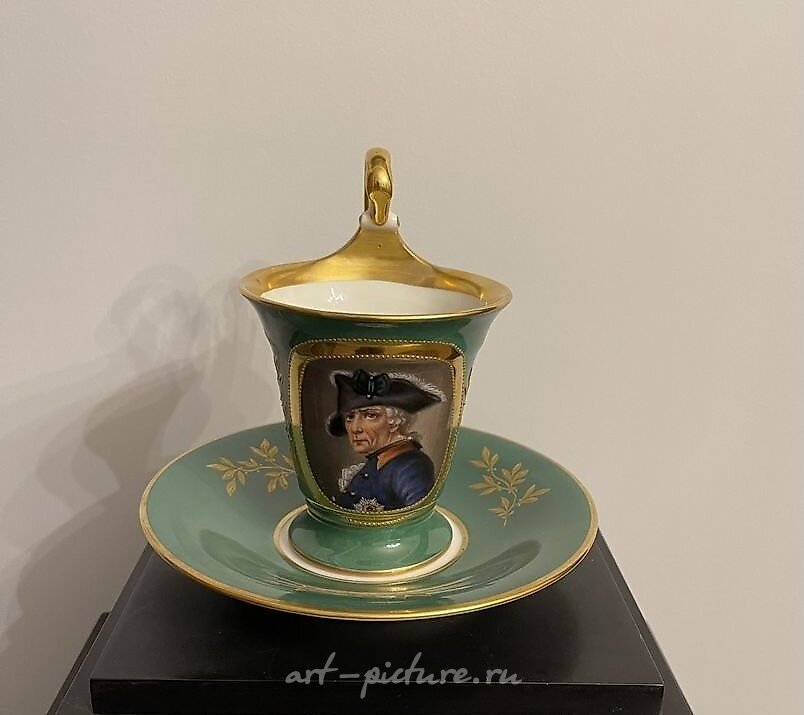
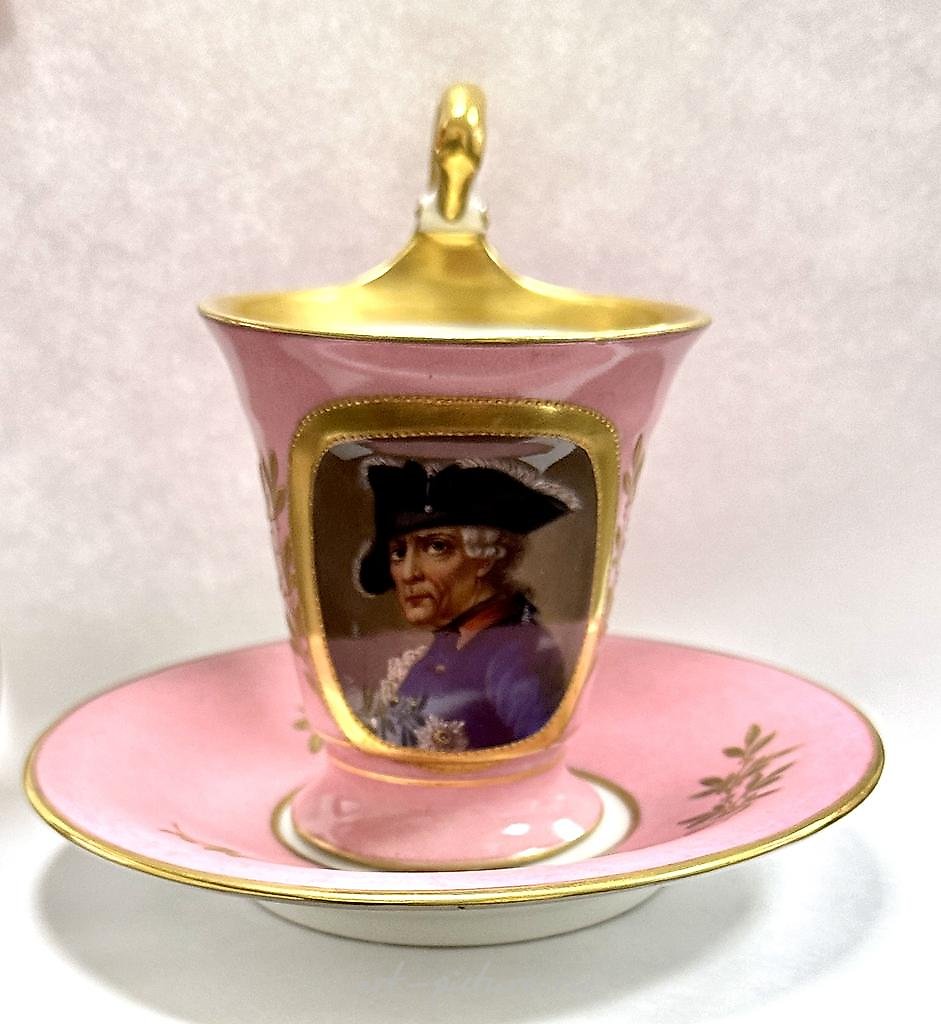
On the one hand, considering quantities produced, KPM porcelain is not uncommon in the antique market. On the other hand, rare and unique items with high-quality painting are found rarely and are highly prized. Just a few years ago, the price of ordinary cups was 300–500 euros. Now, on the European market, a regular cup's price ranges from 1,000 to 3,000 euros. A highly artistic cup with complex architectonics (with mascarons, sculptural elements, etc.) and superb painting may cost from 5,000 to 15,000 euros. Notable too are cups commemorating the Peace of Tilsit (1807), decorated with portraits of Alexander I and Napoleon, as well as series dedicated to the Battles of Leipzig and Waterloo and adorned with portraits of monarchs whose armies participated. Before the capture of Prussia by Napoleon I, a small series of paired cups with portraits of Alexander I and his spouse, Empress Elizabeth Alexeievna, was also issued. These items are undoubtedly rare, and their prices can start from 25,000 euros. For reference, over the past 15 years, such cups have not appeared at European auctions.
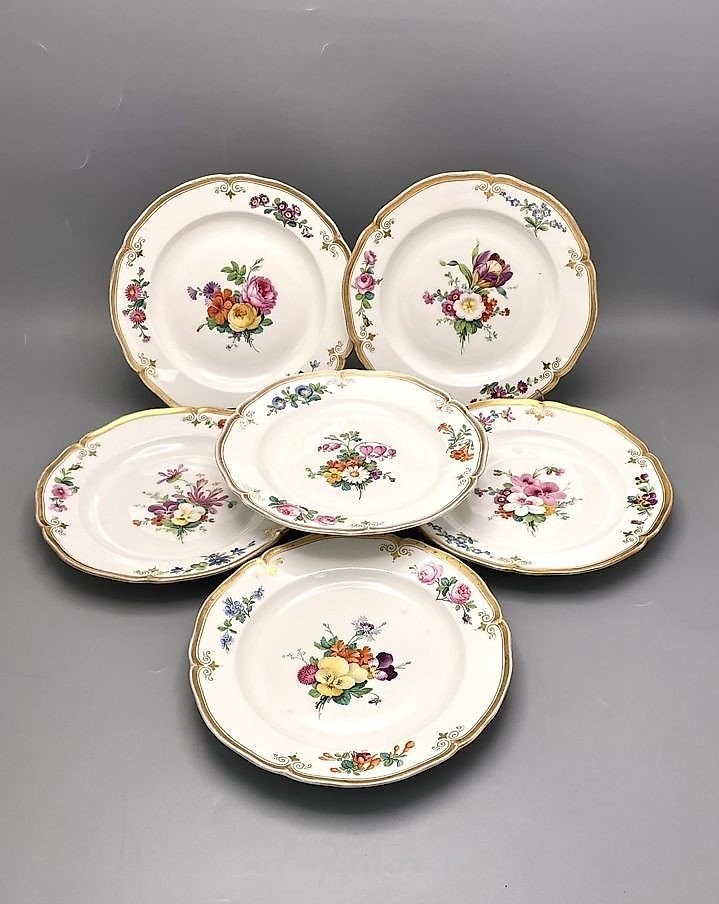
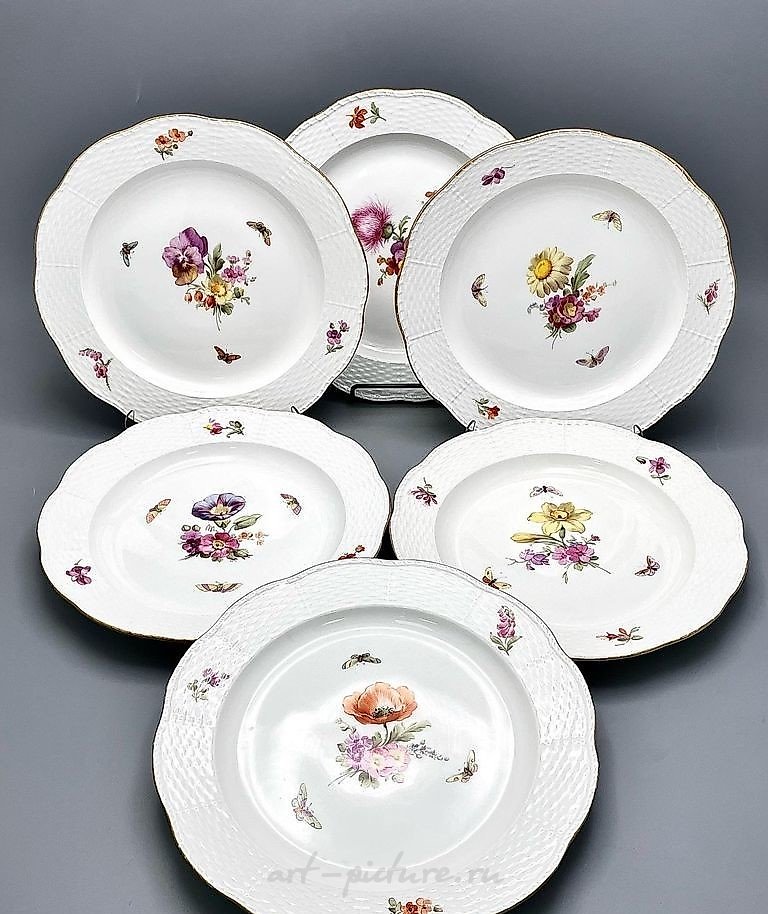
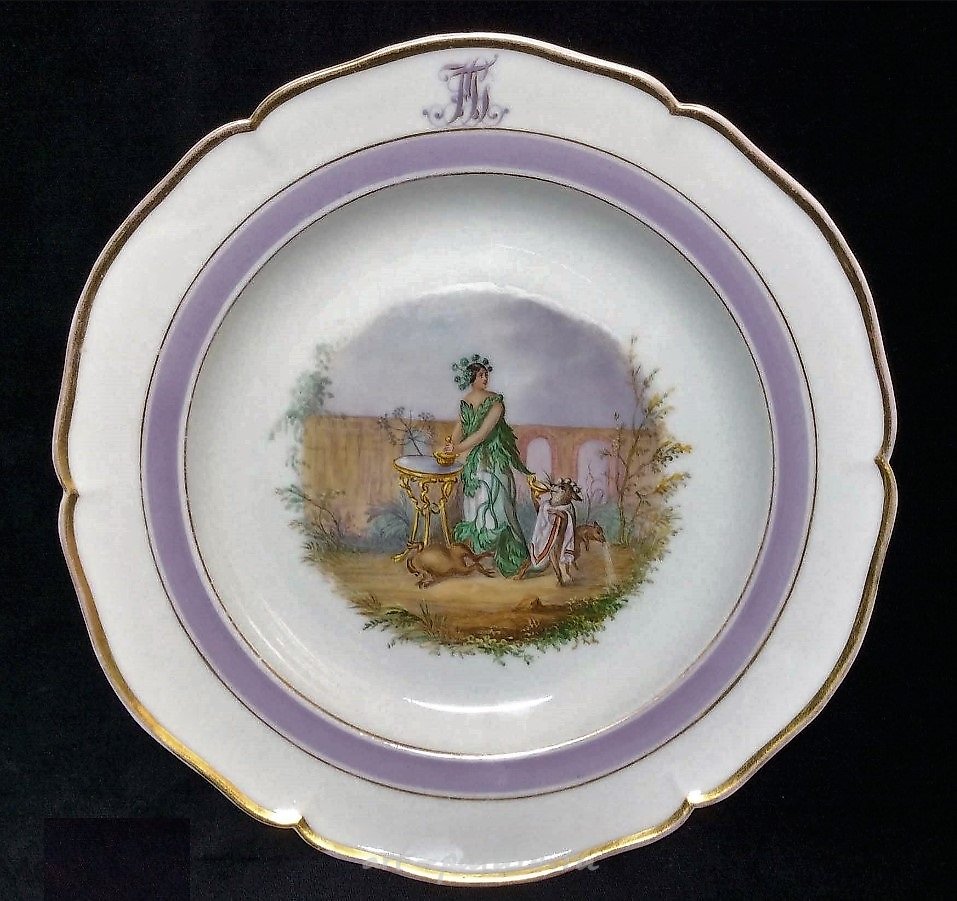
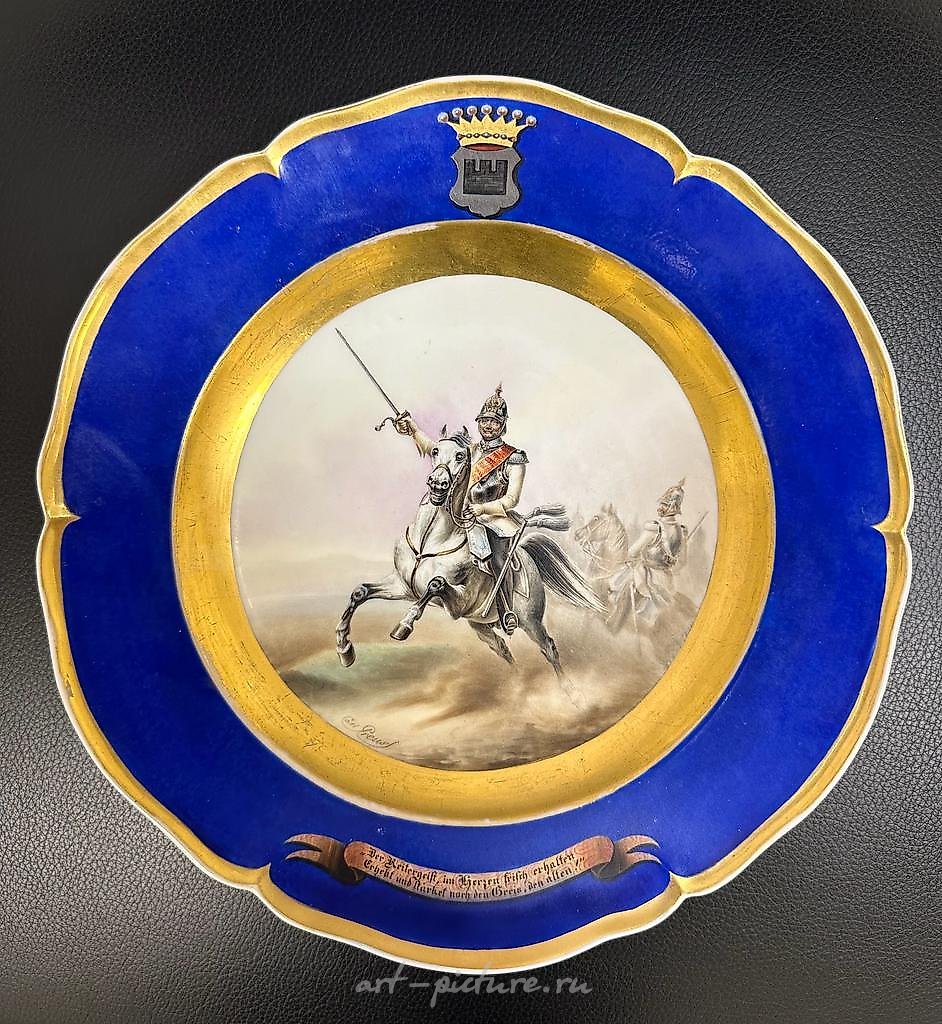
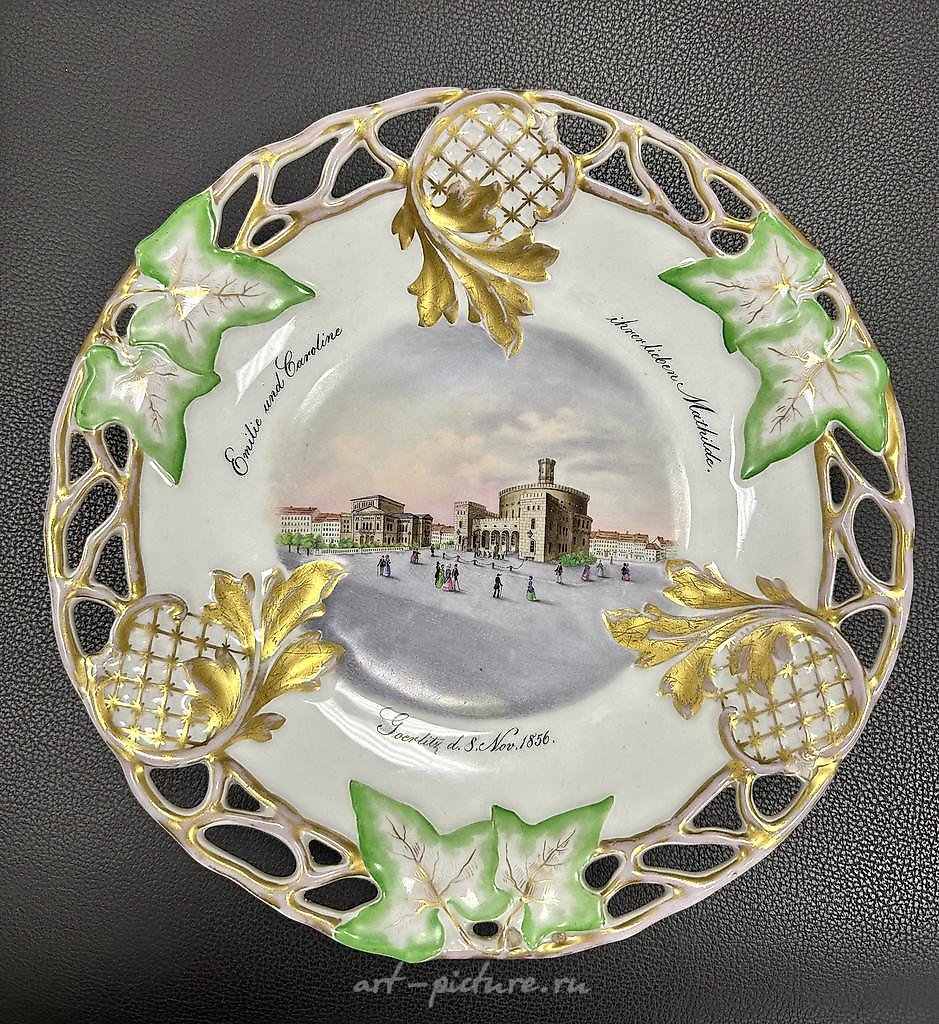
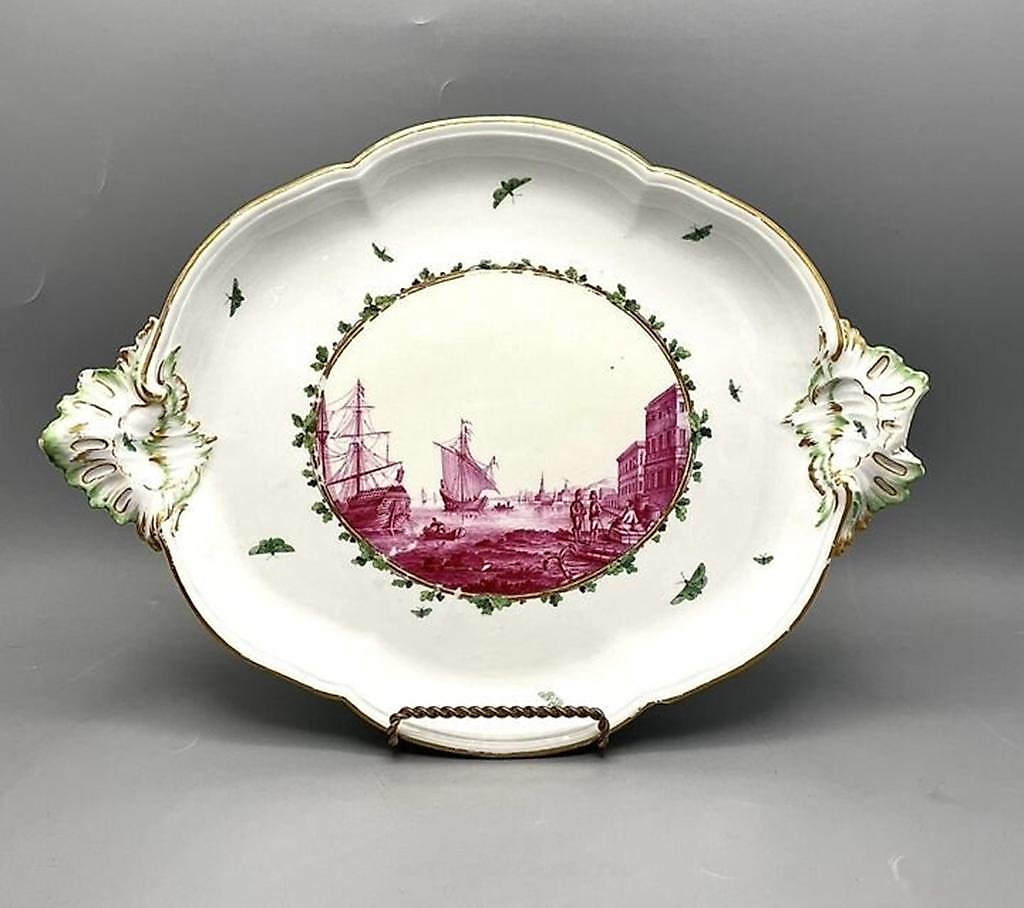
Today, the price of ordinary Berlin plates ranges from 1,000 to 2,000 euros per piece. A topographical plate may cost from 3,000 to 15,000 euros. Plates with figural painting (1790–1840) can be valued at 10,000 euros and up. The fashionable and now-popular "military" plates fetch from 10,000 to 40,000 euros at European auctions, depending on their condition and age. Vases about 30 cm in height—5,000–10,000 euros, about 50 cm—20,000–50,000 euros. Vases above 70 cm can cost from 50,000 to 150,000 euros. For example, at the spring auction in Berlin, a 70 cm vase sold for 130,000 euros. Naturally, prices for KPM porcelain will increase over time. As in any business, on the antique market these depend on supply and demand, and since demand for porcelain is steadily growing (this applies not only to Berlin porcelain but porcelain in general), over time there will be fewer and fewer items to meet this demand. I do not urge everyone to invest in art—there are many other fields for capital with faster and more predictable returns. There is always room for speculation in the antiques market. However, the best investor is always the serious collector. To invest in porcelain, you need deep knowledge, a good consultant, and long-term plans. However, this does not guarantee quick success, as the market may depend on subjective factors such as fashion. To objectively assess profit, at least 5–10 years need to pass. It is quite possible that a KPM plate purchased in 2022 for 5,000 units will double or even triple in price in ten years.